
Social robots: the European challenge is not technological, but cultural

Social robotics has moved beyond the experimental phase and is entering industries, hospital corridors, classrooms, logistics hubs and public services. As is often the case with major technological transitions, the real question is not whether the solution works, but how and where it will be integrated.
Social robots' or 'companion robots' represent a new dimension of our daily lives. Factories, hotels, camps, schools, shopping malls, airports, hospitals: social robots are and will increasingly be an integral part of it, accompanying humans in their work, without replacing them.
This is confirmed by reports such as 'Social Robots and Society: Global Pathways to Acceptance', the result of an international research project developed in recent years and recently published by the UAE Centre for the Fourth Industrial Revolution in collaboration with the Dubai Future Foundation. In the health sector alone, almost 280 user experiences were mapped in 33 countries with more than 50 different models already deployed in real-world contexts.
Social robotics is one of the most advanced expressions of the convergence of technology and human needs. We now have systems capable of operating in complex contexts, understanding people and supporting them in sensitive areas such as healthcare, education and public services. The growth of applications at a global level shows that social robots are a concrete reality that contributes to well-being, inclusion and quality of services, but can also be an effective lever to push European manufacturing, which can become a leader in this field. We already have everything to do so, we just have to be willing to take up this challenge, which is cultural before being economic.
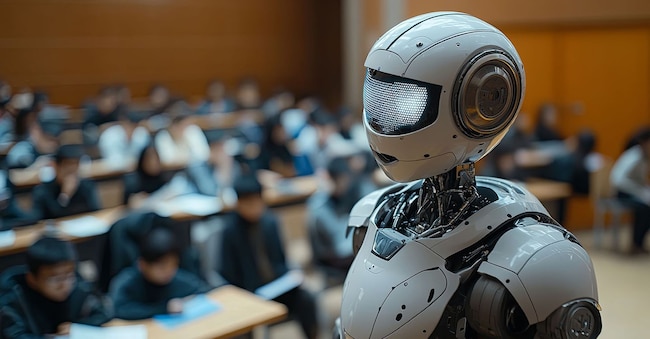
Unlike industrial machines, confined for decades within defined production perimeters, these robots are designed to interact. They are true 'companion robots' also thanks to the use of artificial intelligence. They speak, recognise faces, respond to contextual stimuli, modulate behaviour and expression. They lie between robotics, cognitive science and social psychology to the point of transforming the machine into a relational interface.

