Fashion Special

Soft luxury trend: minimalism from the North

Ten years ago, Elin Kling and Karl Lindman got married and started their fashion vision. Today it is a $100 million business with a strong identity: 85 per cent Swedish and 15 per cent New Yorker.

by Louis Wise
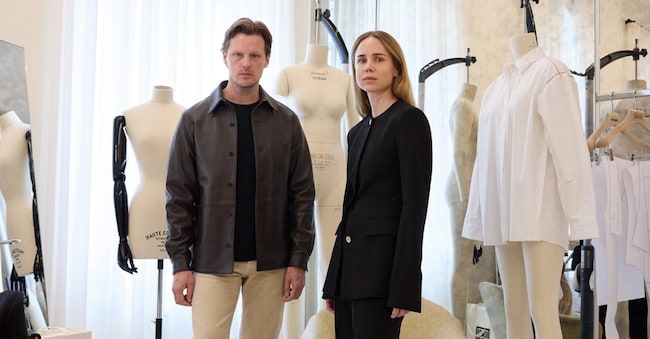
Kling e Lindman. Tutte le immagini ©Andreas Öhlund. Tutti i capi presenti nel servizio sono di TOTEME.

8' min read

8' min read

In the fashion world, when one speaks of discreet elegance, one usually refers to an aesthetic based on neutral tones, precious materials and a sophistication that is expressed through details. Toteme, the ready-to-wear brand founded by Elin Kling and her husband Karl Lindman 10 years ago, has not only made this vision its own, but has managed to turn it into a solid business. Last year it recorded a turnover of over USD 100 million, which looks set to approach USD 150 million by the end of 2024, with 14 shops worldwide and a further six openings planned for 2025. All these results were achieved in the sign of understatement: no celebrities as ambassadors, little publicity - at least until recently - and relatively few press releases. Elements that might come as a surprise, especially considering Kling's successful blogging past, coupled with the couple's notoriety.

But that is exactly the point: the couple. Elin and Karl are Swedish, and Toteme is a brand with Swedish essence. It espouses several principles of Scandi style - including sober colours, practical design and a rigorous attention to detail - but has taken a path that has taken it further. "It's not a question of establishing what Swedish or Scandinavian fashion is - or was -: rather, it's a question of imagining its evolution," explains Lindman. Sitting next to his wife at the brand's headquarters in Stockholm, he wears jeans and a navy blue cardigan, while she wears a white turtleneck under a thin cream jumper, gold necklace and earrings, indigo selvedge jeans and black slingbacks.

Loading...

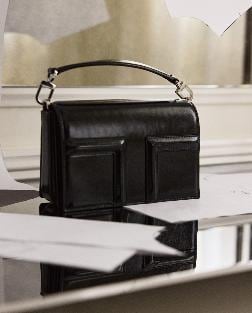
Toteme can count on some long sellers. Above all, the iconic coat-scarf (from 880 euros), which has inspired several imitations, and the T-Lock bag with clean, contemporary lines (from 1,190 euros), today the most successful item, with 16,000 pieces sold in the last year. The brand's aim has always been to avoid being susceptible to trends or defined by a single product. It must be acknowledged, however, that it is experiencing a moment of great success also and precisely because of certain well-known and increasingly popular pieces. Last winter it launched a jewellery line, opened a shop on Mount Street in Mayfair, London, and in January it showed for the first time during Paris Fashion Week. After a refurbishment, the Stockholm flagship shop has just reopened as part of the 10-year anniversary celebrations, and another shop opens in New York this month. Since its inception, its strength has been to position itself alongside other high-end brands dedicated to sophisticated casual and office wear, while offering more affordable starting prices.
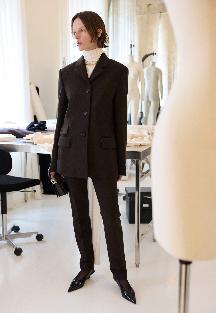
Blazer in lana (700 €), sciarpa in lana e seta a maglia fine (390 €), pantaloni slim in lana a vita bassa (430 €), zeppa slingback in pelle (480 €), collana placcata oro Signature Collar (810 €) e borsa Mini T-Flap in pelle naplack (820€).

"Toteme offers customers essential garments for a refined and minimal wardrobe," explains Libby Page, market director at Net-A-Porter, which has included the brand in its catalogue since its launch. "We were immediately impressed by Elin's impeccable approach to creating a curated wardrobe, with collections that transcend seasonal trends". Stylist and consultant Alexandra Carl is of the same opinion: "I associate Toteme with a style that we would all like to make our own forever, and not with a trend to be followed only for a certain period". The brand nurtures a contemporary desire for "bold simplicity and well-made pieces. I think there is a widespread misconception that rapid growth is desirable: Toteme demonstrates the exact opposite'.

For Elin and Karl, success is the crowning achievement of a venture that is almost exactly the age of their marriage: they got married in the summer of 2014 and launched the project in the autumn of the same year. Lindman, former art director of Interview magazine, oversees the branding of the operation, Kling handles the design. His approach to fashion is as careful as his choice of words: 'To tell you the truth, when I think back to the early years, I'm surprised we're still married,' he admits, smiling. 'We went through some difficult times.
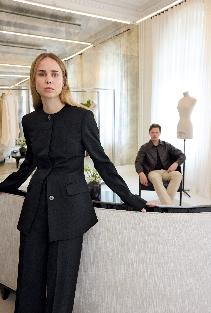
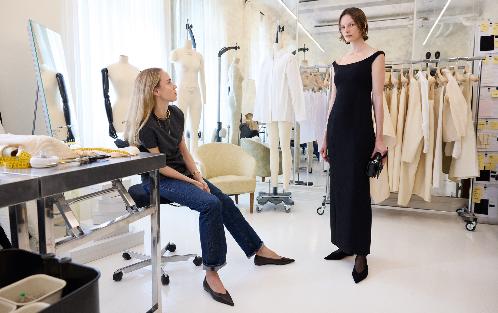
Elin Kling e Karl Lindman nell’headquarter di Toteme a Stoccolma. Kling indossa giacca in lana senza collo (740 €) e pantaloni su misura in lana(390 €).

"Elin doesn't like to go to the supermarket because she doesn't like to feel overwhelmed by too many choices," says Lindman, turning to her. "She is clear about what she wants - I think it is an aspiration shared by many other women: a desire for simplification." She confirms: 'I don't dream of a huge walk-in wardrobe with tons of clothes. That would be a nightmare for me.

Fashion has intrigued them both since their youth. Lindman remembers collecting the soaps and perfume samples his grandmother gave him, fascinated by the elegant packaging. Kling, who grew up on a farm, was always careful about how she dressed. She commissioned dresses from her mother, a sewing teacher. For the school prom, unlike her classmates who had chosen lavender silk princess dresses, she asked her mother to make her a simple black dress dotted with sequins (already very Toteme). First she became an established blogger, then a fashion journalist. In 2011, she collaborated with H&M. Right from the start, her attention to detail was evident: 'I was always looking for new experiences, but I didn't yet have in mind starting my own brand.

The idea was born some time later over a glass of wine, during a couple's holiday in Jamaica, when she and Karl had been dating for a few years. Fantasising, they began to imagine the life of a certain kind of woman: what her wardrobe and her house would look like, even what kind of flowers she would buy. "The problem with Elin - which is then her strength - is that, if you pause to speculate about something, the next day she is sitting with a pen and paper in front of her, ready to take action," explains Lindman. 'I like to dream big and I like to realise my dreams,' she replies, shrugging her shoulders and smiling.

At the basis of the project, there was no market gap to be filled. "Especially in the conception phase, our vision was precise: from the design of the garments to the way they were worn, the products had to meet a customer need and interpret a lifestyle," explains Kling. Right from the start, the approach to simplification was decisive: in a decade of widespread logomania, Elin and Karl started by designing essential garments, without any prominent logos, and they did so without courting investors. A decision they made also thanks to the suggestion of a stylist friend of Kling's, who advised against raising capital from third parties: "He told me that learning how to run a secure and stable business on your own is fundamental".

According to Lindman, 'in many ways, common sense helped us. We were clear: with limited funds, we had to try to build something solid, so that it would appeal and sell, so that we could later create a bigger collection, in the hope that it would continue to appeal. The positive response came from the debut, which included items such as Annecy, a long, loose cashmere coat (from 1,190 euro), still a best seller. "We went forward one step at a time. The product has always been central simply because, if we had not been able to sell it, we would have had to close the business,' Lindman explains. In retrospect, Kling admits, they took a lot of risks precisely because they had no experience, but the fact that there were two of them made it easier to encourage each other.

Kling indossa un top della prossima collezione e jeans in denim di taglio classico (270 €), scarpe Asymmetric Ballerina in pelle (450 €) e collana placcata in oro Collar (810 €). La modella indossa un abito in misto poliestere riciclato (780 €), slingback con zeppa in pelle scamosciata (480 €) e borsa T-Flap in pelle naplack (820 €).

The evolution has been steady, with an 80 per cent growth rate over the last seven years. In terms of positioning, the brand has operated with a 50-50 mix of direct sales and wholesale, relying on giants like Net-A-Porter. Lindman has never had any doubts about this: 'We think they are a great showcase for brands and we want to learn from them. An approach that has had some drawbacks, however: recently, when Matches went into receivership, it emerged that Toteme had a claim of almost £1 million against the e-commerce platform, and is unlikely to recover it. By opening its own shops, the brand has made itself less vulnerable to this type of risk. "Wholesale distribution will remain relevant. However, as we are growing globally, we will continue to expand our retail presence,' is the current strategy.

Toteme's pieces are seasonal, but many always remain in the collection. "The fact that a coat design is four years old doesn't make it outdated: we don't stop cherishing that product," Lindman points out. "Today we still sell well many of the pieces we started with. It is our version of fashion sustainability. Something that Elin and Karl also take into account when they move into new market segments such as jewellery, for example. "In these cases we are also very careful because we still have to continue to excel in the categories from which we started."

Page reports, in the past six months, a 250 per cent increase in Net-A-Porter searches for Toteme black bags, while those for boots have grown by 150 per cent. At Mytheresa, 'the brand excels in all divisions, including ready-to-wear, shoes and bags - a remarkable achievement,' says Richard Johnson, commercial director, sustainability. "Key pieces include the scarf-jacket, now reimagined as a coat, and the T-Lock bag, anointed as an it-bag. By limiting discounts, the company is protecting the brand image and targeting customers who buy at full price. But it is still a more affordable price than the high-end luxury brands,' Johnson concludes. 'This is exactly the positioning we were hoping for,' says Lindman. "We want people to have the same emotions when buying one of our garments as they would with a high-end product. Our target audience is not just high-spending customers," adds Kling. "I think ours is a very Swedish price positioning."

Borsa Mini T-Flap in pelle naplack (820 €).

Toteme was founded in New York, but seven years ago, when their eldest daughter was two, the couple moved, and with her the brand, to Stockholm. "The day we moved back to Sweden, we were able to pinpoint the exact focus of our project," says Lindman. "We thought it was important to find the Toteme woman here, where our roots and heritage are. Sweden has its problems and issues, but we are very proud of our country and its values. The intention was to create a brand that would interpret them, and the moment we started to go in this direction, everything else became clear." "Of course, Swedes can be quite square," Kling admits. "That's why I like to repeat that, in everything we do, we need a 15 per cent punk spirit, and I think New York has provided us with that."

The Toteme woman was developed in Kling's own image, yet ever since she launched the brand, she preferred to avoid exploiting her celebrity, so much so that today, years later, most customers are unaware of who is behind Toteme.

What will be the next step? For the time being, Elin and Karl have studied other brands, lifestyle giants they admire such as Giorgio Armani or Ralph Lauren. 'Considering the slowdown of some luxury brands, I think Toteme has even more opportunities, because it has set its aesthetic and its prices in a smart way,' argues Robert Burke, luxury consultant based in New York. Burke compares him to Thom Browne, another designer who started out as an independent and who 'remained extremely consistent in his vision: all his moves were measured and strategic'. Eventually, he sold the brand to the Ermenegildo Zegna Group for $500 million.

Certainly, Lindman and Kling have long-term plans. First of all, they are the majority owners of what is, to all intents and purposes, a family business, and have no plans to sell at the moment. On the other hand, as far as sharing a private and working life is concerned, Kling has no doubts: 'I recommend it, we are enthusiastic about it. After all, in a marriage, even simple decisions, such as choosing to renovate a room or build an outbuilding or a patio in the garden, can be quite challenging if you're not used to comparing and working together. And we are building shops!".

ESSENTIAL Model Sara Blomqvist. Hair and make-up Johanna Norlander. TOTEME, toteme.com..

Copyright reserved ©
Loading...
Loading...

Newsletter

Notizie e approfondimenti sugli avvenimenti politici, economici e finanziari.

Iscriviti