Phenomenon

Solar eclipse: who makes the glasses for viewing it?

The US and China lead the way, but European production is on the rise. In Italia, several companies resell the devices

2' min read

Translated by AI
Versione italiana

2' min read

Translated by AI
Versione italiana

Solar eclipse – the last one was in 1999. The total eclipse set to be visible across mainland Europe on 12 August has not been seen for over two decades. In Italia, it will occur shortly before sunset but will be partial: in Milan, the peak is expected at 8.20 pm, with around 92 per cent of the Sun obscured.

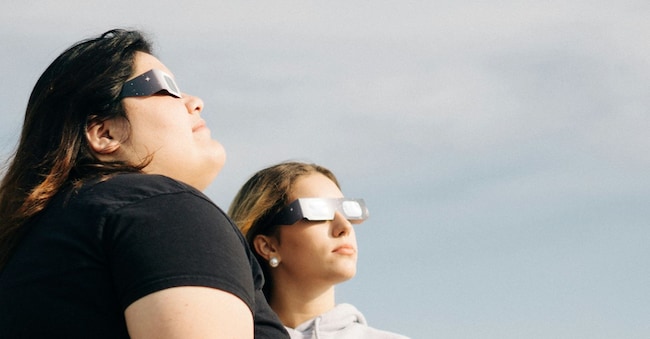
To view the phenomenon safely, you must wear glasses with filters designed for direct observation of the Sun. Ordinary sunglasses, even very dark ones, are not sufficient. Behind these cardboard frames lies a small international industry, ranging from the production of the filter material to assembly and compliance testing.

Loading...

The American Astronomical Society (AAS) currently lists 25 verified manufacturers across the United States, Europe and China. To be included on the list, companies must submit test reports demonstrating compliance with the international standard ISO 12312-2, carried out by accredited laboratories.

The American giant

The industry leader is American Paper Optics, based in Tennessee. It also produces sunglasses and solar viewing glasses on behalf of other brands and manufactures them in the United States; it claims to have sold more than 50 million pairs for the 2017 American solar eclipse and 75 million in 2024.

The AAS list also includes Rainbow Symphony and Thousand Oaks Optical. However, a proportion of global production takes place in China: Cangnan County Qiwei Craft, Hangzhou Retsing Eyewear, Jaxy Optical Instruments and Shenzhen Lionstar Technology. Some of these companies also manufacture on behalf of foreign distributors, who will then apply different brand names to the products.

Europe

There is also more recent European production. Spain is one of the countries – alongside Russia, Iceland, Greenland and a small part of Portugal – to experience a total eclipse. And in Barcelona, Celestech operates, claiming a production capacity of over 250,000 pairs of glasses per day on a single shift. The factory carries out printing, die-cutting, filter application, folding and packaging.

Based in Germany are Baader Planetarium, which manufactures the AstroSolar Silver/Gold Solar Viewers, and TSE17, a company founded ahead of the 2017 US solar eclipse, during which it sold more than 12 million pairs of solar eclipse glasses.

A more recent brand is Absolute Eclipse, which was founded in 2026 in Cēsis, Latvia. The company states that it manufactures within the European Union, and the slots for ordering customised bulk batches for the August eclipse are all fully booked.

In Italia

In Italia, there are several retailers selling eclipse glasses, and many rely on major foreign manufacturers. Eclissami, a brand based in Reggio Emilia, was launched in the run-up to the event on 12 August and sells devices manufactured by the Chinese company Cangnan County Qiwei Craft, one of the largest operators in the sector, which also features on the AAS’s certified list.

Auriga is a different case altogether. It is a Milan-based company founded in 1983 that specialises primarily in optics and electronics. It is one of Italy’s leading distributors of astronomical observation equipment and, through its own brand, DiProgress Edu, also sells the DP-SG01 eclipse glasses.

Copyright reserved ©
Loading...
Loading...

Brand connect

Loading...

Newsletter

Notizie e approfondimenti sugli avvenimenti politici, economici e finanziari.

Iscriviti