
Solar panels, new rules needed to finance disposal
With the current end-of-life system at risk. In Italy it will rise from 427,000 in 2025 to over 12 million in 2050

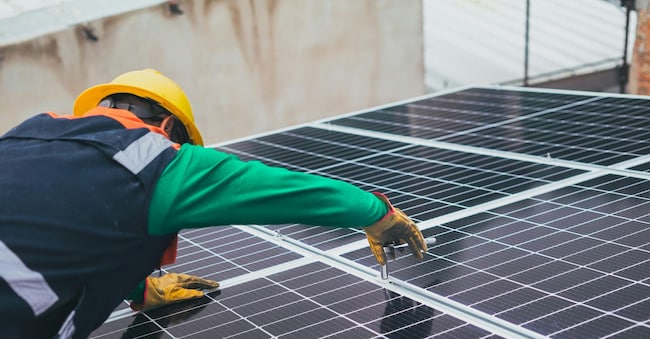
The current system of financing the disposal of photovoltaic panels is based on producers paying a fee for treatment into the trusts of the various end-of-life management consortia. Well, the model risks failing to guarantee the proper treatment of this waste, which is part of the WEEE, in the near future. The alarm comes from the Erion Weee consortium on the basis of the study 'Photovoltaic waste management in Italy: a new financing model' by the consultancy and research company Ref.
The race to the bottom
We are talking about non-incentivised panels, i.e. those that do not benefit from the support of the old Energy Accounts. "For the incentivised ones, the contribution is a reasonable amount for end-of-life management," explains Giorgio Arienti, managing director of Erion Weee: "The problem arises for the non-incentivised ones. Since the disposal fee is paid by the manufacturers, we have seen in recent years a hunt for them by the various WEEE management consortia. In order to secure the end-of-life management of more manufacturers, they have continually lowered the value of the contribution, which is much lower than EUR 10, to as low as EUR 1. Figures that are not enough to guarantee the proper treatment of a panel in 10, 15 or 20 years. And which we as Erion Weee do not agree with,' Arienti emphasises.
Exponential Growth
This phenomenon is intertwined with the exponential growth, in the coming years, of the quantities of panels that will become waste. At the end of 2021, around 20 million photovoltaic panels were installed in Italy without incentives, in the three-year period 2022-2024 a further 28 million were put into use, and another 49 will come into operation in the next three years. "Between 2025 and 2050 there will be an almost 30-fold increase in the number of photovoltaic panels destined for decommissioning each year, with important implications for plant owners, consortia and, more generally, for the entire community. We will go from about 427 thousand decommissioned panels in 2025 to more than 12 million in 2050, with a consequent increase also in terms of mass: from 9 thousand to 264 thousand tonnes per year of photovoltaic WEEE to be collected and managed correctly per year," Ref writes in its report.
Impressive growth and a small contribution per panel will lead to a deficit in end-of-life management of up to EUR 80 million per year by 2050 in the worst case scenario, the study also points out. With consequent risks: export to countries without adequate treatment plants or abandonment in the environment. Not to mention the non-recovery, also pushed by Europe, of materials such as glass, aluminium, silicon and silver.
The generational model
"The national plant system is already preparing for increasing volumes of panels to be treated, also thanks to the NRP investments," Arienti emphasises: "The financing model needs to be adapted. And based on Ref's study, Erion Weee proposes the adoption, also for photovoltaic panels, of the generational financing model already used for all other types of household WEEE. It is a system that assigns the economic responsibility for end-of-life management to the manufacturers on the market in each year, in proportion to the amount placed on the market in the same year. "The contribution charged by each consortium in this way will depend on the actual forecast of material to be disposed of. How much will it cost me? I will distribute the budget among my producers,' Arienti specifies.


