The debate

'Something big is happening on Ai, like Covid'. The post goes viral

Viral post by Matt Shumer, founder of HyperWrite, reignites global debate on the impact of generative artificial intelligence

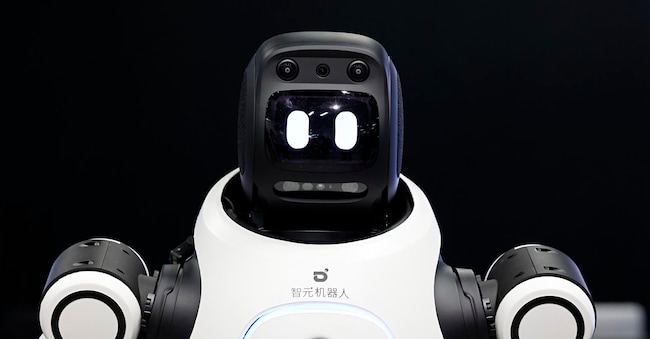
epaselect epa12732236 Il robot "AgiBot Humanoid Robot G2" è esposto durante il World AI Cannes Festival 2026, una fiera internazionale dedicata all'intelligenza artificiale, a Cannes, in Francia, il 12 febbraio 2026. Il festival si svolge dal 12 al 13 febbraio 2026.  EPA/SEBASTIEN NOGIER

3' min read

Translated by AI
Versione italiana

3' min read

Translated by AI
Versione italiana

There is one passage, in the long social post that has gained over 60 million views in recent days, that struck more than the figures and predictions: 'Something big is happening'. It is the incipit of a speech on artificial intelligence by Matt Shumer, the American founder and CEO of HyperWrite, the company specialising in generative AI applications for individual productivity.

In the post, Shumer argues that in recent months the new generation models have made such a qualitative leap that it marks a historical discontinuity. Not a linear progress, but a turning point. A moment that, in his words, is reminiscent of 'February 2020': when the Covid-19 pandemic still seemed distant and, in a matter of weeks, would transform the economy, work organisation and value chains on a global scale.

Loading...

The comparison is deliberately strong. And it is precisely this analogy that has ignited a heated debate between entrepreneurs, venture capitalists, researchers and Big Tech managers. For Shumer, the acceleration imparted by the latest generation of generative artificial intelligence models is no longer a phenomenon confined to laboratories or early adopters: it is entering production processes, drastically reducing the need for certain cognitive tasks and redefining the perimeter of the skills required.

From individual productivity to substitutability of functions

The central point is not so much about AI's ability to 'help', but its increasing ability to 'replace'. Shumer recounts that he has delegated to models technical tasks that until recently he considered non-automatable: writing complex code, analysing articulated data, designing decision flows. It is no longer a matter of completing a text or suggesting a formula, but of performing articulated tasks from start to finish.

In this sense, the discussion shifts from the traditional productivity narrative - more output for the same input - to the more delicate one of functional substitutability. Whether a system is capable of autonomously performing the tasks of a junior analyst, entry-level developer or novice consultant, the impact is measured not only in terms of efficiency, but of employment structure.

It is no coincidence that Dario Amodei, at the helm of Anthropic, also intervened in the debate, evoking the possibility that a significant share of white-collar entry-level roles could be automated within a few years. A prediction that, although contested in numbers, photographs a change in perception: AI is no longer seen as a marginal support, but as a potentially structural factor in the reallocation of labour.

The Sceptics Front: Beware of Ad Effects

The more assertive positions are contrasted by a sceptical front, which calls for a distinction between demonstration capabilities and large-scale implementation. Technological transformations, many analysts remind us, rarely result in immediate and uniform shocks. The history of industrial automation and digitisation shows slower trajectories, characterised by phases of absorption, organisational adaptation and the creation of new professionalism.

According to this reading, the pandemic analogy risks overestimating the speed of the transition. Companies need to integrate systems into their processes, address regulatory constraints, and manage reputational and compliance risks. Real adoption, especially in regulated sectors such as finance, healthcare or legal services, may follow less explosive curves than pioneer cases suggest.

And yet, even among the most cautious, a consensus is emerging: the quality of models is improving at a rate that is forcing companies and workers to reconsider their strategies. Not so much because 'tomorrow' millions of jobs will disappear, but because competition will increasingly be played out on the ability to integrate AI into decision-making flows.

Over alarmism

The merit of Shumer's speech lies not so much in the accuracy of the percentages, but in bringing the issue of the employment impact back to the centre of the economic debate. If we are indeed facing a 'February 2020 moment' of artificial intelligence, the answer can neither be dismissal nor panic. Like any major technological transformation, it opens up space for growth and innovation, but requires investment and industrial vision. The alternative is to undergo change, leaving other ecosystems to set the standards.

At stake is not only short-term productivity, but also the quality of work and the sustainability of the economic model in the medium term. It is on this terrain - rather than on suggestive analogies - that the true extent of the artificial intelligence revolution will be measured.

Copyright reserved ©
Loading...

Brand connect

Loading...

Newsletter

Notizie e approfondimenti sugli avvenimenti politici, economici e finanziari.

Iscriviti