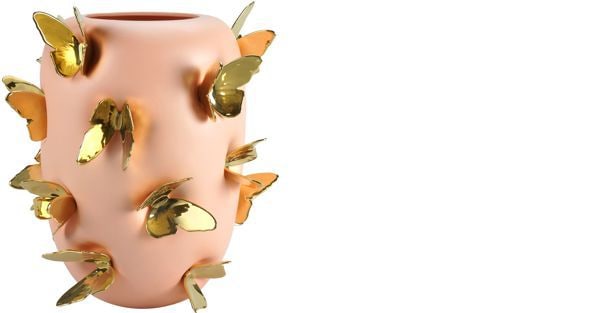
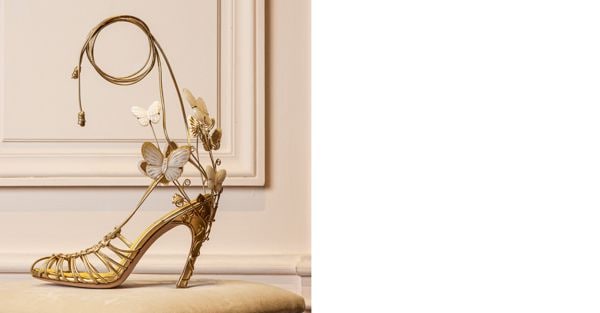
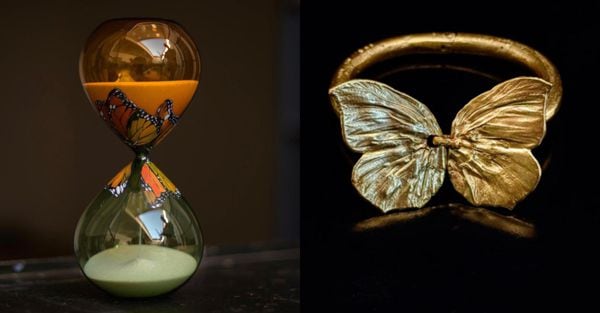
Butterfly SOS: featured in fashion, art and design, but increasingly rare in the wild
Whilst Italia still boasts the greatest biodiversity, we need to invest in reflowering and green spaces to save these species from extinction. So that, as well as living on in embroidery and prints, they may take to the skies once more.

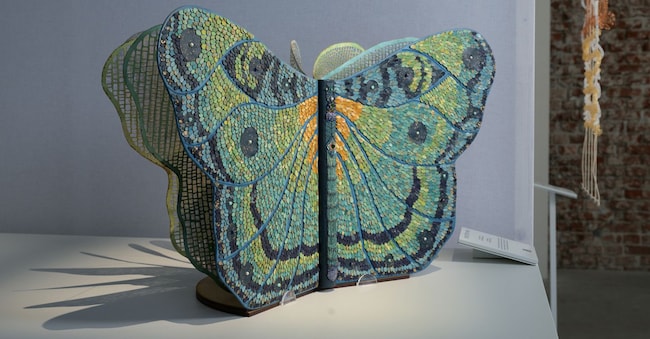
Herman Hesse wrote that butterflies are not animals like any others, but “the ultimate, highest, most joyful and vitally important essence of an animal”. A joyful symbol of the rebirth of the body, the spirit and nature: after spending the winter sheltered amongst the foliage, the small copper (Gonepteryx rhamni) takes flight, heralding the arrival of spring. It is instantly recognisable: the females are pale, but the males have sulphur-yellow wings, with two small orange spots and a greenish underside, just like the leaves against which they blend in. It is the longest-lived of them all: it lives for a year, withstanding the cold thanks to a natural antifreeze, glycerol, which circulates in its bodily fluids. Butterfly tricks. Just like the iridescent colours of many species: these do not come from pigments, but from the way light interferes with microscopic nanostructures on the wings. An invisible architecture of light that has so inspired creatives in the worlds of fashion, art, cosmetics and design. Even the automotive world: Lexus’s ‘Structural Blue’ paintwork mimics the colour of the blue Morpho (Morpho menelaus), a large butterfly found in the forests of Central and South America, which certainly does not go unnoticed – after all, we imagine that was the intention of the Toyota engineers.

“In butterflies, blue dominates our aesthetic perception: it is a rare colour in nature and acts as a powerful attractant,” explains Leonardo Dapporto, a lecturer in Zoology at the University of Florence. Beauty is not just in the eye of the beholder; there are characteristics on which almost everyone agrees. “We asked thousands of people to look at pictures of butterflies and pick out the most beautiful ones,” says the researcher. “At the top of the list are those with bright colours – blue, of course, but also yellow. Contrast is also popular, both in the colours and in the shape of the wings.’ And the patterns: polka dots, stripes, and false eyes that create a Mona Lisa effect – they seem to stare back at you from whatever angle you look at them – deterring predators. ‘An enchanting sight that also influenced the Flemish painters of the fifteenth and sixteenth centuries,’ continues Dapporto. ‘In their paintings, the false eyes of the peacock-eyed Vanessa (Aglais io) are reproduced with extreme precision, in keeping with their analytical naturalism, but are shifted towards the centre of the wing, becoming the visual focal point of the composition. It is a recurring tendency among painters, probably unconscious: they are mesmerised by that eye and reorganise the composition around it.”

Beauty is alluring, but it can also be exclusionary. “One of the main European instruments for the protection of biodiversity is the Habitats Directive, which identifies priority species for protection,” explains the scientist. “Many of them are indeed rare, but they are also beautiful. An aesthetic bias that influences research: the most charismatic species attract more attention and funding, whilst it is often the less conspicuous ones that are most threatened.’ Like many butterflies of the genus Erebia, small brown moths found in the European mountains that are in trouble due to the climate crisis. ‘Paradoxically, these little butterflies are at risk of extinction from the cold because of the heat,’ says Dapporto. ‘They are adapted to survive mountain winters covered by a layer of snow which, however, due to climate change, is becoming increasingly unstable. Being left without this blanket on cold winter nights can be fatal for their larvae.’

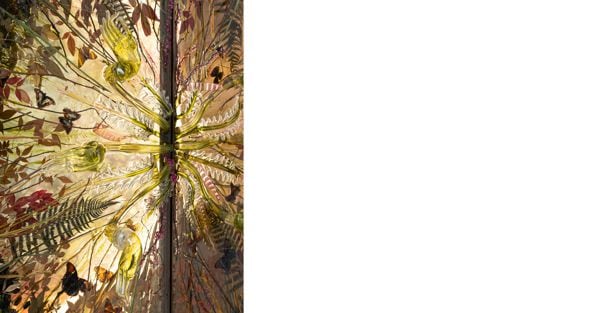
However, there are more rigorous tools for guiding conservation efforts: the Red Lists of the International Union for Conservation of Nature. These are drawn up on the basis of objective criteria: population trends, range contraction and the severity of threats. Here, colour and aesthetics – so important, for example, in Manu Crotti’s cabinet – no longer matter once they are out of the spotlight. Dapporto is part of the team that compiled the European Red List of butterflies, alongside, amongst others, Simona Bonelli of the University of Turin. ‘Between 2010 and 2025, the proportion of European species at risk rose from 9 per cent to 15 per cent,’ explains the researcher. “For Italia, we only have figures from 2016, when threatened species accounted for between 6 and 9 per cent. The next update to the List is due in 2027, and we expect the situation to worsen.” So, whilst butterflies are once again taking centre stage in high fashion and accessories and continue to inspire the creations of designers and artists – from Matthieu Blazy to Barnaba Fornasetti, from Alessandro Michele to Manu Crotti – away from the spotlight they have become increasingly scarce. Putting them back at the heart of nature and our experience is a collective responsibility, and ours in particular: Italia has the greatest biodiversity of butterflies (300 out of 500 European species), not to mention the thousands of moths, the night-flying butterflies.
“The positive thing is that we haven’t just stood by and watched,” continues Bonelli. “In recent years, a great many monitoring, conservation and awareness-raising initiatives have been launched.” Thanks to the Butterfly Monitoring Scheme – a monitoring network established in England in the late 1970s and now operating across Europe – we have more data on butterflies than on any other pollinating insect. “Volunteers regularly walk along set routes (transects), recording the species they spot,” explains the butterfly expert. “Italia joined the scheme in 2019: today it has around 250 transects and hundreds of volunteers. It is a system coordinated and supervised by researchers, which allows us not only to identify the most threatened butterflies, but also to monitor population trends.”