
SOS corals: restoration efforts focus on underwater nurseries
Coral reefs are home to a quarter of all species but are being damaged by climate change. Restoration plans are being fast-tracked around the world

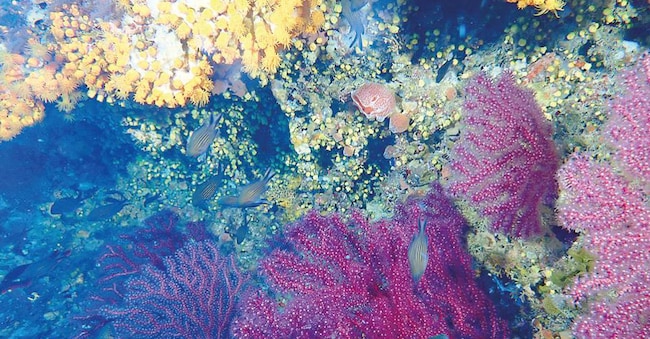
Corals are not just a tropical postcard image. They are living structures that support biodiversity, fisheries, tourism and scientific research, and protect coastlines from the force of the sea. And, with global warming, protecting them is also becoming a climate adaptation strategy.
The emergency
Coral reefs are structures formed from the calcareous skeletons of corals. They cover just 0.2 per cent of the ocean floor, yet are home to at least a quarter of all marine species. According to the United Nations Environment Programme (UNEP), the goods and services provided by reefs — fishing, tourism, coastal protection, climate regulation and molecules of medical interest — are worth around 2,700 billion dollars a year. Yet the crisis is outpacing conservation programmes. Between 2009 and 2018 alone, the world lost 14 per cent of the corals on its reefs. One of the main threats is bleaching, which occurs when excessively high sea temperatures cause corals to expel the microalgae with which they live in symbiosis – microalgae that are essential for their nutrition and colour – and which, in the long term, can lead to their death. NOAA, the US National Oceanic and Atmospheric Administration, and the International Coral Reef Initiative confirmed in 2024 that a major global bleaching event had taken place: a crisis affecting the three major ocean basins where corals live – the Atlantic, Pacific and Indian Oceans – which exposed around 84 per cent of the planet’s coral areas to thermal stress.
Restoration work
The risk is not limited to biodiversity. Reefs act as natural breakwaters: a study published in *Nature Communications* has estimated that healthy reefs can reduce wave energy by an average of 97 per cent. Restoration is therefore seen as a form of natural protection, alongside mangroves, seagrass beds, dunes and traditional coastal defences. ‘Restoration projects are important tools and, in some contexts, can yield very positive results, but they should not be seen as a definitive solution,’ explains Giovanni Chimienti, a marine biologist, National Geographic explorer and lecturer at the University of Bari Aldo Moro. “They can help restore damaged habitats and accelerate natural recolonisation processes, but they are no substitute for conservation.” The global map of projects highlights different approaches. Among the best-known initiatives is that of the Coral Gardeners, an organisation founded in 2017 in Moorea, French Polynesia, by Titouan Bernicot. The method involves ‘coral gardening’: fragments selected from healthy colonies are cultivated in underwater nurseries, monitored as they grow and then replanted on damaged reefs. The nurseries are underwater nurseries, often constructed using tree-like or grid-shaped structures, where the fragments are cleaned and allowed to grow before transplantation. According to data released by the project, the Coral Gardeners have already planted over 160,000 corals in French Polynesia, Thailand and Fiji, with the aim of reaching 200,000. In Roatán, Honduras, the Roatán Marine Park combines asexual and sexual coral reproduction, fragmentation, micro-fragmentation and transplantation in degraded areas, using a model that intertwines research, training and tourism.
The case of Japan
However, restoration efforts are not limited to tropical reefs. Regeneration and monitoring protocols are also being trialled for precious corals – used in jewellery and distinct from reef corals. Cibjo, the World Jewellery Confederation chaired by Gaetano Cavalieri, cites in the 2024 report of the Coral Commission led by Vincenzo Liverino a Japanese project launched in 2016 as a best-practice example, involving the transplantation of tips of local precious corals onto artificial substrates at a depth of around 100 metres. On the cages, between 2017 and 2020, the survival rate was 99.1 per cent.
In the Mediterranean
The Mediterranean, meanwhile, tells a different story. Here there are no large tropical reefs, but rather submerged forests of gorgonians, black corals, madrepores, pennatulids and deep-sea habitats that are still poorly understood. Black corals and gorgonians are ‘true ecosystem engineers’, observes Chimienti, explaining that these ecosystems create three-dimensional structures, slow down currents and provide shelter, spawning grounds and natural nurseries. The black coral forest discovered off Marettimo, in the Egadi Islands, reveals the existence of rare and vulnerable habitats, formed by organisms that grow slowly and can live for decades or centuries.

