Climate crisis

South America, glaciers melt and mega-drought will advance

According to new studies, glaciers will melt by 2100 and will no longer be able to compensate for rainfall deficits. With devastating impacts

by Jacopo Pasotti

(Reuters)

5' min read

Translated by AI
Versione italiana

5' min read

Translated by AI
Versione italiana

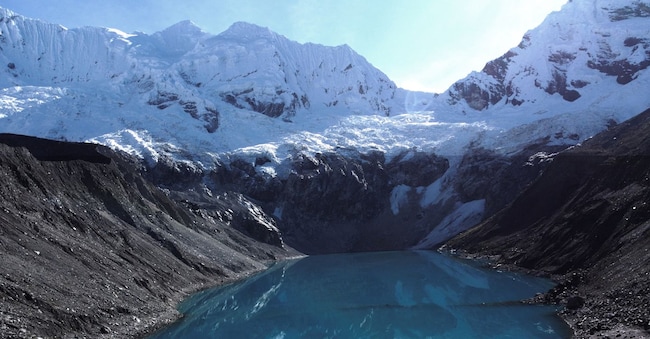
For more than a decade, Chile's mega-drought, one of the longest and most intense droughts ever recorded in South America, was mitigated by the glaciers of the Andes. Melting at an accelerated rate, they compensated for part of the rain deficit, preventing the collapse of urban and agricultural water systems. But a new study published in the journal Nature Communications Earth & Environment warns that this 'emergency stockpile' is set to run out within this century.

The numbers of the crisis and the collapse of a system

The research, led by Alvaro Ayala of the Swiss Federal Institute for Forest, Snow and Landscape Research (Switzerland) and a team of glaciologists and hydrologists from institutes in Chile, Switzerland, Austria and New Zealand, and headed by Francesca Pellicciotti of the Austrian Institute of Science and Technology (Ista), describes a genuine structural loss: a thousand-year-old water heritage that is being eroded faster than it can regenerate.

Loading...

According to glacio-hydrological simulations that the international team conducted on one hundred of the largest glaciers between the 30°S and 40°S latitudes of the Andean chain, the glacial volume could shrink between 55% (optimistic scenario) and 78% (pessimistic scenario) in the coming decades and by 2100.

During the current mega-drought, the contribution of glacial meltwater was essential to maintain a reduced water flow for societies and economies downstream of the mountain range.

During a drought, glaciers provide more water than normal: 'Where there are mountains and glaciers, the cryosphere, i.e. snow and glaciers, play a special role. They are water reservoirs and become even more active in droughts: glaciers produce water, much more than they do under normal conditions because there is less snow and the ice is more exposed. So there is more glacial melting,' Pellicciotti explains. In some extreme years, such as 2019, melting has even increased by 390 per cent compared to normal, compensating for a 66 per cent reduced rainfall. This means, however, that the melting ice masses shrink even faster during these periods.

In summary: the mega-drought that is affecting that sector of the Andes today will deal a severe blow to the 'water towers' of the coming decades. The water capital of the Chilean cryosphere has been eroded and will not be replenished for centuries, perhaps millennia.

The discovery of "megasicities"

"Mega-droughts are mainly defined by their duration," says Pellicciotti, who says: "We were there to study the glacial environment when this mega-drought started, in 2010. The first two or three years the experts were observing it. Chile has a drought every two or three years, a cycle related to the El Niño phenomenon. Generally they are cycles that last one or two years. This one has started, he continued, and is not yet over. René Garreaud, a famous Chilean climatologist, called it megadrought, mega-drought, and today these events are studied all over the world.

Such an event, Pellicciotti explains, is 'unprecedented'. And this is important, because 'we are witnessing a historic event, which no climate model has been able to predict, and which we still cannot explain,' the expert concludes.

In a much warmer environment, up to +4.5 °C in glacial areas, it is reasonable to expect that future mega-droughts will be at least as severe as the current one. This means higher melt rates, more evaporation and, above all, less resilience of the mountain hydrological system.

After 2050, in 20 years or so, once the ice has diminished, there will no longer be a natural shock absorber capable of sustaining cities, agriculture and industry during prolonged periods of drought.

In the case of certain extreme events, there is no going back, in short. So much so, says the expert, that in Chile they are beginning to speak of a 'new normal' climate. Being without any precedent, however, we are sailing in the ocean of uncertainty.

Only one certainty: impacts

The study shows that in the future during droughts equivalent to today's, the summer water contribution of glaciers could decrease by 40-60%. The reason is simple: there will no longer be enough ice to melt because the glaciers will have almost completely disappeared by then.

This implies longer dry seasons, more intermittent rivers, high stress on agricultural production, higher energy costs and more likely conflicts in the arid regions of Chile and Argentina, an area already marked by social tensions related to water management.

Industry and agriculture are already bearing the brunt of the mega-drought, which some economists have estimated to be around USD 1.2 trillion. Among the hardest hit is the mining industry. Chile mines about 26% of the world's copper, more than twice as much as any other country. Unfortunately, mining requires large amounts of water for a number of processes, including dust control at the mining site, cooling of machinery, and processing and transport of the ore.

The study thus offers a glimpse of a future in which water will no longer be guaranteed even in the mountains: a crucial wake-up call for governments, industries and communities dependent on the South American cryosphere.

Europe, droughts, crises ahead

The attention of glaciologists and climatologists to these extreme events is growing, and of course their gaze now also extends to other regions, including Europe.

There is no shortage of droughts in Europe. "There have always been and we remember for example those 2003, 2018, 2022, 2023. What we have observed is an increase in frequency. But they generally last one season, which allows a stressed system to recover," says Pellicciotti. "The level of the rivers goes back to what it was, the soil moisture restores, and so do the forests. But when you have a drought that continues from season to season at some point something breaks down in the system."

In Europe, events like the one in Chile have not yet occurred, explains the hydrologist. But in addition to the increased frequency of drought events, and there have already been cases where droughts have covered two seasons instead of just one, thus increasing their duration. And this too should ring alarm bells for policy makers.

"In my opinion, we have to prepare ourselves to think that something similar could happen in Europe, a scenario in which we cannot hope that after an extreme drought, the following year's winter rains and snow will reinvigorate the system. I think we should prepare ourselves. We must understand what happens when there is a mega-drought that damages the hydrological cycle in the mountains of Europe. We cannot think of ourselves as a closed, protected oasis. Instead, we can use the Chilean case to anticipate what may happen in Europe. Here, unlike Chile, we have excellent governance systems. And so we can adapt.

The end of an era

The study leaves no room for naive optimism: change is already underway. The water future of Chile and Argentina will depend less and less on glaciers and more and more on political and technological choices in the coming decades. For centuries, the glaciers of the Andes have functioned as a water bank: depositing water as ice in the winter and gradually returning it in the warm months. That bank is closing, and the final balance will be much lower. The Alps, which are certainly less prone to extreme drought events of this magnitude, are nevertheless at risk of increased water crises. The South American case may therefore be useful to prevent damage to the environment and economies of the circum-Alpine countries.

Copyright reserved ©

Brand connect

Loading...

Newsletter

Notizie e approfondimenti sugli avvenimenti politici, economici e finanziari.

Iscriviti