
South Korea, Yoon apologises but does not resign
The president went on TV to take responsibility for martial law and deferred to the vote of his fellow party members

2' min read
2' min read
From our correspondent
NEW DELHI - Just hours before the parliamentary vote that could send him to trial, South Korean President Yoon Suk Yeol finally broke his silence. He did so to apologise for proclaiming martial law, but not to resign, thus leaving his political fate to the will of his fellow party members. In a short speech to the nation broadcast on TV, Yoon summarised what happened on the night of Tuesday to Wednesday, justified his decision with his 'desperation' as president and did not convince anyone.
The rejection of the parties
.As was easy to predict his words did not resonate with many of the parliamentarians who will judge him in Seoul this afternoon. The leader of the Power People Party, Yoon's own party, made it clear that the president is out of the picture. 'The president's normal duties are impossible, and it is inevitable that he will leave earlier than expected,' Han said.
Opposition leader Lee Jae-myung was even tougher. The Democratic Party number one called the speech 'very disappointing' and promised to continue pushing for the president's impeachment. 'The biggest danger to South Korea right now is him,' Lee declared. Heavy words, if one thinks that across the border from North Korea is a dictator armed with nuclear weapons and ballistic missiles. 'The only way to resolve this situation is for the president to resign immediately or be removed from office early through impeachment,' Lee concluded.
The challenge of the two squares
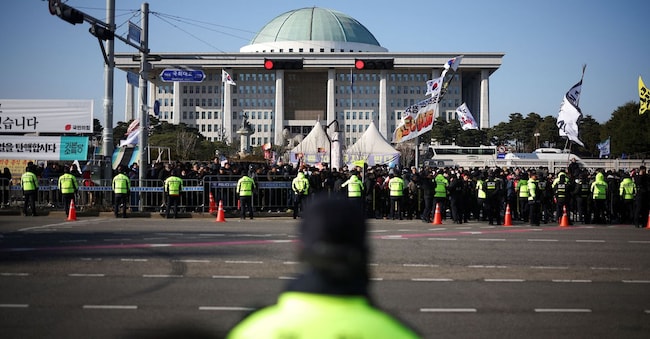
.Barring any surprises, therefore, it will go to a vote. The opposition parties need eight troublemakers from the ranks of the People Power Party, which, despite its leader's statements, officially remains on the president's side. A second challenge is instead being played out in the streets of the South Korean capital where both the president's detractors and that part of the population that, in spite of everything, wants him to remain at the helm of the country and is even calling for the arrest of opposition leader Lee are lined up. The former are much more numerous and are crowding around the National Assembly building where the vote will take place. The latter have occupied a square and are sitting on plastic chairs waiting for the result of the vote.


