Agro-industry

Agriculture in space is closer to Earth with robotics and vegetable gardens in weightlessness

Increasing number of experiments by universities and companies are finding commercial applications: prototypes for growing food in space and extending the life of missions are multiplying;

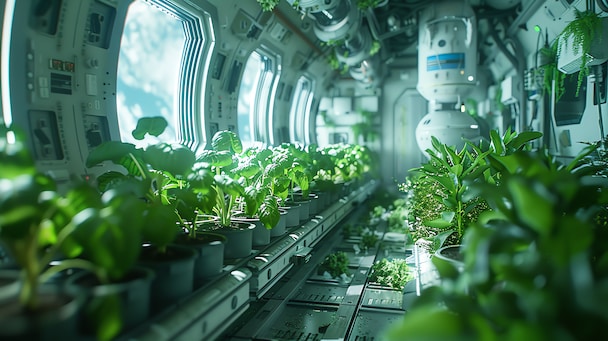
by Maria Teresa Manuelli

Piante che crescono nello spazio in assenza di gravità

3' min read

3' min read

From Earth to space and back. Salad machines for growing salads in a controlled environment, capillary mats for irrigating in the absence of gravity and the atmosphere, micro-horts for autonomous cultivation in the galaxy. But also IoT sensors, satellite technology and lots of robotics. This is space agriculture moving forward.

"Science now offers the concrete possibility of creating an artificial ecosystem to produce food in places considered extreme and therefore impossible, such as space. But these same prototypes then return from space to Earth in the form of commercial applications to help our agriculture," explained Stefania De Pascale, astro-agronomist and professor of Horticulture and Floriculture at the Federico II University in Naples during her talk at OlioOfficina 2024.

Loading...

The search for solutions to support human life in space has a vast field of application right on Mother Earth and is developing a growing and interesting business, also in our country.
According toMise data, the space economy in 2018 was worth around 370 billion euro globally, which is estimated to become over 500 by 2030. A sector that employs 1 million people worldwide and with a very high 'return on investment' value: for every euro spent, 11 are created. It is not surprising, on this basis, that the Space Economy is now regarded as one of the most promising engines for economic growth.

In Italy there are about 200 companies in the sector, 80% of which are SMEs, with an annual turnover of 2 billion euro and 7,000 employees (+15% in the last five years. Source: Ministry of Economic Development). Italy is one of the few countries in the world that can boast an autonomous and complete space industry, thanks to constant investment over several decades.

Not only 'space' food to bring ready-made terrestrial food to orbiting spacecraft - see the recent collaborations of Rana, Barilla and Damiano with extraterrestrial missions to develop nutrition programmes for astronauts - but increasingly prototypes to grow food directly in space. This would lengthen the duration of missions and the distance that can be travelled.

The Agriculture Department of the University of Naples, in collaboration with the Italian Space Agency (Asi) and the European Space Agency (Esa), has been engaged in the study of these in-orbit cultivation systems for over twenty years. With La Sapienza of Rome, it has developed a vegetable garden on board a micro-satellite that was launched from the Kourou base in French Guyana. At more than 6,000 km from earth, it represented the farthest vegetable garden. And on the international space station (Iss, only 400 km from earth) there is already 'Veggie', a space garden with the aim of studying plant growth in microgravity, while adding fresh food to the astronauts' diet.

'Clearly, when we talk about longer missions,' De Pascale specifies, 'we need to think about crops that have a higher nutritional value than salads, the so-called staple crops on earth. These include potatoes, soya and rice. With Thales Alenia Space in Turin, we are working on a modular unit for growing potato tubers in microgravity on board the international space station. In particular, we are looking for the most suitable cultivar. Again with Asi and La Sapienza, we are also developing rice plants specifically improved and adapted for the space environment'. Cultivars and cultivation solutions that would then also be used on Earth in areas unsuitable for cultivation, such as deserts, the poles or megacities.

The 'Melissa' (Micro-Ecological Life Support System Alternative) project, on the other hand, which has engaged Esa for more than 30 years, studies regenerative life support systems, which aim for the highest degree of autonomy and thus produce food, water and oxygen from mission waste. Italy is a reference point for the study of plants precisely. The aim is to bring mankind to produce food on the Moon, or rather on Mars, since the possibility of life on what is considered a twin planet has been investigated for at least 25 years now.

But for those who cannot wait for the conquest of space, there isthe possibility of dining at the first starred restaurant in orbit. There are six seats on the spacecraft and they can already be booked for the debut launch in 2025, although the cost is decidedly out of the ordinary: around 450,000 euros. The trip - carbon neutral - is proposed by the luxury space travel company SpaceVIP and will last six hours at an altitude of 30 thousand metres. It will include a set menu with dishes created by Danish chef Rasmus Munk, whose restaurant Alchemist in Copenhagen was awarded two Michelin stars in 2021. The proceeds of the expedition will go to an association that supports gender equality in science and technology.

Copyright reserved ©
Loading...

Brand connect

Loading...

Newsletter

Notizie e approfondimenti sugli avvenimenti politici, economici e finanziari.

Iscriviti