
Space, Capua's Cira working on lunar drones, satellites and hypersonic flight
The Campania cluster unveils three projects in the new plan to 2028

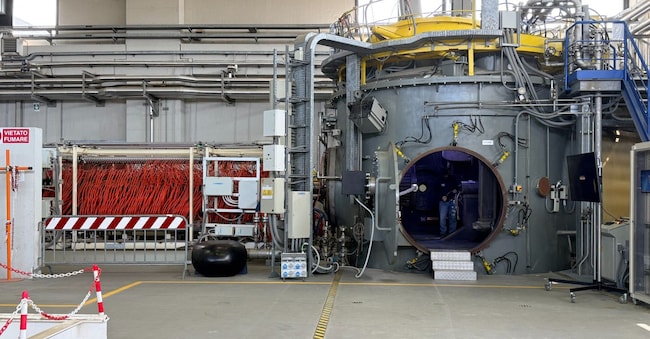
Moon Drone for the Moon, Hyperspace for hypersonic flight, and a new generation of lightweight interoperable satellites: these are the three projects announced in a preview to Il Sole 24 Ore by the Italian Aerospace Research Centre in Capua, Italy, Cira. They concretise the technological guidelines of the three-year Strategic Plan 2026-2028 and, through the words of its president, Tommaso Edoardo Frosini, suggest where the Italian aerospace industry will go in the coming years. "Our goal is to strengthen the Centre's role as a driver of innovation, putting skills, infrastructure, and research at the service of an increasingly autonomous and competitive sector," says Frosini.
The plan, published a few weeks ago, organises the three-year period along five macro-areas, from air flight to hypersonic flight and planetary exploration, providing 370 researchers and the country's largest aerospace infrastructure. Three of the projects that animate the areas had not been made public until now: Moon Drone is a modular and energetically autonomous system for operating on the lunar surface. It refuels, repairs, reconfigures and coordinates a swarm of drones without relying on external support. Hyperspace is a feasibility study for a suborbital aircraft capable of travelling at seven times the speed of sound (Mach 7). The third direction is a new generation of lightweight satellites with high-efficiency, modular and interoperable electric propulsion, optimised for space deployment and future controlled re-entry capabilities.
These programmes are flanked by high altitude stratospheric platforms, the so-called Haps, and enabling tools such as digital twins. The projects are supported by the recently approved budget, which shows a growing Centre: the value of production in 2025 reached 57 million euro, 13% more year on year; for 2026 the forecast exceeds 65 million. Also supporting the trajectory is Prora, the National Aerospace Research Programme of which Cira is the implementing party, worth over 21 million for each of the next three years. 'We want to be more and more a driving force for the Italian and European scientific and business community,' adds Frosini, 'by providing expertise capable of generating real benefits in terms of competitiveness, safety and quality of life.
The planetary exploration strand has already recorded a concrete result: on 6 May, Cira passed the manufacturing readiness review of the Sama project (a separable external shield for aerocapture in the Martian atmosphere), obtaining authorisation from the European Space Agency and Thales Alenia Space to produce the demonstrator with the Neapolitan company Ali. Test campaign in the summer, target technology readiness level 4.
The defence node underpins the whole plan. The document emphasises 'the growing relevance of dual-use technologies and the connections between aerospace, security and defence,' says Frosini. Cira is already a test centre for Nato Diana (Defence Innovation Accelerator for the North Atlantic) and is accredited in the Defence Test & Evaluation Base of the European Defence Agency. The same hypersonic tunnels used for Mars will test a military vehicle returning from orbit. In a Europe that has begun to invest again in defence as an industrial lever, this positioning is now worth more than ever before.

