
'Space economy increasingly strategic but international cooperation declining'
Josef Aschbacher explains the challenges of a market where the weight of the private sector is growing and where Europe can and still wants to play a leading role
by our correspondent Beda Romano
 Aggiungi Il Sole 24 Ore
ai preferiti su Google
5' min read
5' min read
PARIS - For decades, even during the Cold War, space remained immune to political tensions. A common good by definition, it had managed to preserve international cooperation, even when regional conflicts between the blocs and the nuclear arms race tested world peace. Today, the Russian war in Ukraine and the heated confrontation between the US and China are jeopardising global cooperation, at a time when space is becoming increasingly important economically.
It is estimated that one tenth of the European economy depends not on factories or offices, farming or industrial production, but on satellite navigation. Two examples: four billion mobile phones as well as two thirds of the new agricultural machinery around the world are connected to European Galileo satellites. The space economy is on the rise, and has also become, one might say, a springboard into politics, as demonstrated by the parable of Elon Musk, now the chief advisor to the next US president Donald Trump.
Europe still leading
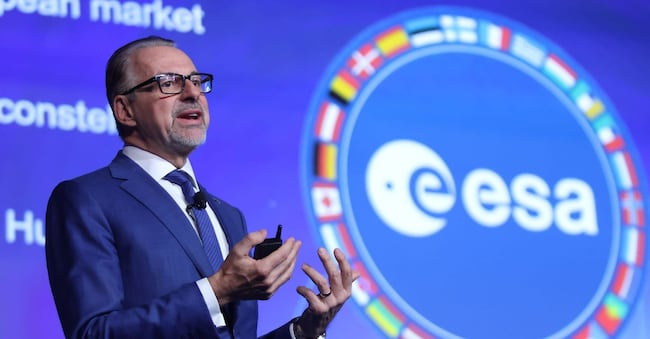
.Europe is still one of the leading players in this field, despite the fact that it is also lagging behind, as stated in the Draghi Report on the future of the European economy. Josef Aschbacher is director general of the European Space Agency, a body founded in 1975 and based in Paris. It has 2,200 employees and coordinates the work of 22 national bodies. Austrian, 62 years old, in an interview with Il Sole 24 Ore he touched on the most sensitive issues of a field that straddles science, economics and politics.
'During the Cold War,' says Josef Aschbacher, 'there was indeed cooperation with international partners, including Russia, because that was the will of the political leaders. Today the political situation has changed. From one day to the next, with the Russian invasion of Ukraine, the Twenty-Seven stopped all cooperation with Moscow, including the very use of the Sojuz rocket. 'This,' he continues, 'is the result of the current polarisation of geopolitics. Space is no exception, unfortunately'.
Esa currently has two rocket launchers. The first, a large one, is Ariane 6, launched into space for the first time on 9 July. Our interlocutor comments: 'If I look at the statistics, about 40 new launchers have been developed in the last 23 years. In 47% of the cases, the new rockets have failed on their first launch (...) Ariane 6 is an excellent launcher in terms of technology and engineering'. The second European rocket, on the other hand, is of medium size, is called Vega, is Italian, and was recently retired. It will soon be replaced by the more powerful and cheaper Vega C version, which will be launched tonight at 10.30pm Italian time, after a failed attempt in December 2022.


