Space economy

Space robots, the turning point will be the achievement of autonomy

The key step is to be able to make decisions without waiting for answers from Earth, which are likely to come too late

by Leopoldo Benacchio

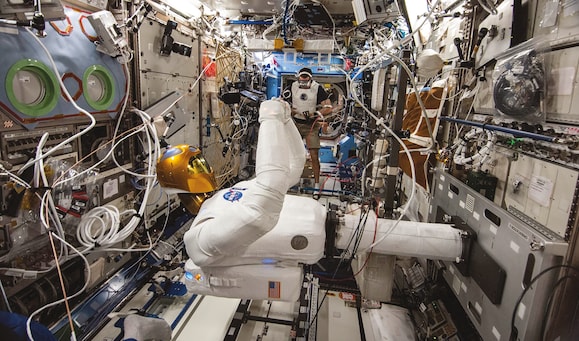
Robonaut 2 (R2) è un robot umanoide sviluppato da Nasa, il primo di questo tipo ad essere inviato sulla Stazione Spaziale Internazionale

4' min read

Translated by AI
Versione italiana

4' min read

Translated by AI
Versione italiana

'Oh, Adam, you will no longer have to work in sweat and you will return to Paradise [...] You will be free and supreme, you will have no work and no need to perfect your being [...]'. This is the wish that Karel Čapek, author of R.U.R., 1920, makes to us all in his science fiction book, in which he introduces for the first time 'robots', automatons working instead of workers.

Today, they surround us and serve us well, from cleaning and scrubbing floors, to helping in the operating theatre, where scalpels and scissors are now tools of the past, to exoskeletons and even the amazing humanoid robots, as well as those used in the military.

Loading...

Now we await an expected marriage, even with some trepidation, from which we expect great results: the grafting of increasingly high-performance Artificial Intelligence into the robots themselves.

On Earth we see the development of these technologies, but it must be said that space is certainly the environment where there is an absolute need for robots and where we can also find excellent solutions to be transferred back to 'terrestrial' robots.

Robot builders on the Moon

Per le imprese spaziali, e i programmi futuri, la nostra attenzione si posa sugli astronauti, se però pensiamo al ritorno alla Luna, impresa appassionante, allora parliamo soprattutto di robot, ottimi esecutori che non sono sensibili, come noi, alle radiazioni cosmiche e agli sciami di particelle. Robot costruiranno le prime case rifugio per gli astronauti e i primi laboratori, ricavando mattoni dalla regolite e dalla polvere lunare, strade per permettere i movimenti ai rover, che a loro volta sono robot con le ruote, e anche scenderanno nelle cavità dei crateri lunari del Polo Sud del nostro satellite, per capire se e quanto ghiaccio di acqua ci sia e se ci siano tunnel in cui gli astronauti possano rifugiarsi. E ci fermiamo qui perché stiamo sbordando su un altro importante tema. Marte, non ci si pensa mai ma è l’unico pianeta, per quanto se ne sa, popolato solo di robot: attualmente ce ne sono una decina fra attivi e no, americani e cinesi, che sopravvivono alla radiazione e alla terribile polvere ma

Space robotics is therefore a must; robots are machines that can perfectly well operate beyond the atmosphere, where humans are weighed down by space suits, which are small spaceships and have to provide food, oxygen, hydration and other things; all things that robots do not need, while they can work 24/7.

The human is nice, but it is expensive and dangerous, and it is about changing the attitude towards robots: it is not just about delegating physical force, but also complex, dangerous, repetitive tasks. In perspective, they will do level jobs: space station maintenance, lunar or asteroid mining, to name but a couple of tasks. The point is to build an equal team, with robots as strategic partners, a collaborative balance to be sought.

Robotics reduces costs, requires less care than for humans, and increases efficiency. Shapes and sizes as well as attitudes of space robots are of many different types, dictated by the task they have to perform: we have mechanical arms, smart spheres, real satellites, rovers that walk, photograph, dig, and analyse with their real physical chemistry laboratories. On the side are humanoids, increasingly present and appreciated as real metal astronauts.

What is the role of humanoids?

The first one generally mentioned is the Canadarm 1, 1981, a formidable large robotic arm that helped astronauts on the International Space Station, Iss, to dock arriving shuttles and also carry out repairs outside.

The turning point for space robots lies in the transition from teleoperation to autonomy. In the space field, this is a fundamental requirement; think of the fact that a communication signal from the Moon to the Earth, and vice versa, takes two seconds. It may seem a few, but it can be an eternity in the case of imminent danger looming. Let's not talk about Mars then, where a signal, round trip, takes from 8 to 40 minutes, depending on the mutual position of the planets.

For this, lunar or Martian robots must have autonomous navigation, be able to plan safe routes, recognise shapes, do mapping, recognise the geology they walk on, and have self-diagnosis and repair capabilities. These are all indispensable qualities, in which the help of AI is crucial.

The importance of the humanoid robots, initially used by NASA in the ISS as an artificial astronaut with only a torso, is growing. Robonaut, the name given to the experience, however, in 2013 had everything it needed to perform the same gestures as a component of the ISS in the flesh. It has been shown that human features, unnecessary in many other cases, are fundamental in orbiting stations, such as the one that will be built around the Moon, because in this way the robots can move easily in environments designed for humans and also operate with great precision in pressing buttons, turning switches, lifting levers. So much so that to bring the resemblance to 100%, the new robonauts have also been equipped with legs.

Landfall

From experiences in space, know-how spills over to Earth, where we find humanoids in the most diverse tasks: caring for the elderly and those with disabilities, through to collaboration in industry, monitoring and support in the health sector, and even search and rescue tasks.

Copyright reserved ©
Loading...

Brand connect

Loading...

Newsletter

Notizie e approfondimenti sugli avvenimenti politici, economici e finanziari.

Iscriviti