Science

Space: the US and China are vying for the lunar ‘clock’

Beijing has completed a map of the Earth’s natural satellite. But who will decide how time is measured on the Moon?

Pechino. Resa pubblica la carta della Luna più aggiornata e precisa mai prodotta

4' min read

Translated by AI
Versione italiana

4' min read

Translated by AI
Versione italiana

Artemis, NASA’s programme for a sustained return to the Moon, is progressing, albeit in fits and starts, and is receiving a great deal of attention from the Western media. China’s equivalent programme is receiving far less attention, but has been proceeding steadily so far.

What is regolith?

Following the successes of previous lunar missions, including those to the far side of the Moon, the Chinese are pressing ahead with two further missions: Chang’e 7 and Chang’e 8. The first, likely to be launched next year, will study the south pole using a lander – a self-propelled vehicle designed to confirm the crucial presence of water in the craters. Chang’e 8 will follow in 2029 and will complement the previous mission to understand what can actually be done with lunar resources, primarily regolith.

Loading...

The idea is, in fact, to use that grey, extremely fine, highly abrasive and electrostatically charged dust that covers the Moon to build structures and roads. It seems only right to assess whether this is actually feasible or not. Furthermore, Chang’e 8 will carry scientific payloads from the nations participating in the Chinese lunar programme, including a Pakistani rover weighing around 30 kilograms, for terrain mapping and the chemical and physical analysis of the regolith.

With this move, Beijing has confirmed its intention to reach the South Pole of the Moon by 2030 and to establish its own international space station between 2035 and 2040.

The lunar map

Going to the Moon to stay there, however, is quite a different matter from sending a rover there – which is already quite a feat in itself. That is why the CNSA, the Dragon’s Space Agency, is working hard behind the scenes, without too much publicity or press conferences. Three major initiatives are on the table: the most up-to-date and accurate map of the Moon ever produced has been made public; a constellation of 30 CubeSats will be launched into the cislunar region to understand what happens in the environment between the Earth and the Moon and beyond; and finally, China wants to be the one to establish ‘lunar time’, a task in which it has a clear advantage over the US.

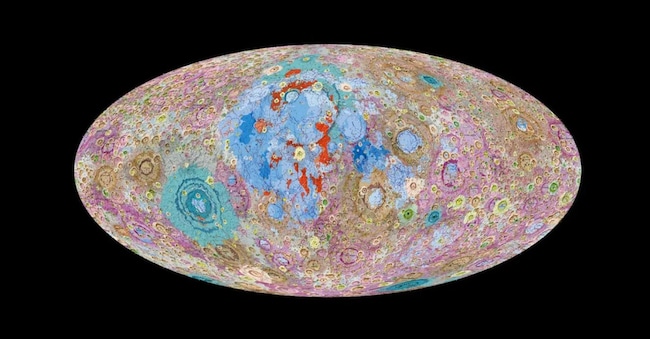
In short, that country, together with its space allies, seems to be saying: if I’m going somewhere, I need a well-drawn map, to know what the weather will be like, and to have a good watch, given that time passes differently on the Moon than on Earth due to the effects of relativity. China has unveiled a global geological map of the Moon, 2.8 metres long and 1.2 metres high, on a scale of 1:5 million. Produced over four years by institutes of the Chinese Academy of Geological Sciences, the Chinese Academy of Sciences and various universities, it catalogues 13,519 craters, 81 large basins, 14 categories of structures and 17 types of rock, with sections dedicated to the poles.

It is not simply a summary of the atlas already published in 2024: it combines images and remote-sensing data from the Chang’e probes with in situ measurements and analyses of samples brought back from both the near side and the far side of the Moon by Chang’e-5 and Chang’e-6. Harmonising data obtained from instruments with different resolutions and spectral signatures required specific algorithms and manual checks. The map also updates the lunar chronology: the basalt samples show that volcanic activity continued until around two billion years ago. The colours have scientific significance: light colours for young terrain, purple-red for older terrain, and blue for the basalts of the lunar seas. The symbols and legend set a new Chinese standard for planetary cartography.

Orbit tracking

Beijing has since launched the C3 programme, a constellation of 30 CubeSats, each weighing less than 30 kilograms, which are expected to monitor the cislunar space – from low Earth orbit up to two million kilometres – by 2030. The mini-satellites will track space weather and gamma-ray bursts, pinpointing their locations with an accuracy of less than one arcsecond. The project, which is open to international cooperation, aims to replace sporadic observations with continuous monitoring, which will be useful for research and, above all, for the safety of future human missions.

What time is it on the Moon?

Finally, there is the issue of time. On the Moon, atomic clocks run about 56 microseconds faster per day than on Earth, due to the difference in gravity. That may not seem like much, but for a positioning system, a deviation of just one microsecond can result in positioning errors of hundreds of metres: a risk for landers, rovers, astronauts and navigation networks. NASA is developing a Coordinated Lunar Time for LunaNet; China, which has the Queqiao relay satellite orbiting the far side of the Moon, is planning its own navigation network.

The contest between Washington and Beijing is therefore not just about who will be the first to return to the Moon, but about who will set the standards for communication, navigation and safe operations in the new cislunar space. Whoever wins will have an obvious operational and, above all, industrial advantage.

Copyright reserved ©

Brand connect

Loading...

Newsletter

Notizie e approfondimenti sugli avvenimenti politici, economici e finanziari.

Iscriviti