Space

SpaceX, 15 billion bet on Starship to dominate the space economy

SpaceX has invested over $15 billion in the development of Starship, the rocket designed to support the growth of Starlink and future lunar and Mars missions

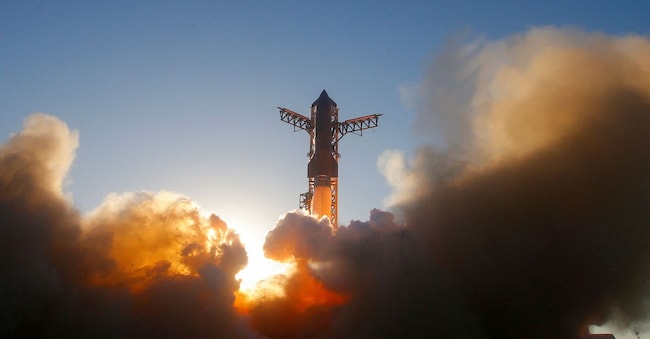
Un booster Super Heavy di SpaceX che trasporta il veicolo spaziale Starship decolla durante l’undicesimo volo di prova dalla rampa di lancio dell’azienda a Starbase, Texas, Stati Uniti, il 13 ottobre 2025. REUTERS/Steve Nesius/File Photo REUTERS

2' min read

Translated by AI
Versione italiana

2' min read

Translated by AI
Versione italiana

The space race targeted SpaceX enters a decisive phase. According to documents for the future listing viewed by Reuters, Elon Musk's company has invested more than $15 billion in the development of Starship, the next-generation rocket destined to redefine access to orbit and beyond. A figure that far exceeds the approximately 400 million spent on the Falcon 9, the reusable launcher that now underpins the company's commercial leadership.

Starship represents the strategic pivot on which rests a valuation that could reach USD 1,750 billion in the run-up to landing. The system, more than 120 metres high and fully reusable in intention, is designed to carry much larger loads: up to 60 next-generation Starlink satellites per single launch, as opposed to about two dozen at present.

Loading...

The link with the Starlink constellation is crucial. Indeed, the group's profitability depends on the ability to drastically increase the frequency of launches and reduce costs per satellite. The stated goal is to begin launches of the V3 version of the satellites as early as the second half of 2026, taking advantage of Starship's increased capacity.

Investments

In 2025 alone, SpaceX has earmarked $3 billion for research and development in the space segment, entirely dedicated to Starship. A significant acceleration from the previous year's 1.8 billion, reflecting the complexity of an unprecedented project.

Since 2023, there have been 11 flight tests, alternating between spectacular progress and explosive failures. Among the most notable achievements is the capture of the Super Heavy booster by mechanical booms on re-entry, a solution designed to make re-usability faster and more efficient.

However, the main challenge remains: turning these successes into repeatable large-scale operations. According to industry analysts, the real test will be the ability to sustain hundreds, if not thousands, of launches annually. A pace necessary to realise Musk's vision of a network of solar-powered computing satellites as an alternative to terrestrial data centres.

Infrastructures

The constraints are not only technological but also infrastructural. A single launch requires huge amounts of resources: the equivalent of 244 tankers of natural gas and about a million gallons of water to mitigate acoustic vibrations. Scaling these demands to industrial levels raises questions about operational sustainability.

Also among the most complex obstacles is in-orbit refuelling, a procedure that has never been demonstrated involving the transfer of fuel between Starship vehicles in space. Technologically crucial for lunar and Martian missions, but still highly risky.

Starbase

In South Texas, the Starbase site has become the production heart of the programme. Here SpaceX is trying to apply industrial logic similar to that of commercial aviation, aiming for serial production of rockets.

An approach that entails risks: frequent design changes, due to testing, impose continuous adaptations even to production facilities.

The next stage will be the debut of the V3 version of Starship, described by engineers as a completely redesigned project. Its success will also be crucial for NASA's Artemis lunar programme, which has already awarded SpaceX over $3 billion for the development of the human lander.

Copyright reserved ©
Loading...

Brand connect

Loading...

Newsletter

Notizie e approfondimenti sugli avvenimenti politici, economici e finanziari.

Iscriviti