Space

SpaceX rocket crashes into the Moon at 8,700 km/h

A SpaceX rocket, 12 metres long and weighing 4,500 kg, crashed onto the Moon, forming a 27-metre crater

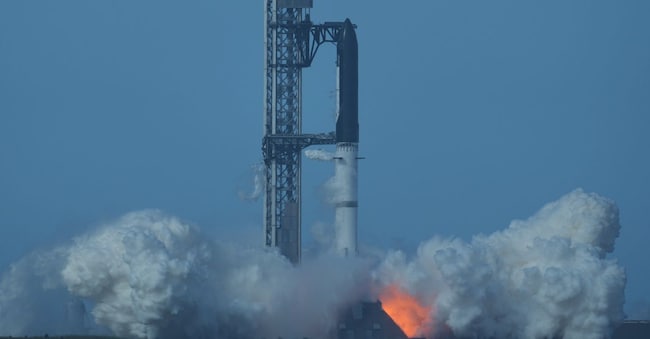
Un mega-razzo Starship di SpaceX inizia il decollo - poi fermato - a Starbase, in Texas, giovedì 16 luglio 2026. (AP Photo/Eric Gay)     Associated Press / LaPresse Solo Italia e Spagna APN

2' min read

Translated by AI
Versione italiana

2' min read

Translated by AI
Versione italiana

A SpaceX Falcon 9 rocket, 12 metres long and weighing 4,500 kg, crashed onto the Moon.

Scientists have stated that the rocket’s speed at the moment of impact was approximately 8,700 km/h and that it created a new crater (estimated at 27 metres) near the Moon’s illuminated edges.

Loading...

The force of the collision was equivalent to the energy released by the explosion of approximately 3 tonnes of TNT.

SpaceX has emphasised that this was an accidental impact.

The BBC has reported that scientists have confirmed that the rocket struck the Moon, but are awaiting definitive confirmation from data provided by the US space agency’s telescopes.

The lunar soil belongs to humanity

This was an unplanned incident which highlights the need to establish international regulations to prevent such situations, which could pose a danger to future bases.

 ““The impact of the object – the upper stage of a Falcon 9 rocket that had carried out two missions to the Moon – is the result of a combination of factors,” Alessandra Celletti of the University of Rome Tor Vergata told ANSA.

 The main cause was SpaceX’s decision to abandon the rocket stage used to send the Blue Ghost and Resilience landers – both privately owned and launched on 15 January 2025 – to the lunar surface.

A launch that used up all the fuel on the rocket, a decision which meant sacrificing the possibility of a final engine reignition to move the rocket into a re-entry orbit towards Earth and allow it to burn up in the atmosphere.

The trajectory of the out-of-control module was ultimately determined by the complex interaction between the Earth’s and Moon’s gravitational fields and the intense solar activity of recent years.

Loading...

“An incident that highlights a legislative loophole,” added Celletti – “because although there is a space treaty dating from the late 1960s, there is no law governing liability for the fall, as in this case, of satellite debris onto the lunar surface, which is a surface that belongs to humanity”.

The impact sent up a huge amount of dust and debris, which was also observed by telescopes.

“It is also an important opportunity for our new project called Space Math, which focuses on space mathematics”.

 “We know, in fact,” concluded Celletti, “that unlike the Earth, the Moon has a highly non-uniform gravitational field, a phenomenon caused by significant variations in the subsurface. Studying how debris and dust will move – some of which could remain in orbit for centuries or even millennia – will enable us to gain a better understanding of the interior of our satellite.”

Copyright reserved ©
Loading...

Brand connect

Loading...

Newsletter

Notizie e approfondimenti sugli avvenimenti politici, economici e finanziari.

Iscriviti