2026 World Cup

Spain 1–0 Argentina after extra time: La Roja win the World Cup

At MetLife Stadium, Spain beat Argentina in a lacklustre final, dominated by tension and fatigue. Ferran Torres scored the decisive goal in the 106th minute

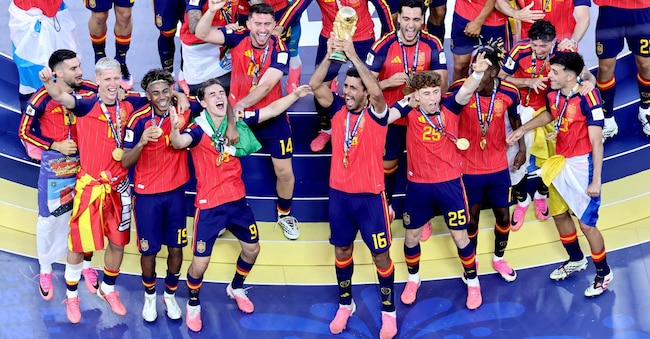
epa13121769 Il capitano della Spagna Rodri solleva il trofeo mentre la squadra festeggia la vittoria nella finale della Coppa del Mondo FIFA 2026 tra Spagna e Argentina, nel New Jersey, Stati Uniti, il 19 luglio 2026. La Spagna ha vinto per 1-0.  EPA/RONALD WITTEK EPA

4' min read

Translated by AI
Versione italiana

4' min read

Translated by AI
Versione italiana

Spain have been crowned world champions for the second time in their history, beating Argentina 1–0 after extra time in the 2026 World Cup final. A goal by Ferran Torres in the 106th minute decided a long, tense and often lacklustre match – the only truly decisive moment in a contest marked by the fatigue accumulated over a month of competition.

Match report

In front of over 80,000 spectators at MetLife Stadium, the two teams took to the pitch with the intensity typical of a World Cup final, but from the very first minutes it was clear that they were not at their best. Spain maintained control of possession, as is their tradition, whilst Argentina preferred to sit back and look to counter-attack.

Loading...

The first half was characterised more by tension than by chances. Argentina focused on controlling the game and were often forced to chase the ball as their opponents passed it around: Lisandro Martínez was booked in the 40th minute.

The pattern remained the same in the second half. La Roja continued to control possession but struggled to create any real threat in the final third. Argentina defended well as a unit, with Emiliano Martínez making a number of decisive saves to keep the score at 0–0.

In the second half, Leandro Paredes and Cristian Romero were both booked (90’), a sign of growing nervousness within the Albiceleste squad. But above all, the booking for Enzo Fernández – who had already been booked – who, in the 82nd minute, picked up a second yellow card for a challenge on the edge of the box on Cubarsì, leaving his side down to ten men ahead of extra time.

The winning goal

The moment that decided the World Cup came in the second half of extra time. In the 106th minute, following a move down the left, Nico Williams played a precise ball into the box for Ferran Torres, who, from close range, unleashed a powerful left-footed shot under the crossbar to beat Emiliano Martínez and make it 1–0. It was the moment that finally tipped the balance in the final.

Argentina attempted a response that was more spirited than clinical, but fatigue limited their ability to create clear-cut chances. In the closing stages, the Albiceleste’s frustration became even more apparent, culminating in another booking for Alexis Mac Allister in the 111th minute. After more than two hours of battle, the final whistle handed the World Cup to Spain.

A well-deserved victory

It was not a final destined to go down in history for its technical quality. Both teams appeared to be worn down by an extremely long tournament and an extremely demanding fixture list. The pace was often slow, decisive moments were few and far between, and there were more technical errors than expected.

Argentina gave the impression of having reached the final without showing much attacking flair. They defended bravely and relied mainly on Emiliano Martínez’s saves, but created too little up front to have any real hope of winning the title.

Spain, despite putting in a performance that was anything but memorable, were the side who pushed hardest for the win. They controlled possession, consistently occupied the opposition’s half and created the most dangerous chances. They did not shine, but they showed more initiative and composure than Argentina at the decisive moments.

Spain’s journey

Luis De La Fuente’s team have built their World Cup campaign with great consistency. After topping their group, La Roja overcame a series of top-class opponents in the knockout stages. In the round of 16, they knocked out Austria, before defeating Portugal in the quarter-finals and Belgium in the semi-finals, before comfortably beating France 2–0 in the final match to secure their place in the final.

The penalty scored by Mikel Oyarzabal and Pedro Porro’s goal proved decisive against the French, enabling the Spanish side to reach the World Cup final and secure a title they had not won since their triumph in 2010.

The honours lists of the two national teams

Spain and Argentina went into the final match of the 2026 World Cup with a history rich in success and a footballing tradition that ranks among the most prestigious in the world.

Argentina were chasing their fourth World Cup title following their triumphs in 1978, 1986 and 2022. The Albiceleste, the reigning world champions, were aiming to retain their place at the pinnacle of world football and join Italia and Germany on the roll of honour with four World Cup titles.

Spain, on the other hand, were aiming for their second World Cup title following their historic victory in South Africa in 2010, when the generation of Casillas, Xavi, Iniesta and Villa won La Roja’s first World Cup.

At continental level, too, both teams boast an impressive list of honours. Argentina have won 16 Copa América titles, an all-time record for the competition, whilst Spain are the most successful national side in the history of the European Championships, with four titles (1964, 2008, 2012 and 2024).

Financial awards

The total prize money allocated by FIFA for the 2026 World Cup is 871 million dollars. Spain will receive 50 million dollars (around 43 million euros), whilst Argentina will receive 33 million dollars (around 28 million euros). England, who finished third, received $29 million, and France, who finished fourth, received $27 million.

Copyright reserved ©
Loading...

Brand connect

Loading...

Newsletter

Notizie e approfondimenti sugli avvenimenti politici, economici e finanziari.

Iscriviti

Tutto mercato WEB