
Spain weathering global crises: ‘GDP set to grow by 2.6% in 2026’
The Madrid government has revised its economic forecasts upwards: ‘Consumption and investment are doing well’. Growth is much stronger than in the Eurozone. And unemployment is falling

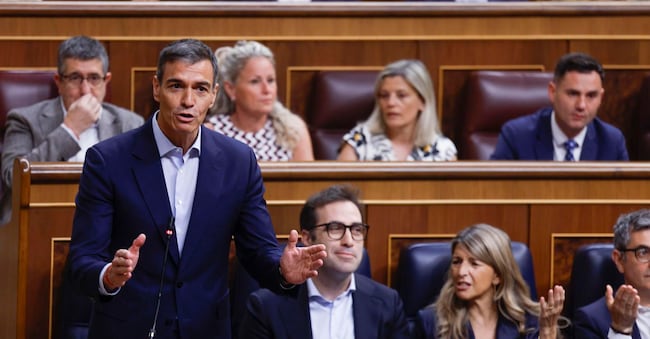
Pedro Sánchez’s government has raised its growth forecasts for the Spanish economy this year (and for the next two years), whilst also improving its forecasts for employment and the budget deficit. Spain is weathering and responding to international tensions – from US tariffs to the energy crisis caused by the wars in Ukraine and Iran – far better than other major European economies. Meanwhile, buoyed by these indisputable economic achievements, Sánchez is attempting to divert attention from the corruption scandals that, in recent months, have implicated the Socialist Party and even his own family.
The government forecasts that the Spanish economy will grow by 2.6 per cent this year (up from the previous forecast of 2.2 per cent): a figure significantly higher than that of countries such as Germany, Italia and France, which are struggling to achieve 1 per cent growth in gross domestic product. “Growth is essentially driven by robust consumption and investment over the period 2026–2029,” explained Economy Minister Carlos Cuerpo. “All of this,” he added, “is further supported, on the supply side, by an improvement in employment and an increase in hourly productivity.”
Madrid has also revised its growth forecast for 2027 upwards, raising it from 2.1% to 2.2%, and has stated that growth will remain above 2% until 2029. Cuerpo said that GDP growth in the second quarter of this year will be similar to or slightly higher than that of the first quarter (which stood at 0.6% quarter-on-quarter and 2.7% year-on-year compared with the same period in 2025).
This is the macroeconomic context on which the government should base the General State Budget for 2027. Over the last three years, the ruling left-wing coalition has been unable to present new draft budgets due to a lack of support in a highly fragmented Parliament, and has merely re-tabled the 2023 budget.
Sánchez and his ministers are sticking to more optimistic forecasts than those of other institutions, such as the Bank of Spain, which forecasts growth of 2.3 per cent for this year, or the OECD, which recently raised its estimates for Spain slightly, forecasting growth of 2.2 per cent for this year. The government emphasises ‘the strength of the economy and the policies which, for years – particularly on immigration and renewable energy sources – have enabled Spain to gain strength and autonomy’.


