
Speed cameras: 6 out of 10 devices at risk. But it is a clash over numbers
Back-and-forth between the Ministry of Infrastructure and the Association of Italian Municipalities on speed detection devices. The MIT: complete the tracking; the ANCI: data already available. Porta Pia's rejoinder: unclear data

4' min read
4' min read
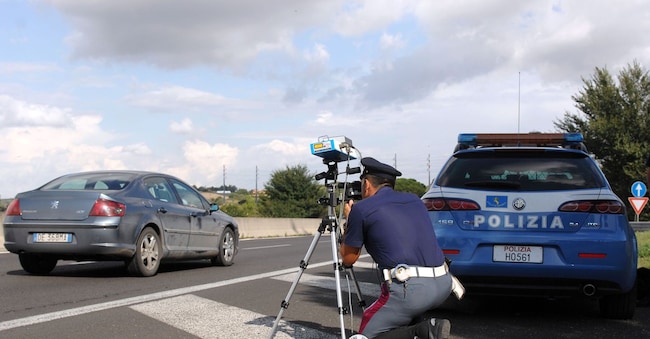
Six out of ten speed cameras risk being switched off if the draft decree prepared by the Ministry of Infrastructure led by Matteo Salvini and frozen a few weeks ago were to reach port. The alarm can be read against the numbers of the Anci after the Porta Pia ministry in the press urged the tracking asked of local authorities in recent days. On which, in the last few hours, there has been an intense back-and-forth between the MIT and the association representing Italian municipalities. But let us go in order.
According to the data provided by the president and mayor of Naples Gaetano Manfredi, "an initial reading of the data, net of a few cases of supplementary or extensive decrees, shows that for fixed devices about 59.4% have approval decrees prior to 2017 and 40.6% after 2017, while for mobile devices the data shows 67.2% have approval decrees prior to 2017 and 32.8% after 2017, and on the technical details of which the Anci offices remain available for any further study and discussion".
The impact
.But what do these figures imply? In order to grasp the meaning of the numbers provided by Anci, we need to take a step back and retrieve that provision on speed cameras that prepared by the MIT had already taken the road to the European Commission as provided for by the Tris procedure before being frozen. And in particular Article 6, which states: 'The devices or systems approved in accordance with the provisions of the Decree of the Minister of Infrastructure and Transport of 13 June 2017, no. 282, being compliant with the provisions of the technical annex, are to be considered approved ex officio'. And the others? "All the others will have to follow a peremptory procedure with the deactivation until the completion of the same, which provide that the holder of the approval of a device or system approved before the entry into force of the decree can apply for approval by supplementing the documentation, submitted at the time of the approval, within the deadline of six months from the entry into force of the decree." Superimposing Anci's numbers on the potentially approved rules would mean that almost 60 per cent of the fixed devices would have to be switched off, 'only the company could apply for homologation with long technical timescales, however, at the Ministry,' explains Altamura, commander of the Verona Municipal Police and member of the Coordination Table on Road and Urban Safety at Anci. For mobile devices, the percentage increases to almost 70% of the devices in circulation. So what to do? Altamura reiterates the call to sit around a table again, as has already been done in the past: 'The decree has been suspended, Anci is communicating the data, do we want to go back to a technical table or get hundreds of speed control devices out of the way? - he concludes. High speed is the cause of serious and very serious accidents and we have to use the available devices as correctly as possible'.
Jurisprudence
But not only that. Altamura also points out that after the many interventions of the Supreme Court of Cassation, the last of which just over a month ago (judgement 10365/2025 deposited on 14 March) in which it was reiterated that the approval of devices is separate from the approval and is also indispensable for imposing fines, 'there has been no wave of thousands of appeals in the various cities and indeed, we have cities where justices of the peace and courts are giving the local police the right answer' confirming the legitimacy of fines. Altamura emphasises this several times: 'We are the ones who want order and guarantees, we are on the side of legality'.
The bang for the buck
.The repartee between Salvini and Anci was all in the press. "In the light of the recent rulings of the Court of Cassation on the approval and homologation requirements,' the minister wrote in a letter addressed to the Anci and anticipated in the press, 'ascertaining the number of devices actually used and the relevant approval regime is a necessary condition and an indefectible prerequisite for being able to restart the procedure for the adoption of the interministerial decree on the rules for their approval. The reply from the municipalities, however, was not long in coming. "The Anci has already carried out a survey of the devices and related prototypes approved by the Ministry of Infrastructure and Transport pre2017, in order to have available a representative sample of data from Italian municipalities, distinguishing between territorial specificities and fixed and mobile remote speed control devices,' Manfredi concluded. A few hours later came the ministry's rejoinder: 'In thanking Anci for the preliminary data provided on the presence of fixed and mobile devices attributable to the pre- and post-2017 approval decrees, what the Ministry of Infrastructure and Transport would like is not a percentage but a clear and unequivocal number,' Salvini's department replied in a note. "How many speed cameras are there and where are they installed? Minister Matteo Salvini called for a real census of the devices installed on a national, regional and local basis, in relation to the different approval regimes'. Because, the communiqué continues, 'iin the absence of a complete and detailed statistical picture, it is difficult to understand how to intervene in a concrete and reasonable manner to prevent incorrect driving behaviour'. Ball in the middle.


