
The ‘sponge city’: when urban soil absorbs water, flooding is prevented before it reaches the drainage networks
A report by SHIFT maps Italian and European examples of nature-based solutions for stormwater management, such as rain gardens, bioswales and vegetated retention basins – technologies that are economically competitive with tarmac. Without stable funding and integrated governance, these remain mere experiments

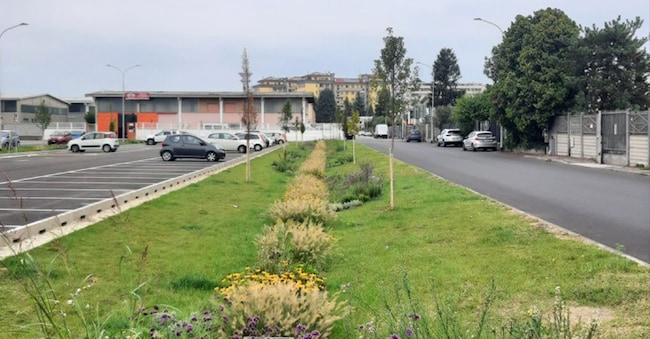
When it rains heavily in a city with an impermeable surface, the water has nowhere to go. Drain covers become blocked, sewers overflow, and streets turn into rivers. It is a long-standing problem, but climate change has made it a structural issue: heavy rainfall events are more frequent, more intense, and affect cities built for a climate that no longer exists. The traditional response is more pipes and more concrete; it is expensive, slow to implement and does not address the root cause: urban soil that has lost its ability to absorb water.
There is an alternative that is already in use, technically mature and, in many cases, more cost-effective than conventional infrastructure. It is called Sustainable Drainage Systems (SuDS) and is also known as the ‘sponge city’: a solution that treats rainwater not as waste to be disposed of as quickly as possible, but as a resource to be retained and, where possible, reused. Rain gardens, bioretention areas, permeable paving, vegetated retention basins and bioswales: these are features that restore the urban soil’s drainage capacity.
The second Climate Paper by SHIFT, an Italian climate policy think tank supported by the CAP Group, catalogues over twenty projects implemented in Italia and across Europe – from the Venice Lagoon to Barcelona, and from Milan to Paris – assessing their performance, costs and co-benefits. The picture that emerges is clear: ‘Nature-based Solutions (NBS) are already technically mature in many areas,’ the study states. ‘The constraint is not feasibility, but three recurring barriers: a knowledge gap, inadequate funding mechanisms and fragmented governance.’
The Milan case: 88 projects, 50 million, 32 local authorities
The most advanced initiative in Italia is the ‘Città Spugna’ programme run by the Metropolitan City of Milan: 88 projects spread across 32 municipalities, with €50 million in PNRR funding. The programme is transforming the Milanese hinterland into a system capable of absorbing, retaining and filtering rainwater within the area, thereby reducing dependence on the sewerage network. The projects combine bioretention areas, permeable paving, flood control basins, drainage trenches, wetlands and vegetated filters, regenerating around 530,000 square metres of urban space, with over 2,000 trees and 32,000 shrubs planted.
Two projects illustrate the variety of possible approaches. In Pieve Emanuele, tarmac car parks and public squares have been disconnected from the combined sewer system and fitted with bioretention areas that retain, treat and infiltrate rainwater: 14,393 square metres regenerated, an investment of approximately 909,000 euros, and over 5,700 plants planted. In Paderno Dugnano, an asphalted car park has been transformed into a park with permeable paving, a 140-metre vegetated channel and an infiltration basin: where the ground is permeable, NBS eliminate the inflow into the stormwater network, avoiding costly upgrades to the underground drainage system.


