Private equity

Sport, from football to basketball, fund investments continue to grow

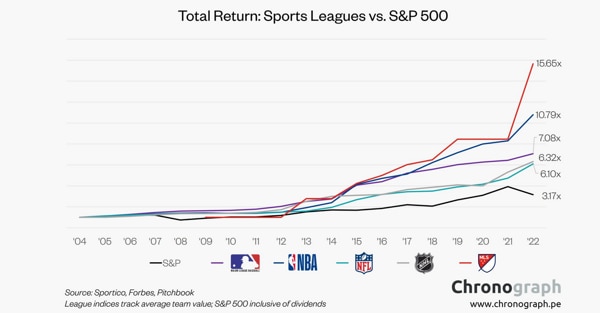
Returns on investments in the clubs of the major American leagues have far exceeded the returns of the S&P500 over the past 20 years

by Monica D'Ascenzo

4' min read

4' min read

Investments in sport are opening up new spaces for both private equity and venture capital funds. The latest news, in order of time, is the initiative of Morgan Stanley, which launched at the end of October a new investment portfolio linked to the major sports leagues, Parametric Custom Core Sports League Strategy, aimed at clients with substantial assets and sports fans. The new initiative will allow investors to invest in a select index of companies with strong sponsorship, media and advertising ties to major sports leagues, starting with a minimum investment of $250,000. The portfolio will consist of large-capitalisation US equities, selecting between 250 and 400 stocks of companies visible on the sidelines, in tickers or among the advertisers of major sporting events, replicating the risk characteristics of the S&P 500 index.

First was football

.

European football opened the world of sport to private equity investment in 2006, when Paris-Germain was bought by three US funds in the first sports deal of its kind. Since then, such deals in Europe's most popular sport have multiplied: today, more than a third, i.e. 33 out of 96, of European football clubs in the five biggest leagues have private equity, venture capital, sovereign wealth funds or private debt companies in their shareholder base.

Loading...

During 2023 alone, funds invested EUR 4.9 billion in the five biggest European football leagues, compared to only EUR 66.7 million in 2018. Thus, funds will hold stakes in 41.7 per cent of clubs in the 2024-2025 season, compared to 36.7 per cent two seasons ago. Football institutions are trying to develop rules on fund ownership, but they lag behind other federations such as the US Nfl.

"Minor" sports

.

While it is undoubtedly true that football remains at the top of the sports investment list, even for US closed-end funds, it is also true that sports defined as 'minor' are beginning to benefit from the growing trend in the sector. Thus, in recent years, lesser-known sports such as padel and volleyball have begun to attract the interest of investors.

Niche sports are characterised by passionate fan bases, albeit numerically smaller than those of football at least in Europe, and interesting future growth potential. Sport, on the other hand, is according to analysts at the intersection of two interesting vectors for investors: live events and intellectual property.
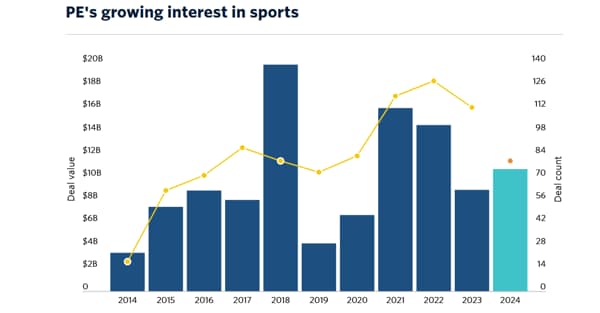
The concomitance, therefore, of several factors, including the visibility of team sports offered by the Olympics, has led private equity funds to almost double their investments in the sector over the past decade, with over $10 billion invested in the first nine months of 2024, according to PitchBook data.

Investimenti dei private equity nei club sportivi

Andamento del numero di operazioni e degli ammontari

Fonte PitchBook

The search for investment opportunities in sport led, for example, Cvc Capital Partners to invest USD 300 million in the International Volleyball Federation in 2021, contributing to the creation of Volleyball World. The new capital allowed for the introduction of new competitions, such as the Volleyball Nations League (VNL), which in turn further boosted volleyball's popularity to the extent that participation in the VNL in 2024 increased by 13% compared to 2023 and 33% compared to 2022, reaching a total of 751,000 spectators. In addition, Volleyball World TV recorded a 21% increase in live viewing and a record 103% growth in viewing of the women's finals.

The transition from football to the padel now seems natural for many former players. The same thing is happening in investments. Qatar Sports Investments acquired, for example, the World Padel Tour from its organisers, Damm, in 2023, unifying the professional padel circuit under the new name Premier Padel, now regulated by the International Padel Federation. MCH Private Equity has also invested in the sport through its Spain Oman Private Equity Fund, financing All For Padel, an Adidas-licensed equipment brand.

The US example

.

David Rubenstein, co-founder of Carlyle and co-owner of the Baltimore Orioles, said of the potential for returns on investment in sports: 'It is very difficult to buy a sports team and lose money. This is probably true in the US and less so in Europe. Indeed, analysts have pointed out that sports teams did not see a slowdown in merchandising even during the pandemic. This allowed them to compensate for the losses in match admissions.

Comparing the returns of investments in sports clubs with the performance of the S&P500 over the past 20 years shows how the former have performed better than the latter. This has led to an increasing interest in closed-end funds. To date, the league with the largest private equity presence among team shareholders is undoubtedly the NBA, where 20 out of 30 teams have a link to funds. This is followed by the baseball league (MLB), where two-thirds of its teams are owned by funds. Major League Soccer has less investment to date due to the lower profile of football in the States, but it is also true that it has shown the highest returns in recent years.

Also playing a role in making the investment attractive is the fact that the number of clubs is limited. In the US there are only 153 major league sports franchises, counting MLB, NHL, Nfl, NBA and mls. If one then takes into account that many properties do not vary for decades, one understands how individual transactions often take place at very high multiples. Moreover, the sports sector, analysts note, operates as an effective monopoly, because strict rules limit new entries and leagues control media revenues, merchandise sales, sponsorships and athletes' salaries.

Not to mention the streaming rights of matches. Today, media rights tend to offer the most lucrative value creation lever within sports investments for private equity, contributing around 40-60% of individual league revenues. Rights for which competition is constantly growing as a result of new players entering the market. Amazon, for example, became the first streaming service to win a series of sports rights exclusives, securing the streaming rights for Thursday Night Football in a deal expiring 2033 for 1 billion per year. It is expected that the Nfl alone will generate $10 billion per year in media rights revenue from 2023 to 2033, and in 2022, the 'Big Ten' (college football's oldest conference for non-American readers) secured a seven-year $7 billion media rights deal with Fox, CBS, and Nbc. These are constant streams of recurring revenues that ensure the stability of budgets in the medium and long term. A detail that does not escape the due diligence of closed-end funds.


Copyright reserved ©
Loading...

Brand connect

Loading...

Newsletter

Notizie e approfondimenti sugli avvenimenti politici, economici e finanziari.

Iscriviti