Private equity

Investments in sports teams have higher returns than the S&P500

The Nba has a total return of 2,088.9% from 2014 to 2024, compared to 687.3% for the stock market index


by Monica D'Ascenzo

2HJ7X60 Brooklyn Nets guard James Harden (13) shoot the ball during an NBA basketball game against the LA Clippers, Monday, Dec. 27, 2021, in Los Angeles. The

6' min read

6' min read

The average value of an Nfl franchise in 2024 was $5.7 billion, up from $1.2 billion in 2013. If the pace of growth remained constant, this could reach a potential value of an American football team of over $27 billion by 2035, according to a Pwc report. This example is enough to give the scale of how investment in sports teams in the United States is gradually attracting the attention of more sophisticated investors. Only a decade ago, in fact, the teams of major American sports were predominantly fought over by wealthy local families. In recent years, however, an important player has been taking an increasingly prominent position: this is private equity, also thanks to the change in the regulations of the major US leagues, which have opened up to closed-end funds, albeit with various limitations on the stakes they can acquire in individual teams. Today 74 major North American sports teams, with a total value of $229.1 billion, have investments or financing from closed-end funds.

Fund capital has certainly acted as an accelerator for the growth in value, so much so that all the major US leagues (Nfl, Nba, Mlb, Nhl) show a total return (measured by the average value of the teams each year) well above that of the S&P 500 (naturally taking into account dividends distributed) over the last 10 years. The basketball league (Nba) stands out with a return of 2,088.9% from 2014 to 2024, although in terms of team value the average is $4.66 billion, according to official valuations. A figure that places the league between the average value of a National Football League (Nfl) team, at $6.49 billion, and that of an average National Hockey League (Nhl) franchise, estimated at $1.92 billion. There is no shortage, however, of teams that far exceed the average such as the Golden State Warriors (with a record $9.4 billion), the New York Knicks ($7.5 billion), the Los Angeles Lakers ($7 billion), the Chicago Bulls ($5.8 billion) and the Houston Rockets ($5.7 billion).

Loading...

IL RITORNO IN 10 ANNI

Loading...

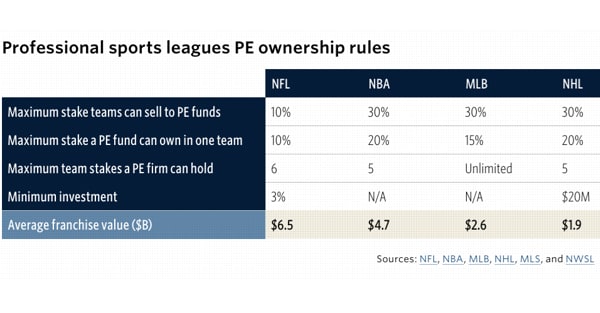
In PitchBook's ranking of total returns over the past decade, the Nfl ranks second with 1,220.4%, followed by the NHL (1,170.9%) and the MLB (907.3%). Over the same period, the S&P 500 boasts a total return of 687.3%. The steady increase in sports franchise valuations is driven primarily by two recurring events that occur roughly every five to ten years: media rights contract renewals and collective bargaining agreements, PitchBook analysts note. But what actually ensures the value growth of teams is the loyalty of fans who do not hesitate to spend on match streaming subscriptions, stadium tickets and merchandising. Funds have been able to seize the opportunities as the leagues' rules change, most of which have capped the stakes private equity can hold at 30%.
Funds dedicated to sport

.

Private equity firms are allocating increasing amounts of capital to the sports, media and entertainment sectors. In the US, among the first to structure was Ares Management, which closed a $3.7 billion fund dedicated exclusively to this sector in the second half of 2022. Ares is also in the process of launching a new semi-liquid product focused on sports, media and entertainment, with monthly subscriptions, in order to expand access to this type of market to investors who need more liquid assets.

In April last year, Arctos Sports Partners closed its second fund with more than $4.1 billion for strategic investments within the sports industry. In May 2024, it was the turn of RedBird Capital Partners with its fourth $3.3 billion fund, dedicated to sports, media and financial services. There is also no shortage of funds from the venture capital industry: Bluestone Equity Partners, for example, closed its first growth equity fund in the first quarter of 2023, raising USD 300 million.

The landscape is becoming so desirable that even larger giants have decided to move in this direction: among them Sixth Street, with around $75 billion under management, which recently announced its intention to launch its first fund entirely dedicated to sports investments. Sixth Street is not new to the sector: in addition to having acquired a National Women's Soccer League (NWSL) team from the San Francisco area, in 2021 it participated, together with a consortium led by Michael Dell, in the purchase of 20% of the San Antonio Spurs.

Recently, Tpg also announced the launch of Tpg Sports, a new platform dedicated to investment opportunities across the sports ecosystem, becoming the latest in a series of historic private equity managers to enter the sector. Other operators are instead adopting less conventional approaches. This is the case of Marc Lasry, former owner of the Milwaukee Bucks and ceo of Avenue Capital Group, who sold his stake in the team in 2023 to allow Avenue to raise a dedicated sports fund. Similarly, Harbinger Sports Partners, led by a consortium of industry insiders including former Dallas Mavericks owner Mark Cuban, launched a $750 million private equity fund to acquire minority stakes in professional teams.

Investments

.

Private equity transactions have been increasing in recent years, both through the acquisition of minority stakes and through direct investment by industry professionals. Among the most notable transactions, PitchBook points to the acquisition of the Washington Commanders by Apollo co-founder Josh Harris for $6.05 billion: at the time of the transaction two years ago, it was the highest amount ever paid for a sports team. To finance the purchase, Harris obtained capital from Arctos Sports Partners and Ares Management. However, Nfl rules do not allow direct financing from PE funds and limit debt to a maximum of $1.1 billion. As a result, Harris had to take out a loan from Bank of America to complete the transaction and then went on to restructure the company from an underdog team to a team capable of contending in the Superbowl finals.

In 2025, sports transactions in the States accelerated in March when the MLB's San Francisco Giants sold 10% of their franchise to Sixth Street for an undisclosed sum. The proceeds will be used to redevelop the stadium and surrounding real estate development. This is not the first time that the Giants have opened the door to private equity capital, since Arctos is already present in the shareholder structure with a minority stake.

In the same week, the Boston Celtics of the NBA were also the subject of a historic transaction: sold to William Chisholm, co-founder and managing partner of Stg Partners, for $6.1 billion, a new record for a North American professional sports team. The structure of the deal involves two phases: the immediate acquisition of the majority stake in the summer of 2025, valuing the team at $6.1 billion, followed by a second payment in the first quarter of 2028 that could push the valuation up to $7.3 billion, depending on the team's performance on the field. Sixth Street, which will participate in the deal by investing USD 1 billion, also peeps in.

Investments in women's teams

.

The number of franchises is limited, around 30 per league, and this leads to investor appetite to explore new markets, such as women's teams. In March 2024, the ever-present Sixth Street led a consortium of investors to acquire an Nwsl expansion team, the Bay Area's Bay FC, marking a turning point as the first financial institution to hold a controlling stake in a US professional team. The total investment, recalls PitchBook, was $125 million, including a $53 million expansion fee - a league record - and the cost of building a new training centre.

In the first quarter of 2024, Carlyle had entered the world of sports by acquiring, along with the Seattle Sounders FC team of the Mls, the Seattle Reign FC women's club for $56.3 million, well above the $3.5 million for which it had been sold just five years earlier. Then in January last year, Portland Thorns FC was taken over for $63 million by the Bhathal family, co-founders of Revitate, an investment platform and family office active in sports, real estate and consumer brands. The third major transaction in early 2024 saw Lauren Leichtman and her husband Arthur Levine, founding partners of Levine Leichtman Capital Partners, acquire another franchise (details in the next part of the analysis).

From deal to deal, today the 14 teams of the Women's Football League (Nwsl), thanks in part to recent acquisitions, have reached an aggregate valuation of $1.5 billion, a remarkable increase from just a few years ago, when franchises were sold for as little as $2 million each. This compares to an average Nwsl team value of $104.2 million today.

Copyright reserved ©
Loading...

Brand connect

Loading...

Newsletter

Notizie e approfondimenti sugli avvenimenti politici, economici e finanziari.

Iscriviti