
Spotify, the farewell of CEO Daniel Ek and what military drones have to do with it
The founder of the Swedish platform leaves the helm to deputies who 'do a great job'. But for months he has been challenged over investments in the German start-up Helsing

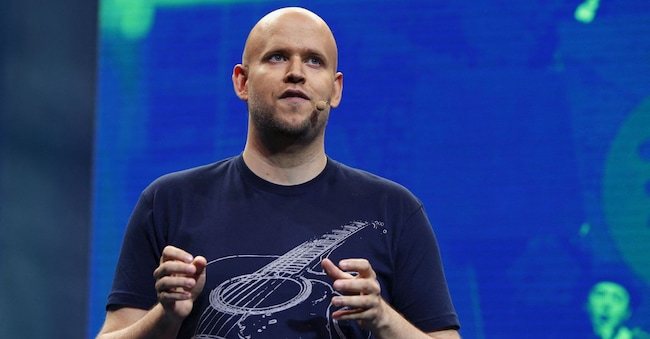
Sooner or later the day comes when the startupper 'comes of age', leaves the helm of his or her business, perhaps broadens the view to the business that revolves around his or her business, or, more banally, enjoys life. It happened in 2019 at Alphabet Google with Larry Page and Sergey Brin, in 2021 at Amazon with Jeff Bezos, it happens now at Spotify, the streaming platform that revolutionised the world-recording-market: also Daniel Ek, the Swedish music-loving former startupper who 19 years ago had an idea that not even Steve Jobs had come up with.
As of January 2026 he will no longer be ceo: in his place will be the current deputies Alex Norstroem and Gustav Soederstroem who, by his own admission, "are doing a great job", he will remain chairman of the board "European-style" and of course a shareholder. A move that is anything but expected, considering that Ek is just 42 years old, significantly younger than Page, Brin and Bezos, created the company, convinced the record majors that his, after the digital revolution, was the best possible service for conveying recorded music, listed his creature on Wall Street, positioned it in the podcast market and led it to the profit milestone.
Aside from his usual statements ('I have two sons but Spotfiy is like my third son and now it's like he's graduating,' he said), what could have prompted him to leave? Putting together the chronicles of the last few months, Daniel Ek's name often appears associated with Helsing, a German start-up that produces military drones used in the war in Ukraine. Through First Matter, the venture capital fund he founded in 2020 with former partner Shakil Khan, Ek has in fact invested 600 million in Helsing, a company that is now worth something like 12 billion. And who knows how much more it is destined to be worth, considering the bellicose talk these days and the "wall of drones" project that the EU is aiming to erect on its eastern flank after the Russian provocations.
Prima Materia's move has not gone unnoticed: since last summer, more than one music artist has announced that they would remove their catalogue from Spotify in protest against Prima Materia's investment in Helsing. The best known of these are surely the Massive Attack, the trip hop band of Robert Del Naja, producer behind whose identity almost certainly hides the street artist Banksy. In mid-September, Massive Attack announced that they had asked their record company Universal Music Group to leave Spotify (at the moment, their tracks are still available) along with the decision not to distribute their music in Israel. Similar stances were taken by the lesser known King Gizzard & The Lizard Wizard, Xiu Xiu and Deerhoof, as well as the Italian Auroro Borealo. Another tricolour artist, Willie Peyote, explicitly criticised Daniel Ek ('He finances drones with music money') at a concert in Naples.
The founder's step to the side, to be mischievous, could then be interpreted as a move to get Spotify out of the corner, avoiding a repetition of the same film from 2022, when in Covid times, to protest against the mega-contract to the no-vax podcaster Joe Rogan, the various Neil Young, David Crosby and Joni Mitchell left the platform, situation however recessed two years later, when the pandemic was over. Ek's could, in short, be an attempt to 'de-personalise' his former start-up for reputational reasons. Because reputation is the soul of marketing. In times of peace and, even more so, in times of war.


