
Piazza: the power of images to imprint themselves on the mind
See what makes a memorable work and a truly immersive experience. Already curating a space that is morphologically very similar to the Arsenale

4' min read
4' min read
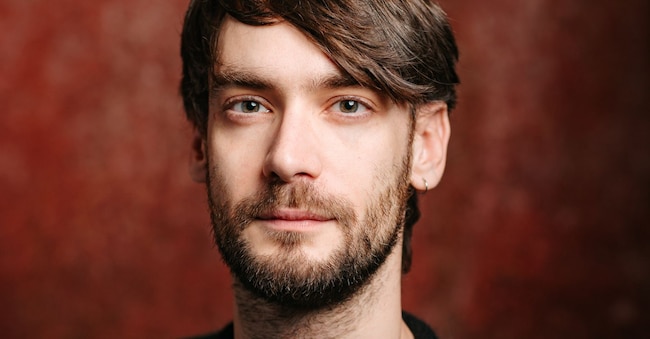
Samuele Piazza, (born 1988 in Parma) chief curator of the OGR in Turin is responsible for the visual arts programme. He has curated solo exhibitions of artists Mike Nelson, Maria Hassabi, Monica Bonvicini, Nina Canell, Sarah Sze, as well as group exhibitions such as "Vogliamo Tutto", "Mutating bodies, imploding stars" and "Dancing is what we make of falling". He holds a Master's degree in Visual Arts from Iuav University in Venice and a Master's degree in Aesthetics from CRMEP, Kingston University in London. He was a Helena Rubinstein Fellow of the Whitney Museum ISP in 2015-16.
Tell us about yourself, your path and your curatorial vision? Above all, which exhibitions, in terms of impact and importance, can be qualifying of your path?
I studied art and philosophy, training between Italy, England and the USA. For eight years now I have been working at the OGR Turin where I am the chief curator. I would say that my work in recent years has focused on a reflection on the status of the contemporary image. At a time when we are used to scrolling through photos with an attention span of a few tenths of a second, I have become interested in those practices that focus on the power of images to imprint themselves on the mind, trying to reason about what makes a work memorable and a truly immersive experience; I am thinking in this sense of the work of Maria Hassabi, of Sarah Sze or of Arthur Jafa. I recently commissioned and produced a video work byCyprien Gaillard ("Retinal Rivalry", 2024) that used experimental 3D video technologies, transforming video into sculpture, redefining the viewer's optical experience; and I am currently finishing work on a publication dedicated to the work of P Staff. I am interested in the way his works mix poetry and violence; in this case we look at ecstasy as a mode of bodily knowledge at the limits of human sensitivity. I have also always been interested in a social history of art, in this sense I think a representative project of my practice is "Vogliamo Tutto" an exhibition I curated at OGR that looked at the imperfect transition between different production models, focusing on the evolution of the world of work.
Looking back, is there an Italian Pavilion that has particularly impressed or inspired you and what mistakes should not be repeated? And broadening your gaze to international ones?
An Italian Pavilion that I remember with pleasure in recent years is the one curated by Cecilia Alemani (2017), a very strong selection of artists and works, a theme, taken up by De Martino, whose large-scale international recovery would explode in later years. It was also the first pavilion in many years to offer a selection of just a few artists. Recently, I looked with great interest at the research work of the Sami Pavilion (2022), which went beyond a simple exhibition to create a complex project and which used Venice as a platform for international visibility for years of research carried out by a working group.


