Sea economy

Maritime transport in Southern Italy: 53% of Ro-Ro traffic passes through southern ports

Maritime traffic of heavy vehicles and machinery in Southern Italy exceeds 50% of the national total, with significant growth in southern ports

by Vera Viola
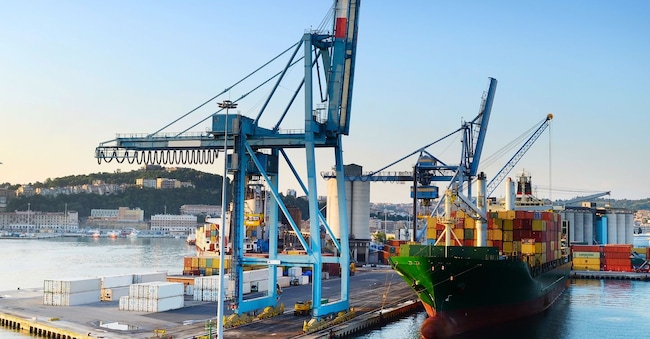
Trasporto marittimo nel Sud Italia: il 53% del traffico Ro-Ro passa per i porti meridionali (Adobe Stock)

5' min read

5' min read

The importance of southern Italian ports is growing. According to the latest Assoporti data processed by Srm, a research centre belonging to the Intesa Sanpaolo group, in 2024 southern ports handled 53% of total national Ro-Ro traffic. We are talking about the traffic of vehicles and heavy machinery at sea, also referred to as the 'motorways of the sea', which is considered a valid alternative to road transport, also useful for decongesting roads, cutting carbon dioxide emissions into the atmosphere and reducing car accidents, in full compliance with European directives on environmental protection. In short, in 2024 (a difficult year due to the ongoing wars), more than half of Italy's Ro-Ro traffic will pass through southern ports: a very positive figure as it far exceeds the weight of the economy of southern Italy, which on average is equal to 20% of the total national economy.

Medium-haul transport slightly up in 2024

This type of maritime transport in the South exceeded 64.6 million tonnes in 2024, registering a slight growth compared to 2023 (+0.2% in Italy and the South in line). With Catania (7.3 million tonnes), Palermo and Salerno (7.1), the first three ports for volumes handled. Data that take on even more importance if we also consider that Ro-Ro traffic throughout Italy, in the period from 2014 to 2023, had already grown by 42%. And that Italy is first in Europe in terms of the quantity of goods transported in short sea shipping, i.e. short-haul routes with a 40% share of the total in the Mediterranean.

Loading...

Worries for 2025: container routes most affected

However, it is impossible to make predictions for 2025, just as Donald Trump's war on tariffs rages on, which, amid announcements, threats and denials, has caused global shipments to plummet. Hardest hit are container shipments, which fell by 49% in the first eight days of April alone. And it is feared that even worse could happen as an effect of the tariffs announced for Chinese ships.

Grimaldi: 'We opposed Trump's tariffs, back to free trade

"We come from years in which free trade on a global scale has brought prosperity and growth _ points out Manuel Grimaldi, president of the group and president of the International Chamber of Shipping (ICS) _ These days we are living in a climate of great uncertainty that is already producing serious setbacks. We have voiced our opposition to US President Donald Trump's measures on duties, although they have been extended, and to the proposed law on increased tariffs for Chinese-built ships. And we confirm the need for a return to multilateral free trade. Italy and Europe _ he concludes _ have strong shoulders to face this crisis as well'.

Returning to the economy of the southern Italian sea in 2024, as far as transhipment is concerned, the port of Gioia Tauro continues to excel, almost reaching a record handling of 4 million TEU in 2024 and being the fourth European container port in the Mediterranean. Gioia Tauro recorded very significant growth in 2024 compared to 2023 (+11%) and even more compared to 2007 (+14.4%).

Deandreis: 'In regional routes Italy is the leader'

.

"While globalisation undergoes strong shocks, but resists _ says Massimo Deandreis, director general of Srm, a study centre that is part of the Intesa Sanpaolo group _ there is room for what we define as 'regionalisation', that is, the intensification of trade in a less extensive sphere, we are talking about short and medium range. In regional routes Italy is the absolute leader. And in Italy it is the Mezzogiorno, at the centre of an increasingly wide network: think of the new routes between Italian ports and Turkey, Egypt, between Bari and Albania. There is a market here, also as a result of the reshoring that has affected these countries close to Europe, and our companies preside over it promptly and efficiently. This is Ro-Ro traffic for which our ports are also well equipped". He adds: 'Southern Italy has more: it has shipping companies. The most important ones in the world that have southern origins and keep their decision-making centres in the south of Italy'. Deandreis will also discuss ports and traffic in the Mezzogiorno at The European House - Ambrosetti Forum 'Verso Sud', scheduled for 16 and 17 May in Sorrento.

The competitiveness of the Italian system must be defended, indeed, continuously conquered. All that remains is to continue to invest in ports so that they can continue to attract investment and traffic. With the ever-increasing use of ships powered by alternative fuels, there is a need for ports equipped with adequate refuelling stations; if the Ro-Ro ships in circulation have become 20% larger on average, the quays must also grow adequately; services must move towards simplification, since speed of embarkation and disembarkation is a significant factor in competitiveness.

Pnrr funds: used for ports, not green fleets

Positive, at least in terms of commitment of funds, is the balance, at the end of 2024, of the investments envisaged by the Pnrr for the strengthening and improvement of port infrastructures, as shown by the latest report of the Court of Auditors on the Pnrr. With regard to the programme of 'Electrification of the docks (Cold Ironing)', under the responsibility of the Port System Authorities and the Regions, the document explains that 'The resources for the four-year period 2021-2024 (amounting to 440 million) have been committed for 438.85 million (99.74%). Equally satisfactory results on the front of 'Development of maritime accessibility and resilience of port infrastructures to climate change', (in practice the fortification of docks that was necessary to defend them from rising sea levels and climate change) for which 1.5 billion was allocated in 2021. In this regard, the accounting magistrates report, 'the allocations for the four-year period 2021-2024 amount to 1.2 billion, of which 99.96% has been committed.

Negative balance, on the other hand, for the funds earmarked for green fleets. Of the 800 million euro initially allocated, 13.5% will be used, barring any surprises: the resources actually disbursed to date have been just over 43.6 million. "The call for tenders_ explains Alessandro Panaro of SRM _ provided for the modernisation of the fleet, which is very positive. But the incentives were only destined for ships built in Italian shipyards and that would have touched Italian ports in a systematic way: two requirements not exactly in line with the needs of the shipping industry, which has therefore made limited use of the incentives'.

Other important investments will be made in the ports of Augusta in Sicily and Taranto in Puglia. "Italy _ adds Panaro _ is accelerating the development of offshore wind energy, focusing on the ports of Augusta and Taranto as strategic energy hubs for new floating platforms. A draft interministerial decree defines the suitable areas and the necessary infrastructure works. The measure is part of the green objectives of the National Integrated Energy and Climate Plan, with important energy and employment spin-offs; the South therefore becomes a protagonist in the development of the wind energy sector in the port area'.

Copyright reserved ©
Loading...

Brand connect

Loading...

Newsletter

Notizie e approfondimenti sugli avvenimenti politici, economici e finanziari.

Iscriviti