
The Dresden Staatskapelle at the Vienna Musikverein
Leading the Saxon line-up is Daniele Gatti, principal director in office until 2030
by Carla Moreni
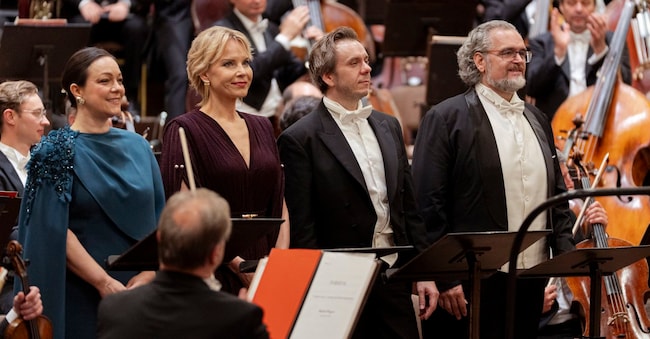
The Musikverein in Vienna remains one of the iconic halls of music in the world. It is the home of the Philharmonic and there is always a mixture of trembling and reverence from other orchestras when they are invited here, even for a single concert. The Dresden Staatskapelle exceptionally arrives for three consecutive dates, which turn into a festival in the round: a feast of sound, technique, tradition and civilisation. Leading the historic Saxon ensemble is Daniele Gatti, principal conductor. Recently at the helm, in office until 2030. And if these are the first results, one can only dream by imagining where it will go.
"Parsifal"
The Milanese Maestro packs an intense symphonic and operatic season for them at home - at Easter there was 'Parsifal', in October a new 'Ballo in Maschera' will arrive - but he is also counting on the big tours, to confirm the supremacy of the fabulous ensemble worldwide. The current one, with thirteen concerts until the beginning of June, lands with a three-day tour in Vienna. A two-faced programme, almost a flag: on one side Verdi's "Requiem Mass", on the other Wagner, with excerpts from "Maestri cantori" and "Parsifal" juxtaposed with Saint-Saëns' Cello Concerto No. 1, classy soloist Gautier Capuçon, and Debussy's "La mer". Rich dish, absolute performing dedication. But it is not enough. To the festive standing ovation in the golden Viennese hall, Gatti adds an extra: Prelude and Death of Isolde, from 'Tristan'. More than an encore, it is a true third part of the concert.
The Wagnerian repertoire has been in the chords of the Dresden Kapelle since the days when the composer conducted the ancestors of today's orchestras. And let us not speak of the conductors to follow. To so much luminous history Gatti adds a revisited phrasing, which enhances large and small patterns, enhancing the polyphonic texture of the fabric, even richer, even more colourful. He often uses a swirling gesture of the arms, calling for fluency and natural forward motion. If heroic and antiquated "Maestri cantori" shine, frayed and mournful resonates by contrast the Prelude to Act III of "Parsifal", with the brightness of magic Good Friday ideally reflected in the hall of the Musikverein: the lights on, crammed like an egg, absorbed in moved silence.
Greens
With Verdi, the change of clothes is tangible: the design has to become sharper to dialogue with the Latin text, of direct eloquence. Gatti believes in the text of the 'Requiem', you feel it: spirituality reverberates in the meaning of individual words. "Tremor", "dies illa", "leonis": the first part of the Mass sinks into fear. Then from the Offertory, with the soft tempo of St Michael's drapery, light slowly enters. And if white is the colour of the offerings ("Hostias") in the glorious "Sanctus", hope becomes concrete. Wonderful in the entrances of the choir, which is the "Singverein", Karajan's one hundred and more amateurs, but of absolute professionalism. What a treasure for Vienna this singing reality. What a bravura Daniele Gatti, on each stage of the 'Requiem' tour in front of a different choir. Only an exact arm like his can hold it together, only a dazzling reading in every detail, everything from memory.
Elīna Garanča
It is no coincidence that a diva such as Elīna Garanča agrees to be part of such a long, such an exciting journey, with upcoming stops in Paris and until 4 June in Prague. Alongside the velvety mezzo-soprano is tenor Benjamin Bernheim, perfect for nasal emission, as Verdi thought, and Riccardo Zanellato, who, although announced chilled, has all the persuasiveness of the aristocratic Italia bass.

