Registrations

Cars, European market stable in October (+0.1%). Electric cars on the rise. Down Stellantis

Registrations almost at a standstill in the Western European market. For the French-Italian group, 16.7% less than in the same month of 2023

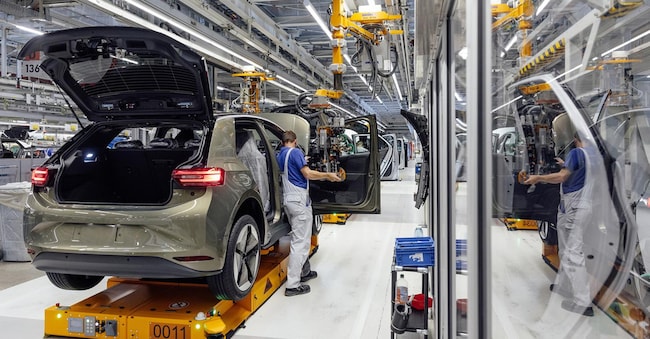
Produzione della VW ID 3 NUOVA presso la Volkswagen Sachsen a Zwickau. (Foto: Oliver Killig)

4' min read

4' min read

In October, the car market in Europe (EU+Efta+UK) remained more or less stable compared to a year ago. Last month, 1,041,672 cars were registered, marking an increase of 0.1 per cent compared to the same month in 2023. Since the beginning of the year, 10,821,299 cars were registered, up 0.9 % year-on-year.

Bev (100% electric) cars registered in October totalled 169,525, up 6.9% year-on-year. Since the beginning of the year, however, these cars showed a drop of 1.7% to 1,602,711 units.

Loading...

The Western European car market is still far from pre-crisis levels, and will probably never return to those levels as the world has changed.

The weight of Germany

.

In the EU alone, registrations of battery electric cars increased by 2.4 % to 124,907 units in October 2024. However, the market volume since the beginning of the year is down 4.9 % compared to the same period last year, with a total market share of 14.4 %. The decrease was mainly driven by a significant drop in registrations in Germany (-26.6%).

Registrations of plug-in hybrid cars fell 7.2% in the EU last month, following significant declines in France (-26.9%) and Italy (-24.9%). In October, plug-in hybrid cars accounted for 7.7% of the car market, down from 8.4% last year. Year-to-date volumes also decreased, down 7.9% compared to the same period last year.

On the other hand, registrations of hybrid-electric cars increased by 17.5 % in October in the EU, with their market share rising to 33.3 %, up from 28.6 % last October, surpassing petrol car registrations for the second month in a row.

Interest in plug-ins

.

2024 shows a swinging trend, also due to an attempt to recover the share of electric cars, which had been shrinking due to the end of incentives in the area's main market, i.e. Germany, and for other minor reasons. This is the comment of Centro Studi Promotor on Acea's registration data. On the other hand, in recent months," he explains, "there has been strong interest in plug-in hybrid cars (Phev), which in October in Germany recorded an increase of 18.2% over October 2023 and a share of 8.3%. According to André Schmidt, president of Vdik (German Association of International Automobile Manufacturers), 'more newly registered plug-in hybrids can make a significant contribution to reducing CO2 emissions compared to traditional combustion engines because users of plug-in hybrid models can already travel significant distances in purely electric mode'.

'The plug-in hybrid,' says Gian Primo Quagliano, chairman of Centro Studi Promotor, 'can also allow important savings on consumption and overcome the fear of electric car users of running out of power due to insufficient availability of refuelling points. And this is because the plug-in hybrid works with a traditional petrol or diesel engine and an electric motor powered by energy recovered during deceleration and by electricity fed in from outside by the plug. The plug-in hybrid cannot be considered a substitute for the electric car at the moment, but it can be a great help in the energy transition'.

The Stellantis drop and the results of Vw, Ford, Hyundai and Toyota

Stellantis registered 150,346 cars in Europe in October, 16.7% less than the same month in 2023, with a market share of 14.4% compared to 17.4% a year ago. Since the beginning of the year, the group has sold 1,700,846 cars, a drop of 7.1 per cent and a market share dropping from 17.1 to 15.7 per cent.

The Volkswagen Group registered 293,327 cars in October, with a share of 28.2% compared to 25% in the same month of 2023. Since the beginning of the year, the group has sold 2,836,343 cars, an increase of + 2.3 per cent for a market share that has risen from 25.9 per cent to 26.2 per cent.

The Renault group registered 102,737 cars in October, with a share of 9.9%, the same as a year ago. Since the beginning of the year, the group has sold 1,040,882 cars, an increase of 1.2% for a market share of 9.6%, the same as the same period last year.

The Hyundai Group registered 89,603 cars in October, 7.5% less than the same month in 2023, with a share of 8.0% compared to 8.6% a year ago. Since the beginning of the year, the Korean group sold 904,879 cars, down 3.8% for a market share that dropped from 8.8% to 8.4%.

The Toyota group registered 85,587 cars in October, 13.7% more than the same month in 2023, with a 7.4% share compared to 7.3% a year ago. Since the beginning of the year, the Japanese group sold 834,875 cars, up 12.5% for a share that rose from 6.9% to 7.7%.

The Ford group registered 26,013 cars in October, 7.9% less than the same month in 2023, with a share of 3.0% compared to 3.3% a year ago. Since the beginning of the year, the group has sold a total of 262,410 cars, down 14.5% for a market share that has dropped from 3.5% to 3.0%.

Copyright reserved ©
Loading...

Brand connect

Loading...

Newsletter

Notizie e approfondimenti sugli avvenimenti politici, economici e finanziari.

Iscriviti