
Wine prices stable, Amarone and Brunello remain the most expensive
The slight upturn in the harvest will not shake up the price list: valuations of Chianti, Pinot Grigio, Ribolla and whites in general are going up. Prosecco down in two out of three denominations

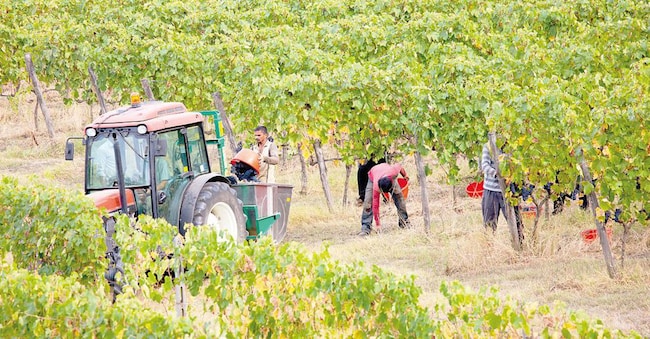
4' min read
4' min read
A positive surprise for Italian wine growers. The prices of post-harvest Made in Italy wines are holding up and there are no significant declines; on the contrary, in many cases there are appreciations. This is what emerges from market monitoring carried out using data from Ismea and above all those supplied by Med.&A. the national association of business agents in mediation and commercial agents (set up within the Italian Confederation of Vine and Wine) and which, with its 20 affiliated companies representing a hundred or so operators in the sector, handles an average of 15 million hectolitres of wine a year (a volume close to 40% of Italian production) for a turnover of around one billion euros.
"Up until a month and a half ago, expectations were different," explains the president of Med.&A., Carlo Miravalle, "We expected a much higher harvest than the one that is now being recorded. Production was penalised by the summer drought in the South, but also by the rains in September and October in the North'. The point is that after the 2023 grape harvest, the poorest in 76 years, a strong rebound was expected, but it did not happen. Already at the G7 in Syracuse, estimates made by Ismea, Assoenologi and the Italian Wine Union spoke of 41 million hectolitres.
'Probably,' Miravalle adds, 'we will be below that figure and just above last year's result: around 40 million hectolitres. A figure that is now supporting prices. Therefore, we will avoid distillations and other economic measures to rebalance the market. On the contrary, we are beginning to see tensions on price lists, particularly on white wines and generic whites. On the other hand, Sicily on whites had a disastrous year. There was also a drop in the production of Trebbiano base sparkling wine or vermouth base produced on the Adriatic ridge between Emilia Romagna, Puglia and Abruzzo. And much more generic white was expected from Veneto, where the latest rains have compromised the quality of the grapes in the vineyards. And in recent days, even theb>big German bulk wine buyers have brought forward their purchases of Chardonnay in fear of further price increases.
According to surveys by the brokers' association the prices of Pinot Grigio delle Venezie Dop, the second largest denomination in Italy (behind Prosecco), which is worth just under 300 million bottles a year, are rising. In October 2024, Pinot Grigio delle Venezie DOP was quoted at 1.10 per litre, up by 10% compared to last year. A figure triggered by the lower production of Italian Pinot Grigio in general.
The scenario for the number one denomination, Prosecco, a label that boasts three variants: the Conegliano Valdobbiadene DOCG, the Asolo DOCG and the macro DOC produced between Veneto and Friuli. The figures show a drop for both Prosecco Doc (1.90 euro per litre, -5% triggered by the release of reserves and stocks and a slight increase in bottling) and Prosecco Superiore di Conegliano Valdobbiadene (2.43 and -12%). The smallest of the three appellations, Prosecco Docg di Asolo, which recorded a 5% increase in list prices and a price of 2.35 euro that has now caught up with the more famous Prosecco Superiore di Conegliano e Valdobbiadene, is saved, thanks also to strong market demand.


