
Stadiums, the commissioner will unlock investments worth 5 billion
With the Sports Decree coming in May, the new accelerated procedure will be triggered, which could activate interventions of up to 10 billion
4' min read
4' min read
Not only and no longer world champions of renderings and models. In May, the Meloni government will launch the 'Sport Decree' that, among other things, will introduce the commission procedure for the construction of new stadiums. A measure strongly desired by the Minister for Sport and Youth Andrea Abodi to eliminate regulatory and bureaucratic gaps and clear the field of political misunderstandings created in these years of 'systemic obstructionism' towards the renewal of a stadium park in Italy whose average age is now closer to 80 than 70 years.
Commissioner's procedure
.In the last 15 years alone, while more than 200 stadiums have been built in Europe, five have been inaugurated in Italy. Now, thanks to the legislative breakthrough that will allow the appointment of a commissioner and the designation of mayors or their delegates as sub-commissioners, the aim is to reactivate blocked procedures or to start new ones. The new commissioner procedure will unlock investments already planned for 4.5 to 5 billion. But according to government estimates, other interventions can be activated with an economic impact that can exceed 7 and even reach 10 billion. 'We do not want to intervene on a piecemeal basis in realities that are territorial,' stressed Abodi, 'but we want to provide simplified tools and procedures. We have made a qualitative leap with the configuration of the commissioner structure, with all that this entails in terms of powers that do not prevaricate but use best practices to speed up the process. This is to respond to a requirement that is 2032, which is brought forward to 2026 for the definition of the five Italian stadiums. Uefa has imposed April-May 2027 for the opening of the various building sites, under penalty of revocation of the assignment. The time is therefore not much'.
But Abodi's goal is systemic, to improve the infrastructure capital. "I am convinced that through the commissarial structures, also using the will of the clubs, particularly those with foreign ownership, and the administrations that in some cases have gone ahead, and with the portfolio of financial opportunities that we will make available, we will be able to open two more building sites between the end of this year and next, in addition to the one in Florence that is already operational. Bologna and Cagliari are two other ready projects, as are Empoli and Parma'.
Stadiums to be upgraded
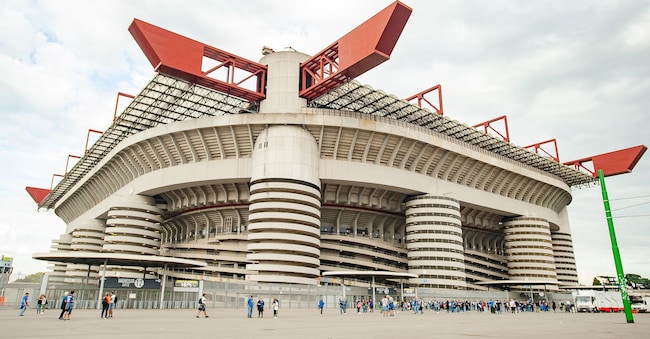
.There are different situations from city to city, with processes that have been dragging on for years and uneven legal models, from privatisations (as in Milan) to forms of public-private partnership (as in Cagliari), from the allocation of long-term surface rights to mere prolonged concessions. The most important interventions from an economic point of view are those of Inter and Milan on the San Siro area (the sale of which is planned for the summer), which could be worth up to 1.5 billion, and that of the American Roma, which has planned a 1.2 billion investment in Pietralata. In the capital, moreover, Lazio has just presented to the City Council a 450 million plan for the redevelopment of the Flaminio.
In Florence, work has already begun on part of the Artemio Franchi, which will cost the public purse around 150 million. In order to complete the work, Rocco Commisso, the Viola president, would be willing to pull out another 50 million. In Parma, the Krause group will directly finance more than 60 per cent of the planned renovation budget (around 150 million). A few days ago, on the other hand, the Region of Sardinia confirmed its 50 million commitment for Cagliari's new stadium, the final construction of which could cost between 150 and 2oo million.


