Towards the elections

States in the balance: a few thousand votes lead to the White House

From Pennsylvania to Arizona, voters in the seven swing states will be decisive. In the polls Harris and Trump are tied

From our correspondent in New York Luca Veronese

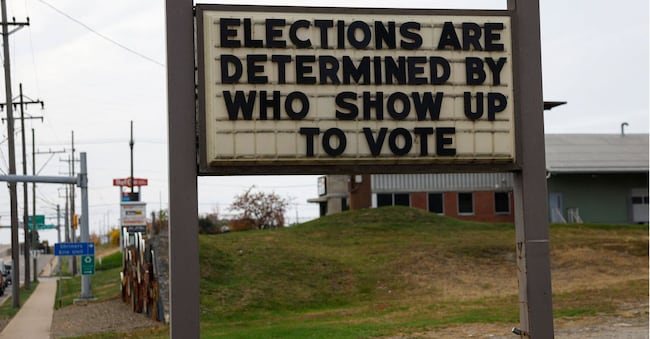
Un tabellone elettorale ad Erie in Pennsylvania

4' min read

4' min read

Seven decisive states for the White House. A few tens of thousands of swing votes needed for Kamala Harris or Donald Trump to become president. In the United States, the winner of the 5 November election will govern a country of over 330 million people, but the contest will almost certainly be determined by the results of the polls in a handful of states.

This is because only seven of the 50 states are considered to be truly in the balance this year, whereas - according to the polls and also considering the recent elections - in most of the United States the game may already be settled at the start. Among these seven battlegrounds, real political battlegrounds, Pennsylvania is the state with the most inhabitants and will be the one to watch, particularly on election night: 'If we win in Pennsylvania we can also make it for the presidency, but if Kamala Harris is defeated in Pennsylvania the challenge becomes really difficult, all uphill,' explains one of the Democratic campaign managers.

Loading...
Loading...

Money, commercials and door-to-door: the challenge in the seven disputed states

.

With little more than a week to go before the vote, all the efforts of the two candidates, their communication, their spending on commercials and electoral activities - from TV to activists going from door to door - are concentrated in swing states, which have shown in the past a tendency to switch sides, and which in analyses of electoral flows are undecided, contestable.

In Pennsylvania, Elon Musk, the boss of Tesla and SpaceX, Trump's main backer, has even moved his headquarters. In the undecided squares, from Wisconsin to Georgia, the Democrats have called Barack Obama, with all his charisma, to their aid. But also singers and well-known faces from television, such as Bruce Springsteen and Oprah Winfrey. The two parties spent more than half of the funds raised - no less than half a billion dollars for the Democrats, something less for the conservatives - in the swing states.

Everything will be decided in the four states of the sun belt, the line of the sun: Arizona, Georgia, Nevada and North Carolina, where the issues of immigration, which presses on the southern border with Mexico, are as strong as those of minority rights, especially Hispanic and African American.

And in the three states of the rust belt, the rust belt that brings together Michigan, Pennsylvania and Wisconsin, where the industrial issue is added to the economic and social difficulties of depressed rural areas: it is the traditional blue wall of the Democrats, which sent Joe Biden to the White House four years ago but turned its back on Hillary Clinton in 2016.

Women's Rights and the Difficulties of the Economy

But especially in the most uncertain constituencies, the two big issues that have emerged from this campaign could be driving the American vote. On the one hand, the domestic economy, with inflation considered by households as the main problem: issues on which Trump seems to have more grip, especially by attacking the Democratic administration of Biden. On the other, women's rights and the right to abortion: key elements of Harris' political action.

In two of the seven undecided states - Michigan and Nevada - 'economic activity contracted in the three months to September,' explained the Philadelphia Federal Reserve.

The Electoral System: 270 Quota

But why is it that elections are not decided by a majority of popular votes and that individual states count instead? In the American electoral system, the winning candidate in each state (and in the capital district, Washington) wins all the so-called electoral votes of that state, which are largely defined in proportion to the population.

In order to be elected to the presidency under this indirect mechanism, a candidate must obtain a majority of the country's 538 electoral votes, or 270: it is therefore possible for a candidate not to have a majority in the overall national vote but to become president, as happened to Trump when he prevailed in 2016.

The polls, with slight discrepancies, are showing a substantial tie between Harris and Trump as far as the national total is concerned: the Democratic candidate has a slight advantage - 49% to 48% - over the right-wing leader in the average of voting intentions calculated by the New York Times. And even looking at individual states, the contest is as close as it has ever been in the last fifty years, the experts indicate a gap that lies within the margin of statistical error: and with gaps of around one percentage point, they consider it impossible to make sensible predictions.

Tow to the final battle

.

If all non-balanced states voted as expected, Vice-President Harris would leave with 226 so-called electoral votes already in her pocket, while Trump's endowment would come to 219 electoral votes. At stake would thus remain 93 large electoral votes, 19 of which are allocated in Pennsylvania. A few tens of thousands of votes could therefore make the difference: in 2020, to put it bluntly, a shift of only 43,000 votes in three states, less than a third of a percentage point in the national total, would have been enough for Trump to defeat Biden and be re-elected.

Harris and Trump are preparing to conclude their campaign between Pennsylvania and the other six crucial states. We're not going back, repeats the Democratic nominee asking Americans to look forward. With us, America will be great again - Make America great again - promises the former Republican president. They speak to different countries, to a divided America, in which the president will be decided by a few tens of thousands of citizens, who will probably vote in Pennsylvania.

Copyright reserved ©
Loading...

Brand connect

Loading...

Newsletter

Notizie e approfondimenti sugli avvenimenti politici, economici e finanziari.

Iscriviti