
Staying in Matera with Upcycled Hospitality
Entrepreneur Mikaela Bandini’s project focuses on providing accommodation in places that were not originally designed for that purpose, whilst preserving their history

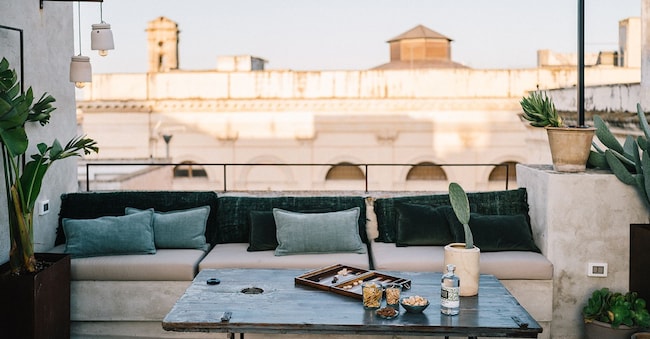
A few days ago, whilst idly scrolling through Instagram, a post by @OrganicErotic caught my eye: the interior of an old, well-worn building with a special atmosphere – old-fashioned yet sexy. It looked beautiful, with that spontaneous patina of time enveloping everything. I’m curious to know what sort of place it is, but the caption simply reads: ‘Nothing here is new; the walls are peeling, the fabrics are upcycled, the furniture has just been touched up’. On closer inspection, @OrganicErotic is a New York furniture shop and that post serves as a mood board: it draws you in but isn’t real.
In Italia, however, there are those who have actually done it. Mikaela Bandini, a South African from Cape Town who has been living in Matera for years, is a whirlwind of ideas and passions. She loves everything from the past and buys anything that catches her eye: a hairdresser’s helmet, the backlit sign of a tobacconist’s or a cinema, an old theatre prop, or abandoned buildings. She buys them, collects them, then decides what to do with them. Her first project was Area 8, a bar in the centre of Matera housed in a former television repair workshop. It is such a contemporary place that it could easily be in London or Berlin, but above all it is a Wunderkammer, where every object – often used in a way different from that for which it was designed – has a story behind it.
Contemporary hospitality
Following on from Area 8, the irrepressible Mika has bought and transformed several disused buildings into contemporary hospitality projects: a cowshed becomes a supper club (Milk Matera), a mechanical workshop becomes a place to stay (Corte dei Limoni), a gym becomes a theatre. He seems to have taken sculptor Pietro Consagra’s warning to the people of Matera quite literally: ‘We must save ourselves from ugliness’. And from standardisation, adds Bandini: ‘In the world of hospitality, it’s very easy to opt for contract-style, scalable and replicable solutions. I, on the other hand, look for unique things that have served a purpose and to which I can give a new lease of life’. This is where the concept of Upcycled Hospitality comes from: offering hospitality in places that were not originally designed for it, whilst preserving their history. Even the research method is unique. Using a drone, she identifies derelict buildings with a separate entrance and outdoor spaces (terraces, gardens, orchards); she then checks the land registry, tracks down the owners and makes an offer. Today, three houses are already ready and available to book; another, a former car body shop, is under construction.
A haberdashery counter is transformed into a piece of furniture
The furnishings follow the same principle: they are transformed objects, pieces salvaged and reassembled using materials from other contexts – wood, fabrics and leathers of yesteryear. The sofas in the Nardò house are 1970s designs upholstered in vintage fabrics. The workstation was a haberdashery counter bought in Biella, whilst the DJ console was the bonnet of an old Volkswagen T2 van. And half a sign from Polignano a Mare station hangs in one flat as a manifesto of life: part ‘A mare’, part ‘Amare’. These are objects found by antique dealers, at flea markets, or through a network of people who know Mika’s tastes and offer her quirky items that might otherwise end up in a rubbish tip. She finds a way to save them. ‘We’re always complaining about fast fashion and fast food, but nobody talks about fast furniture,’ she says. ‘It’s absurd to avoid disposable fashion for ethical reasons and then fill our homes with furniture that has a lifespan of three or four years.’
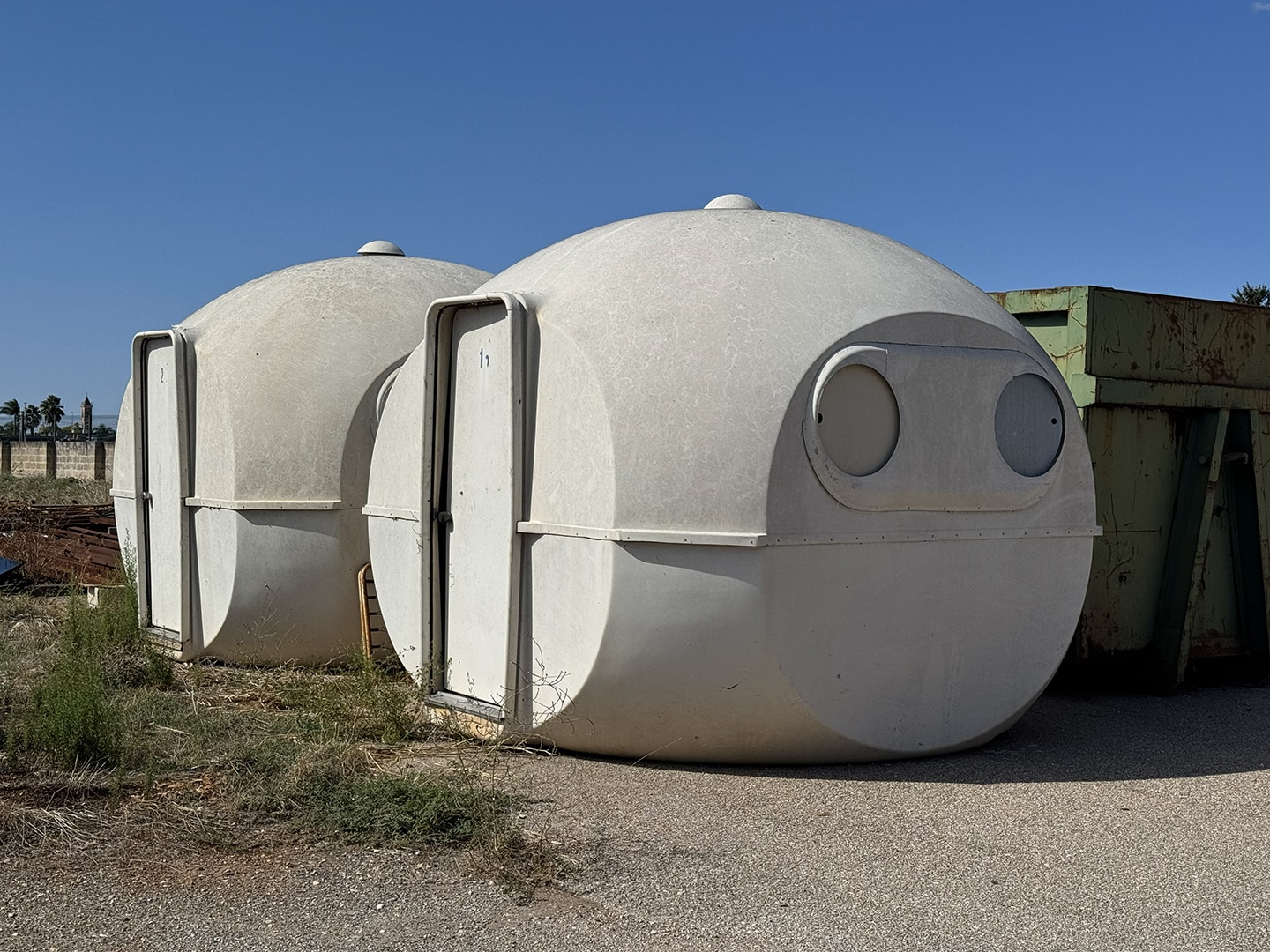
Mika is now working on two Banga bungalows designed by Carlo Zappa in 1971, which come from a disused campsite in Gallipoli. Destined for demolition because they were too complex to transport and restore, she purchased them and, once restored, will place them in her own olive grove in the Matera countryside. Each is a micro-home of around eight square metres, with four beds, a bathroom, a shower and original furnishings. The aim is to open them to the public in 2027. The mission of this creative South African entrepreneur goes beyond architectural restoration. She has created an independent and unique collection of one-of-a-kind, analogue spaces that seem as though they have always existed, offering a sense of belonging and warmth. She has successfully extended the sociological concept of the ‘Third Place’ (i.e. those places of encounter and socialising other than home and work) to the realm of hospitality, and the concept of heritage to mid-20th-century Italian design, encompassing not only historic buildings and UNESCO sites but also objects and structures from the 1950s, Sixties, Seventies and Eighties.

