Automotive

Stellantis and Leapmotor, it's on: Chinese cars for sale in Italy too

On sale from September with the C10 suv and the T03. Trojan horse? Tavares: 'They would come anyway. So we can take advantage of the situation'
by Alberto Annicchiarico

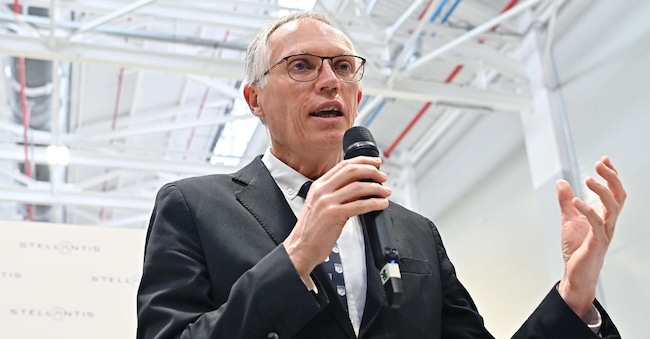
Carlos Tavares, ceo di  Stellantis

5' min read

5' min read

Now it is really true, Stellantis will bring and sell Chinese cars in Europe and beyond. "Just 7 months later we have the closing of the binding agreement between Stellantis and Leapmotor, which had been signed in October. But planning is only 10 per cent, 90 per cent is execution. Now we are entering the operational phase' of the partnership. The words of  Carlos Tavares , CEO of the supergroup created by Psa and Fca at the beginning of 2021. The announcement came during a joint press conference with Zhu Jiangming , founder and CEO of the Chinese manufacturer. Leapmotor specialises in electric models but above all is a manufacturer of modular platforms and technological architectures. Added to this is the availability of Erev versions, or Extended range electric vehicle, technology that translates into the presence of a heat engine dedicated exclusively to recharging the batteries. In 2023, Leapmotor produced 144,000 cars, but this figure could rise to 800,000.

In October 2023, Stellantis became a strategic shareholder of Leapmotor with a EUR 1.5 billion investment, acquiring a stake of around 20 per cent. The agreement also included the establishment of Leapmotor International, a 51-49 joint venture led by Stellantis, with exclusive rights to export, sell and manufacture Leapmotor products outside China.

Loading...

Sales from September, starting with two models

From September (the homologation phase is underway), the Hangzhou group's vehicles will start to be distributed and sold in Europe. "We will start by taking Leapmotor vehicles to nine countries, including Italy, France, Belgium, Spain and Portugal. The plan will be supported by at least 200 sales outlets, Stellantis & You dealerships will be an integral part of this distribution,' Tavares explained during the press conference. "From the fourth quarter we will also enter other important regions, namely South America, a crucial region for Stellantis, then we will proceed with the Middle East and Africa, then India and Asia Pacific.

Initially, two models will be imported, the C10 suv, electric and plug-in hybrid, and the compact full electric T03. The C10 (D-segment, based on the new Leap 3.0 platform, which supports an 800 Volt architecture) should, according to Zhu, compete with Tesla sedans. This suv has a WLTP (Worldwide harmonised light vehicles test procedures) cycle range of 420 kilometres and 5-star Euro Ncap crash safety, the maximum. The T03 is a five-door car for urban use, belonging to the A segment "but with B-segment interior space", according to the manufacturer. It has a WLTP range of 265 kilometres and a price tag of around EUR 20,000. Initially it was rumoured that the T03 could be produced in the Stellantis plant in Tichy, Poland, or in Mirafiori. The CEO of the 14-brand group did not want to specify if and where the Leapmotor baby will be built. It will depend above all on what impact it will have on the European market.

'The launch,' continued the Stellantis CEO, 'will be conducted powerfully and aggressively, and we expect a significant boost to Leapmotor's sales outside China. For the time being, there is no talk of production, which is part of the plans anyway, but of import and distribution, as well as after-sales service.

There is no talk of production yet

.

In fact, decisions on possible production in Europe will also be made 'on the basis of the transformation costs of the factories and taking quality into account, this is how we will make decisions and these are the factors that will guide the choices,' said Tavares, during the call with journalists, explaining that 'for now no decisions have been made, but the criteria on which we will base ourselves are to assess where the highest quality is, where the best costs are, and whether a specific factory has the necessary capacity'.

Many analysts also expected the agreement to evolve into an exchange of technology. Perhaps with the T03 platform being used for new small cars, such as the possible future 500 Electric. Hypotheses that for now are not on paper. 'At the moment,' Tavares clarified, 'the agreement does not envisage technology sharing, but the sale of Leapmotor models outside China. We will evaluate on a case-by-case basis whether to use Stellantis' production facilities in the various regions'. In practice, Stellantis acts as a mere distributor and what Tavares has in fact 'sold' to the Chinese is the gigantic European network of local distributors, dealers and spare parts logistics partners. This is a large area of business in which the Chinese brands are likely to find themselves in trouble.

"With Leapmotor, we will evaluate on a case-by-case basis whether to export from China or use Stellantis' production facilities in the various regions," the Stellantis CEO further explained. "The important thing is to emphasise that we are able to deal with all kinds of scenarios and we will adjust flexibly in each region (US, Europe, China, ed.), making different decisions depending on the various countries and the needs of each market. The aim is to 'proceed pragmatically'.

In any case, 'we want this joint venture to be a success, to bring smart and affordable electric vehicles to the market quickly,' Tavares added, explaining that the agreement will bring a number of benefits to both Stellantis and Leapmotor. "The first is the acceleration with which we bring Ev to the market, the second is that we provide excellent technologies, the best available, cost-effective. The third point will be the fact that Stellantis will be able to have more Evs available to bring to market, making progress in the execution of the Dare Forward 2030 strategic plan," concluded the Franco-Italian group's number 1.

Stellantis Trojan Horse for Chinese Invasion?

Tavares has always spoken in very alarmist terms of the arrival of Chinese competition in Europe, emphasising its danger on the basis of price competitiveness that is unattainable for European manufacturers. Today he emphasised that the race is nonetheless on and that there are not many choices in a Europe that limits duties to 10% (although in these days there is a heated debate on the advisability of raising barriers, a debate in which German manufacturers are opposed due to their strong interests in China).

'This year,' explained the Portuguese top manager, 'Chinese manufacturers will conquer at least 10 per cent of the European market. It is a process now underway, we cannot stop it. We can only fit into this ongoing dynamic, and we are doing so thanks to Leapmotor'. Of course, this partnership could appear to be a Trojan horse for the Dragon's electric cars: Chinese manufacturers see exports as a crucial response to the slowdown in the domestic market. According to Tavares, 'the Chinese would come anyway'. Whereas 'with the joint venture we can use the situation to our advantage'.

President and CEO of Leapmotor, Zhu Jiangming, added that "the partnership between Leapmotor and Stellantis demonstrates a high level of efficiency and quality, and ushers in a new chapter in the global integration process of China's intelligent electric vehicle industry. By utilising Leapmotor's innovative technologies and cutting-edge products, with Stellantis' support inforeign distribution, services and marketing, we aim to offer customers around the world an exceptional driving experience and on-board comfort. We believe that this partnership will give Leapmotor further impetus to become a globally recognised intelligent electric vehicle manufacturer.

Government and union reactions

There was no lack of reaction in Italy. 'Tavares's statement,' commented the Minister for Enterprise and Made in Italy, Adolfo Urso, 'confirms our analysis. There must be at least a second car manufacturer in Italy. In Italy there is only one, which among other things intends to import and sell electric cars or at least Chinese cars in its network'. While Samuele Lodi, Fiom-Cgil national secretary and head of the mobility sector, demanded that 'the production and assembly of Leapmotor models be carried out in the Stellantis plants in Italy and that a round table be convened at the Prime Minister's Office with CEO Carlos Tavares, as we have been asking for some time as a unit'.

Copyright reserved ©
Loading...

Brand connect

Loading...

Newsletter

Notizie e approfondimenti sugli avvenimenti politici, economici e finanziari.

Iscriviti