Cars

Stellantis CEO to the EU: 'Now urgent action on CO2 and flexibility', in Italy relaunch with new models

Stellantis CEO Antonio Filosa anticipates the strategy to revive sales between the US and Europe and takes stock of the Strategic Dialogue with Brussels: 'The Commission favours a flexible system'.

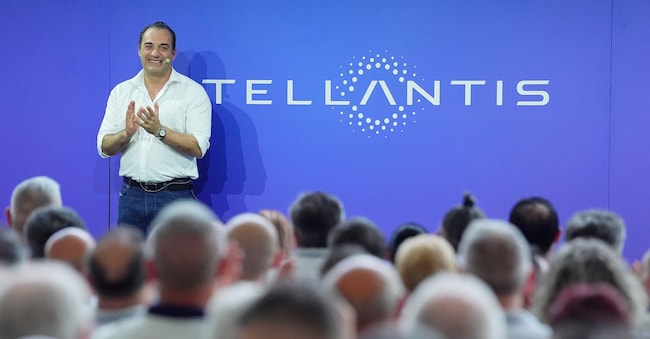
by Filomena Greco

ANTONIO FILOSA CEO STELLANTIS

10' min read

10' min read

He is one of the youngest ceo's in the automotive world, for Stellantis he is a "flag player", he has been working since 1999 within the Group, where he has built his career until arriving in the GEC, the Group Executive Council, in fact the first line of command, in 2018, a few months before Sergio Marchionne died. Antonio Filosa has been leading Stellantis since 23 June and in his first interviews, given to Il Sole 24 Ore and Les Echos, he calls Europe to its responsibility for the crisis of an entire sector. 'The strategic dialogue is very useful, but now it is crucial to act urgently. There is no more time for delays'.

The proposal is to build a more flexible system, more in tune with reality, leveraging technology neutrality to increase customer choice, hybrid and range-extended engines, interventions to renew the circulating car fleet, and supercredits assigned to e-cars, small electric cars, and small city cars. The Italy Plan, "desired by chairman John Elkann and strongly supported by me," says Filosa, represents a momentous opportunity for Italy. "The volumes," he reiterates, "will come from new realistic EU rules and the launches of new models, in particular from the production ramp-up of new proposals such as the Jeep Compass at Melfi, together with models on the Slta medium platform, and the Fiat 500 hybrid at Mirafiori. In the future, with the New Panda assigned to the Pomigliano industrial site, alongside the cars that will be produced on the Slta Small platform'.

Loading...

Next week, a meeting with the EU Commission is scheduled in the context of a possible revision of the regulation to stop endothermic engines by 2035. What is the target to be achieved? .

We are simply talking about the future of the automotive industry in Europe, which depends above all on regulations. I have met with some colleagues and the president of Acea, the association representing European manufacturers. In what the European Commission calls the Strategic Dialogue, as players in the sector we are reaching a common point, which is particularly important to me: it is great to have a dialogue with the Commission and the European institutions, but now we need to move quickly to Strategic Actions. We are running out of time. Car Europe was worth about 18 million registrations before Covid, now it is less than 15 million. Three million fewer cars is equivalent to the Italian and Spanish markets put together, lost in five years. This means suffering for the industrial players but also for the whole supplier network that supports us and for the dealers.

What are the most urgent measures?

The first emergency is that of Light Commercial Vehicles. Last year, in an industry already in decline, the sector registered two million units in Europe, this year we will lose 350,000, which in theory is the equivalent of two factories and 50,000 jobs, if we consider the entire sector and the entire industrial chain. There is a solution, because this decline is mainly due to the regulations that are in place today and that require automakers to sell high mixes of bev vans, which the market does not want right now, for simple reasons. Because, for example, the total cost of ownership for an electric van is always very high, so the industry loses volume and risks major social impacts.

The first appeal we will make through Acea is to place among the most urgent actions that of reviewing the targets and the timing of the targets for the light commercial vehicle sector. The period in which the average CO2 emissions for manufacturers is calculated must be lengthened, from three years, the time allotted to the car sector, to five years, i.e. from 2025 to 2029, always with a view to revising the targets. Second strategic action, is to introduce some flexibilities, for example for biofuels, for direct investments in infrastructure, which in many areas of Southern Europe are lacking. Italy in the Light Commercial Vehicles sector has the Atessa plant, one of our crown jewels, which is currently suffering from this regulatory situation.

For cars on the other hand, how should the European strategy be corrected? 

Here again, the targets are unrealistic and must be accompanied by a series of flexibility measures. Starting with the renewal of the car fleet. In Europe we count 230-240 million units, with an average age of 12 years. A European policy that encourages the replacement of older cars with new ones with a greater choice of powertrain would have a greater benefit on overall CO2 emissions than the annual new car market can achieve. This is acting on a much larger market than the approximately 15 million cars registered in a year in Europe. The second flexibility relates precisely to technology neutrality, which considers not only more electrification-intensive cars, but also other hybrid or range-extended powertrains.

We recognise the positive nature of the dialogue with the Commission, but we do not yet see the necessary urgency with regard to strategic actions, and we want to make the Commission aware of these issues. The idea is to move towards a system of offset credits for manufacturers, which valorises all electrified engines, not just full electrics, investment in infrastructure, but also actions to support the supply network and, above all, actions to renew the car fleet.

Stellantis chairman John Elkann and former Renault CEO Luca De Meo raised the issue of regulation for city cars a few months ago to protect the competitiveness of European industry. Is this an issue on the table?

It is an important issue especially for Italy, but also for Europe, to reward smaller cars, which have a more efficient footprint and lower environmental impact. In our vision they should get a super-credit, against some level of electrification. My chairman rightly pointed out that it would be necessary to introduce a new category, the so-called e-cars, modelled on the Japanese Kei-cars. That would be a very interesting long-term action. In this way Europe would also address the issue of affordability through a combination of measures including super credits for small battery electric vehicles (Bev), incentives based on the ecoscore and measures to renew the car fleet.

In European automotive geopolitics, will the Germans let you do it?

I think the interests at this stage are quite common, we talked about it with the president of Acea and other members and we saw that there is agreement on the flexibility front. We will do the small cars, the Germans will maybe work on plug-in or long range technologies. We all agree that we are facing an important moment, which can also be a positive turning point, but which requires immediate decisions.

In the presentation of the first half year figures, which showed a 13% drop in revenues and a net loss of 2.3 billion, he said that there is a lot of work to be done in the US and that profitability needs to be increased in Europe. Stellantis has lost volume and market share in Europe as well as in the US. And it is struggling to reverse course. How will the next few months go?

In North America, the loss of volume is due to decisions made in the past and the exit from the production lines of seven important models, which accounted for about 300,000 units per year for us, which were not replaced. The solution is clear, we have started to replace them. We launched the Ram 1500 with HEMI V8 engine, we launched the thermal Dodge Charger, next to the electric version, we launched the hybrid Jeep Cherokee that we were sorely missing. We have a future plan of products with electric, range extended, hybrid and thermal technologies

In Europe we have launched many cars between the end of 2024 and the beginning of 2025, the investment in the Smart Car platform has been important and we are seeing a recovery in market share. What interests us very much now is to complete the ramp-up of the launches already made, starting with the Italy Plan.

There is great concern in Italy about the declining volumes in Italian factories, about social shock absorbers and in general about industrial and employment resilience. Italy has returned to volumes only seen in the 1950s. How will the situation evolve How do you see the coming months?

The road is the one indicated by the Italy Plan. The volumes in Italy will come if the rules at European level change. They will come thanks to new launches, they will come from the production ramp-up of new models such as the New Jeep Compass at Melfi and the Fiat 500 hybrid being produced at Mirafiori. Knowing Italy, I think it will be one of the most successful cars. We have earmarked EUR 2 billion in investments for Italian plants and EUR 6 billion for purchases from Italian suppliers in 2025.

The production of the Grande Panda outside Italy, in Serbia and then in Algeria, continues to cause discussion. Is this a strategy to manage production costs and recover profitability? .

Yes it is true, the Grande Panda is made between Serbia, for all markets, and Algeria, only for the local market. But the Pandina is a product of Pomigliano, and the New Panda, as envisaged in the Italy Plan, we are talking about a model with very very significant volumes, will always be at Pomigliano. The Italy Plan is a turning point for the country, because production was declining and now the plan provides for a relaunch through, above all, the Fiat 500 hybrid in Mirafiori and the New Jeep Compass in Melfi.

What is important, however, is that we have begun a productive dialogue with Italian institutions that has led us to the Italy Plan, an industrial plan that will bring a lot of production to Italy, guarantee jobs and volumes of business for suppliers. It is my firm intention to continue this dialogue. Moreover, the Italian government has been among the most insistent in Europe on the need to review the rules, and we thank it for this very realistic vision.

There is a lot of anticipation for possible adjustments to the Italy Plan, will you be presenting any novelties?

The Italy Plan is a very important commitment that Chairman Elkann has productively formulated with Jean-Philippe Imparato. It is from these premises that Plan Italia was born. Let's see with the continuation of the implementations and industrial allocations what will happen on volumes, for me the impact will be positive. We also hope that market demand will evolve positively. The Italy Plan is a winner, for Italy and for us. The Italian Plan represents the future, ours, in Italy, and we are building it thanks to cars destined for large volumes, with latest-generation platforms such as the StLA Medium in Melfi, on which the Jeep Compass will be produced, or the STLA Large and STLA Small, and with components destined for electrified models and therefore looking to the future.

Are there any meetings already scheduled with the trade unions or the government in the coming weeks?

Yes, we are starting to work on an agenda of meetings, first with institutions and then with other industrial stakeholders. They are all global players, such as suppliers, and even when I meet them in America, we talk about European affairs.

An update on the Termoli project, Italy risks remaining the only country among those for Stellantis in Europe that does not have a gigafactory. Where are you at?

The answer to that question can only be given by ACC, the joint venture in which we are a minority shareholder together with Mercedes-Benz and TotalEnergies. However, on the Termoli plant, we have tried to make an important contribution to its future with the assignment of the production of the new EDCT gearbox, the electrified transmissions that will in any case be able to bring wide-ranging industrial activities to the Molise site, because we are talking about components for electric cars, therefore destined for the future, which we really export all over the world. The production of EDCT, by the way, is going very well at the Mirafiori plant, so this is a global implementation step, one of the most important that we have initiated for the future.

The plan to produce one million vehicles in Italy, is that a goal you inherit, will you build a different path with Italian institutions and trade unions?

The road is that of the Italy Plan. Volumes also depend on the performance of the entire car industry, which has lost three million out of 18 million cars in Europe in just a few years. We are working to interrupt this decline, but this depends, I repeat, on the revision of the regulations that we have talked about. What we want to do is to extract the maximum volumes from the projects we have in place and from the additional ones we will assign to Italy, but not only to Italy, in a context in which European industry is deteriorating. We cannot close our eyes to this. It is urgent to arrive at strategic decisions to reverse the march.

For months there have been rumours that 14 brands under Stellantis are too many, Maserati seems to be back to square one, plus Leapmotor is strategic but is seen as an internal threat. How will it go?

Our brands are our strength. We like all the brands we have. I hear a lot of talk about Maserati, and I want to make it clear that Maserati is not for sale, but we need to understand what products to develop and what long-term strategy to adopt for one of our most iconic brands. As for Leapmotor, and more generally the Chinese industry, I was in China for ten days three weeks ago. In the country there is everything you want in terms of technology, Adas, smart cockpits, central computing.

However, we need two more things, a sense of brand and design, because all cars are very similar; so if there is one thing that is still a competitive advantage for us it is the iconicity of our brands and our ability to do design and technology. We see the partnership with Leapmotor as a very positive step because it represents a Chinese response to what is called the Chinese manufacturers' offensive in Europe. It also allows us to create synergies and extend our automotive know-how through their processes, their suppliers, their supply chain.

In Italy there has been and still is a lot of talk about the Marchionne boys, I am thinking of Luca De Meo, who recently moved from the helm of the Renault Group to the world of luxury, Antonio Baravalle, head of Lavazza, Pietro Gorlier, ceo of Comau, Alfredo Altavilla and many others. Do you feel more like a Marchionne boy at the top or an emerging car guy in Europe ?

If there is a leadership idol for me, it is Marchionne. I was educated by him in every sense, in his hyper-charismatic style, sometimes brutal in his honesty, sometimes didactic. I "endured" dozens of years with him, he had a very managerial vision in knowing and following the careers of his top 100. I worked under his direct supervision for six, seven years and he directly promoted me a couple of times, the last one was in March 2018, when I joined the GEC. It was a school, really, and if someone calls me a Marchionne boy for me it is an honour. By the way, all the others I know well and I respect them, they were colleagues or my bosses. I am, in a way, in a positive sense and because of my age, the last one appointed by Sergio Marchionne to the GEC of Stellantis.

Copyright reserved ©
Loading...

Brand connect

Loading...

Newsletter

Notizie e approfondimenti sugli avvenimenti politici, economici e finanziari.

Iscriviti