
Stellantis Turbo 100, Puretech heir says goodbye to problems and arrives with maxi warranty
Redesigned 70% by Peugeot engineers, it has the task of restoring customer confidence

Key points
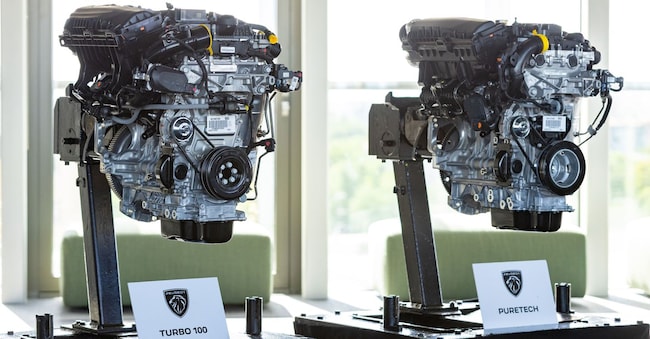
New engine or usual marketing operation? The Turbo 100 engine from Stellantis has the complicated task of restoring customer confidence after the Puretech affair, fitted to some 10 million Stellantis group vehicles and made famous by oil bath belt failure and excessive oil consumption. In order to solve the problem, not only of reliability but above all of image, Peugeot redesigned the 3-cylinder by fitting more than 70% new components. A necessary investment given the amount of engines that have broken down. Asked directly by Il Sole 24 Ore about the percentage of faults on the first-generation Puretech engines produced from 2014 to 2018 and the subsequent second-generation ones replaced from 2023 on the hybrid versions precisely by the Turbo 100 and now also on models with manual gearboxes, the Stellantis engineers did not provide precise numbers but confirmed low percentages. The problem, however, is the spread, with 5 million engines fitted to Peugeot models and 10 million cars in the group.
Given the volume of cars on the road, Peugeot offers a 10-year or 180,000-kilometre warranty for Puretech models already on the road, dedicated to the oil bath belt or oil consumption, and on new cars comes an 8-year or 100,000-kilometre warranty dubbed Peugeot Care on all models regardless of model and engine.
Turbo 100, where it is fitted
Developed by Peugeot, the Turbo 100 engine, as was also the case with the Puretech, is one of the most widely used engines in the Stellantis group's cars. Already used on hybrid cars with automatic transmission for more than two years, under the new name it made its debut on the Peugeot 208 in conjunction with the manual gearbox before being used on a long list of models including the Lancia Ypsilon, Citroen C3 and Fiat Grande Panda.
Turbo 100, what's different from the Puretech
Although the two engines are very similar in size and layout because they are fitted to the same models, they show substantial differences. Among the main differences are a new combustion cycle, now Miller cycle switching from tappets to finger rocker arms, redesign of the entire upper part of the cylinder head, strengthening of the cylinder block, redesigned pistons to reduce oil consumption and have stable oil consumption throughout the life of the engine. The list of modifications also sees a new injection system: in the Puretech with a 250 bar system while on the Turbo 100 it goes up to 350 bar. Another critical point was the oil separator; it was redesigned with internal valves with stronger material and a 10-year or 180,000 km warranty was put on the old component. A new turbocharger with a variable geometry turbine also arrived. The turbine becomes more efficient, allowing the exhaust gas temperature to be reduced.
Maxi test cycle and solutions for existing engines
In order not to make the same mistakes as in the past, Peugeot implemented a new evaluation cycle for the Turbo 100 with over 30,000 hours of testing. Some of the vehicles covered more than 200,000 km in the most extreme conditions, taking into account critical factors such as city traffic. Another key point is that in addition to having designed an engine free of congenital defects, there are now concrete solutions to resolve the shortcomings of the Puretech in circulation, starting with a new oil bath belt.

