Science

Steps towards space logistics and sustainability

D-Orbit engaged in project for refuelling satellites or moving them while in orbit

by Leopoldo Benacchio

3' min read

3' min read

Near-Earth space is precious but overrun with satellites, there are many thousands of them, and soon, with the constellation race of small satellites underway from Europe to China, the situation will become less and less sustainable. This word: sustainability, now pervades even future space projects, not only those concerning life on Earth.

In order to improve, if not resolve, a situation that risks leading to the impossibility of launching further satellites both in low orbit, an effect known as Kessler syndrome, and in geostationary orbit, populated instead by a few but very important vehicles, it is necessary to bring into space services, almost workshop or laboratory-like, that until now have been typical of ground operations, such as refuelling, maintenance and in the future perhaps even satellite construction.

Loading...

Satellites in orbit

.

This is in-orbit servicing, one of the workhorses of D-Orbit, the space logistics company from Fino Mornasco, Como, which is involved in two important projects.

The first is financed by the Pnrr and led by Thales Alenia Space. It deals with a very important topic for the future: the refuelling of a satellite in orbit. The action takes place between two different spacecraft one, built by Thales Alenia Space approaches a target satellite, of D-Orbit, and docks it, after which the latter will take care of the fluid transfer.

The refuelling manoeuvre is essential to enable far-flung destinations to be reached in the future and to transport important loads, sacrificing space for the fuel at launch, which will then be delivered into orbit. It is already planned for the Artemis missions to the Moon, but is by no means simple, due to the typical conditions of space: microgravity, very low temperatures, and the need for precision in all manoeuvres.

The Frontiers of Maintenance

.

The second project, the Rise mission, on the other hand, was financed by the European Space Agency, which is very attentive to sustainability issues, D-Orbit is the Italian lead partner, and the planned funding is EUR 119 million.

The life extension of a satellite goes far beyond just refuelling, but for this 'low orbit does not represent a real market, the satellites here are small, they last a short time, eventually the only further problem is to remove them from their orbit at the end of their mission,' says Renato Panesi, co-founder and commercial director of D-Orbit. Quite a different situation is that of geostationary orbit, 36 thousand kilometres from the earth's surface.

There are only a few very important, as well as large and expensive, utility satellites there, such as those for transmissions. There are several operations to be performed, basically related to maintenance: refuelling the target satellite with fuel, which it has run out of, thus extending its life, or carrying out a visual inspection, to understand the health of the satellite and its panels or assessing any damage that would recommend its replacement.

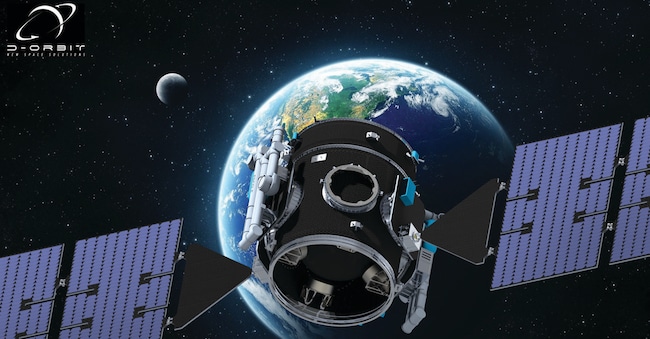
In 2028, D-Orbit plans its first experiment in geostationary orbit with its Gea vehicle, a service module, which in turn is a satellite, capable of attaching itself, with an electromechanical system, to a target and also operating with a robotic arm. Once anchored, Gea will change attitude and orbit, manoeuvring to return the customer's spacecraft to the desired orbital condition. The first customer could be a telecommunications satellite that is running out of fuel, which with the help of Gea could remain in action for several more years.

Panesi: 'Extending the life of satellites'

.

"The real point is to extend the satellite's life," Panesi continues, "so you take control of it if it has shifted, due to the perturbations caused by gravitation, and return it to its rightful position or supply it with electricity, if the panels are low functioning or fail due to obsolescence. In simple, and somewhat brutal terms, it involves building a vehicle that is at once an auxiliary engine, a power bank and a tow truck. A system, capable of approaching satellites and changing their orbit, which may well have a future in defence.

With these two projects, Italy is taking a decisive step forward in the field of space logistics, a new sector that should not be confused with buzzwords: it is not just about transport or delivery. It's about 'escorting the customer, i.e. its satellite, from launch to servicing to removal at the end of its life, from the large satellite to the many-satellite situation,' sums up Panesi, and on the horizon we can see the construction of new satellites in orbit, also using parts of others that are now inactive

Copyright reserved ©
Loading...

Brand connect

Loading...

Newsletter

Notizie e approfondimenti sugli avvenimenti politici, economici e finanziari.

Iscriviti