
StMicroelectronics brings humanoids to chip factories
Plan to introduce more than a hundred robots in factories, starting with those abroad, by 2027. Supply agreement with the Italian
by Nino Amadore
 Aggiungi Il Sole 24 Ore
ai preferiti su Google
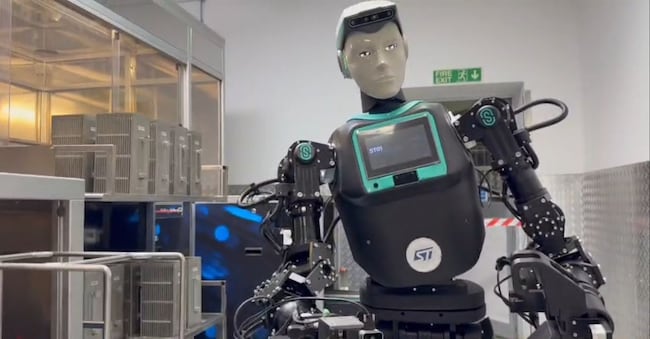
The first has already been seen at work in Malta: a humanoid robot working in the StMicroelectronics plant dedicated to advanced packaging and chip testing. Not an exhibition machine, not a technology fair prototype, but a humanoid embedded in a real production process.
This is where StM's new plan starts: to introduce humanoid robots in the group's factories to automate the toughest, repetitive and physically demanding tasks, freeing staff from low-value-added jobs and moving them to more skilled tasks.
The programme reportedly envisages the introduction of more than a hundred humanoids by the end of 2027, distributed progressively across the group's sites. The first phase will concern non-Italian plants, starting with Malta, where the first robot is already operational. In the coming years, however, the transformation may also affect the Italian plants of StMicroelectronics, within a broader strategy of automation, efficiency recovery and reorganisation of mature factories.
"The robot performs tasks that used to be carried out by humans, but we have mainly intended it for activities that operators would not do willingly," says Fabio Gualandris, president of Quality, Manufacturing and Technology at StMicroelectronics. "These include cleaning machine parts that are still hot, tasks that also require the use of rather dangerous chemicals. This entails the need to wear heavy and uncomfortable protective equipment to protect oneself from the heat and the risks associated with the substances used".
Behind the choice of humanoids there is also industrial selection work. StM studied the world market of suppliers. The first issue that emerged was security: in a semiconductor factory, a humanoid is not just a machine, but a system with software, sensors, connections and potential access to sensitive processes. For this reason, the group moved cautiously, evaluating several suppliers, including Asian ones, before opting for an Italian start-up. "They are not machines to be controlled remotely, with a joystick. That is a scenic technology, in some ways fun, but it still needs years,' is the reasoning behind the industrial choice. We have taken a different path: not robots designed to make an impression, but solutions focused on industrial applications.

