
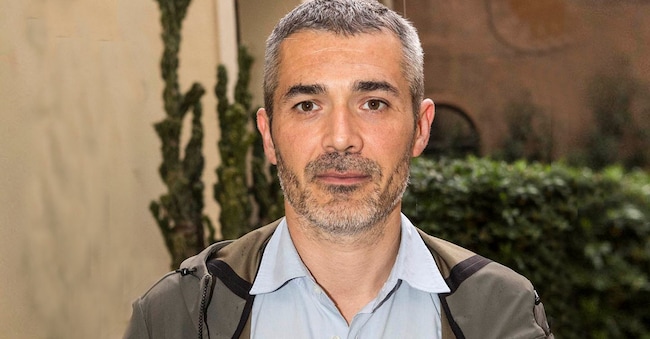
Stocchi: not an act of self-celebration, but of confrontation
Director of the Maxxi in Rome, he has already curated the Swiss Pavilion in Venice in 2022 and co-curated the 34th edition of the São Paulo Biennale in 2021

6' min read
6' min read
Francesco Stocchi, born in Rome in 1975, is among the ten curators whose proposal has been selected by the MiC Evaluation Commission, composed by the General Director of Contemporary Creativity and Commissioner of the Italian Pavilion Angelo Piero Cappello (acting as president), by the president of the Technical-Scientific Committee for Contemporary Art and Architecture Claudio Varagnoli and by three high-profile scholars in the field of contemporary art: Ester Coen, Luca Aurelio Aldo Cerizza and Valerio Terraroli.
Since 2023 Stocchi has been artistic director of the MAXXI in Rome, was active for many years in Amsterdam as curator of the Museum Boijmans Van Beuningen in Rotterdam, curator of the exhibition programme of the Fondazione Carriero in Milan, member of the Comité consultatif du Fonds de dotation de la Fondation La Fayette in Paris and head of the artistic programme of the Fondazione Memmo in Rome. In 2022 he was curator of the Swiss Pavilion at the 59. Venice Biennale and in 2021 he co-curated the 34th edition of the São Paulo Biennale.
Tell us about yourself, your path and your curatorial vision? Above all, which exhibitions, in terms of impact and importance, can be qualifying of your path?
Talking about myself I find a complex exercise, perhaps because I feel more like an observer than an actor, perhaps because it would be better to let others talk about me, it would mean that you have left traces of interest and stimulation, which is then the essence of our work. Thinking about the exhibitions that I remember most carefully, I notice that they are all of a different nature one from the other, this is because doing an exhibition I understand it as answering questions, rather than exhibiting the result of acquired certainties. And the questions are constantly changing. They are, if you like, process exhibitions in their essence, where conceiving and developing them brings us closer to resolving our own curiosities. My exhibitions are first and foremost a matter of personal origin, relative therefore and not absolute. Perhaps this comes from my training as an anthropologist and not as an art historian. I acquired art by observing my mother and father who have always breathed art and in the 'workshop' of the arista Nunzio from the age of 15. Field work, if we want to use an anthropological terminology.The 34th Sao Paulo Biennial (2020) co-curated with Jacopo Crivelli Visconti, explored the dimension of opacity, of what happens when the chords of the undefined, the suggested, the hinted at and the multiform vibrate, as opposed to the dictatorship of the clear and manifest. The richness of opacity, of being able to say various things at the same time, as in poetry. In fact, the Biennial was entitled 'Faz Escouro mao canto', a verse by the Brazilian poet Thiago de Melo, a not too veiled reference to the socio-political situation the country was experiencing at the time.
In 2013, when I was a curator at the Boijmans van Beuningen Museum in Rotterdam, reasoning about the increasing diffusion of images through social media, galleries were starting to send pdfs of their offerings, sites had digital rooms... something was changing in the fruition of works. I wondered what the work was losing or gaining through its representation, so I ended up developing a study in the relationship between photography and sculpture, perhaps the medium that suffers most in the transposition from three-dimensional to two-dimensional. I connected three artists who had worked on this relationship: Medardo Rosso, Costantin Brancusi and Man Ray. The exhibition was entitled Framing Sculpture. Each had emphasised the importance in controlling the image of their work and how the work would profit from this transposition, beyond the logic of dissemination/promotion. Sculptures had been associated with photographs taken by the authors themselves (a common practice for all three), offering the public a comparison between work and representation. It was a way of talking about current events, exhibiting works from 50 or 100 years earlier.
Another collaborative exhibition was a study on Sol Lewitt. Given the spatial sensitivities of Lewitt's work, mixed with its (apparent) conceptual rigidity, I invited Rem Koolhaas to reason together about the (possible) freedom the artist allowed within the rules. The humanism behind Lewitt and behind respect for the rule in general. Lewitt revealed himself, first and foremost in our eyes, to be a subversive and irrelevant 'self-imposed rule-abiding' artist, hence the exhibition 'Sol Lewitt, Between the lines' at the Fondazione Carriero, 2017. The same thing happened on Pino Pascali the same year, trying to pull him out of a Mediterranean vision that in my opinion limited his poetics rather than giving it oxygen. Offering new ways of reading, making a comparison between Pascali and shamanism of African origin. For Pascali, every exhibition was a theatrical mise en scene and his works were precisely staged in a dramaturgy, just as when he invented an unprecedented performance genre using his sculptures as the sets for his actions, a bit like the African masks that are activated when they are worn, subject to a strong structuralist logic, just like Pascali.


