Stories of stone and mysteries along the ancient nuraghi routes
Routes through traditions, villages and nature inspired by the monumental, thousand-year-old constructions scattered throughout the island, ready to become a World Heritage Site

Key points
The official estimate is one nuragic monument every two square kilometres, a wealth that has been protected for six years by the 'Sardinia towards Unesco' movement, which aims to obtain recognition as a World Heritage Site for the region's entire archaeological treasure, consisting of more than ten thousand sites. To this end, a series of 'Dialoghi nuragici', 32 events involving no less than 120 associations, will be held until June.
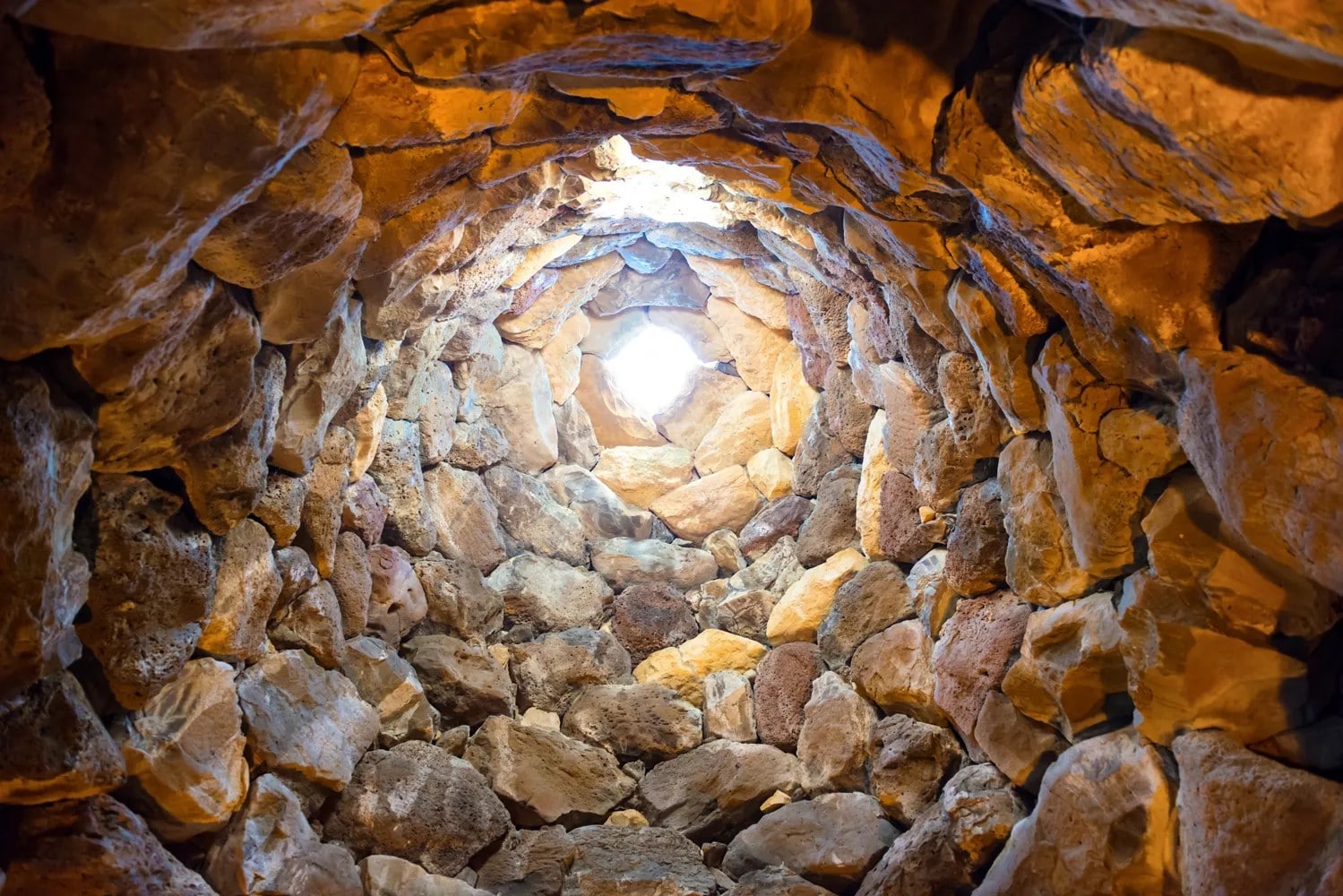
A voyage of discovery of these monumental constructions, erected by arranging large dry-stone rows - their name probably derives from the archaic word nura, which indicates the superimposition of tabular structures - and imbued with sacredness, magic, and magnetic power can begin near the Giara, in the central-southern part of the island, in Barumini, where Su Nuraxi stands: the most famous of the nuraghi, and already a Unesco heritage site since 1997, it develops around a central basalt tower, connected by a rampart to four other angular constructions, with a labyrinth of fifty circular huts, wells and cisterns, boasting a stratification of epochs from the 16th century B.C. to the 7th century A.D.C. to 7th A.D.. Curious, right in Barumini, is the presence of the Spanish Casa Zapata, home of the Aragonese family that arrived in 1323 to conquer the island in the retinue of the infante Alfonso IV, which now houses an archaeological museum and a section dedicated to traditional three-pipe musical instruments called launeddas. To learn about the cuisine of the geographical area called Marmilla, the choice falls on Sa Lolla, where the dishes, cooked in the fireplace and based on asparagus, cardoons, legumes, convey all the flavours of local authenticity.
Vicino Sassari
Moving on to Logudoro, the Santu Antine Nuraghe of Torralba appears on the horizon just as grandiose: named after the emperor Constantine, with its current height of 17 metres (originally 24), it is the tallest in pre-Nuragic antiquity, surpassed only by the Egyptian Pyramids. A first flight of stairs leads from the courtyard to the upper galleries, a second leads to the ramparts of the bastion that resemble those of a medieval castle. A short distance away, one can also embark on an equally spectacular volcanic trek that takes in the Santu Bainzu hill of Thiesi, where two eruptive mouths can be recognised, the practically twin mountains Pabulena di Ploaghe and Ruju di Siligo, the sinuous Annaru-Pòddighe di Giave and the tabular Monte Pélao amidst sharp, conical and rounded ups and downs.
In the Oristanese
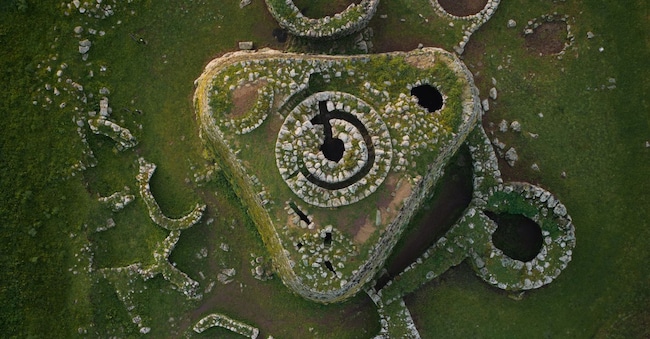
areaAlso enchanting, on the Abbasanta plateau in the Oristano area, is the Nuraghe Losa, which, with its equilateral triangle plan, looks like the prow of a ship from above: dating back to the Middle Bronze Age (15th-14th century B.C.), it was also used as a funerary monument in Roman times. And in the nearby village of Ghilarza, it is worth visiting the Casa Museo Antonio Gramsci, the home where the founder of the Italian Communist Party spent his childhood and adolescence in modesty. Continuing our journey towards Sarcidano, in central-southern Sardinia, we come across the nuraghe Arrubiu in Orroli, surrounded by a mighty bastion formed by five towers and a defensive wall with an equal number of seven towers joined by curtains that then rise to 21: you can even penetrate its central chamber containing a hearth and a ritual vase. To enjoy the atmosphere of this ancestral place at any hour of the day, one can stay at Omu Axiu, a 16th-century manor house converted into an Albergo Diffuso, where a museum recounts traditions related to agriculture and weaving, and one can also attend lessons held by Mrs. Tonia Vargiu to learn how to make pasta by hand, such as macarrones, made with knitting needles. Instead, in the heart of the Porto Conte Natural Regional Park near Alghero, stands the Nuraghe Palmavera, almost overlooking the bay that the Romans called 'port of the Nymphs'. At the north-western end of the island, this village dating back almost 4,000 years was erected with blocks of limestone and sandstone, and consists of a central body and about fifty huts, including one that was supposed to host community meetings, as can also be seen from the seat in the centre, reserved for the chief. It is there that a model nuraghe was found, now housed in the Sanna Museum in Sassari, and it is from there that one can continue the exploration of the island's history at the sites of Sant'Imbenia, the island's oldest Phoenician seaport, and among the remains of a luxurious Roman villa.