
Stories of monumental trees as symbols of resilience and courage
Green Heritage. Northeastern Italy holds the record in the census promoted by Symbola: the transgressive magnolia of Gorizia, the lion king stone pine and the giant sequoia that survived Vajont
4' min read
4' min read
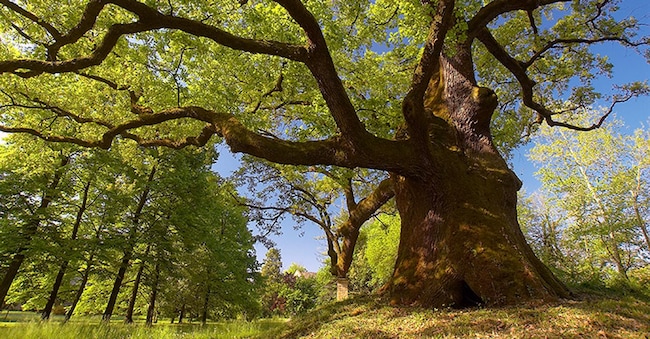
Small Italian municipalities guard the extraordinary and varied heritage of monumental trees, which with resilience have traversed the centuries and now dot the countryside and stand out in built-up areas, offering a unique imprint to the landscape design. This is a green deposit that represents a fundamental asset for the territory, the valorisation and conservation of which is even more urgent in the context of the current climate crisis, characterised by extreme events that threaten the survival of many specimens. The record for the presence of these historical plants belongs to the North East: Friuli-Venezia Giulia, with 454 green monuments is the region that leads the national ranking. Of these, almost half, 209 trees, are to be found in small towns.
A publication now catalogues their existence and position throughout the Boot, province by province: this is the report Piccoli comuni e alberi monumentali d'Italia (Small municipalities and monumental trees in Italy), promoted by the Symbola Foundation in collaboration with the Ministry of Agriculture, Food Sovereignty and Forests, Coldiretti, Fai Cisl and Ami (Monumental Trees of Italy). The census concerns the most precious component of our forest heritage, which generates added value from an environmental point of view and opportunities for economic growth, especially in terms of tourism and therefore development for both medium and large-sized cities and small municipalities. The text leads to the discovery of the more than 250 species that populate the country, where there are 4,287 monumental trees (as of last April), 2,107 in small municipalities. It is precisely in these villages that, according to Ermete Realacci, president of the Symbola Foundation, 'new initiatives by young entrepreneurs, supported also by information technology and technologies' can be born.
The report tells, in fact, territories and also many stories through the presence of these green monuments. For example, in Friuli Venezia Giulia, a border area at the centre, in recent centuries, of claims, continuous border shifts and irredentism, the centuries-old magnolia tree in the public gardens of Piazza Cesare Battisti, in Gorizia, was planted in the mid-19th century to transgress the ban on displaying the Italian flag during the irredentist uprisings. With its evergreen leaves, white flowers and red fruits, in fact, this tree represented an alternative tricolour in a natural version. Changing region and moving to Trentino Alto Adige - which has 137 monumental trees, 89 of them in small towns - precisely in Val di Fiemme, at Pian de la Fava, in the small Castello-Molina, a stone pine known as 'the Lion King' grows instead. The name of the tree has nothing to do with Walt Disney's cartoon, but derives instead from the lumberjack Leone di Masi di Cavalese who, in 1970, was commissioned to fell the plant but, partly because of the technical difficulty, partly because of the respect the specimen commanded, decided to spare the tree, on whose bark the sign of the forest hammer can still be seen today, to remind us of the danger averted. Also worth mentioning is the Paneveggio spruce forest in Predazzo, Trentino, known to violin makers all over the world for the exceptional quality of its wood. Also known as the 'violin forest', it is in fact made up of centuries-old spruce trees that, due to the quality of their fibres, are perfect for sound propagation and are therefore called 'resonance trees'. Sought after by luthiers all over the world, the wood from these spruces is used to make soundboards for pianos and violins. The Cremonese luthier, Antonio Stradivari, is also said to have visited the forest several times to choose the raw material with which to make unique instruments.
Finally, in Veneto, the 256 monumental trees surveyed have sometimes become symbols of resistance such as the giant sequoia of Longarone, in the Belluno area, which survived the Vajont tragedy. The tree, originally from Sierra Nevada, California, is about 170 years old and until the 1950s was known as the tallest sequoia in Italy, before lightning struck its top, lowering it a few metres. On its trunk, at a height of 5 metres, it is still possible to see a large wound caused by the wave of water, mud and debris that swept over the village, razing it to the ground. More generally, the Belluno area was considered by the Serenissima to be a reservoir of resources necessary for the construction of the Doge's fleet, to the point that ad hoc laws were enacted for sustainable forest management. Other green monuments, also in the region, have instead imprinted toponymic content on communities such as the turkey oak that gives its name to the village of Cerro Veronese, in Lessinia.
"This second edition of the report," points out Alessandra Stefani, director general of Masaf's Mountain Economy and Forests, "strengthens the collaboration between the Symbola Foundation and the ministry responsible for the List of Italy's Monumental Trees, one of the country's most prestigious and precious natural and cultural heritages. The work has the merit of raising awareness of the existence of these specimens, guarded by 962 small municipalities over which 50% of the ultrasecular plants are distributed'. Coldiretti is also among the promoters of the publication because it is precisely the farmers, as recognised by the Guideline Law, of which the confederation is a promoter, who are 'custodians' of the environment and its heritage. "In addition to the conservation and valorisation of local productions, farms have become qualified interlocutors of public administrations in the management of the territory, starting precisely with the defence of monumental plant and tree formations," concludes president Ettore Prandini.

