
Strait Bridge, mayors' comments and replies delayed
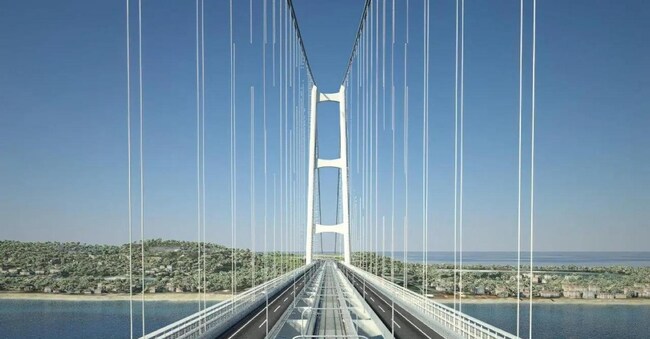
According to an environmental engineering study, drawn up for the municipality of Villa San Giovanni, any type of construction work in the vicinity of the pylon area is excluded. The territories on the alert

4' min read
Key points
4' min read
The observations on the Strait Bridge that the municipalities of Villa San Giovanni and Messina, along with the Metropolitan City of Reggio Calabria, should have submitted to the Ministry of Infrastructure by 8 June have been postponed. The administrations have requested "the suspension of the terms of the preliminary conference until the date of 12.09.2024, or in any case, until the possible further term of suspension of the 'parallel' services conference before the Ministry of the Environment and Energy Security".
The territories want to see this through
.The territories need to see clearly: 'The local administrations' assessment cannot disregard the knowledge of the studies and findings of Stretto di Messina,' explains the mayor of Villa San Giovanni Giusy Caminiti, 'which will substantially modify the bridge project. Therefore, before formulating our observations, we need the right timing to allow us to verify and analyse what will be produced'. A need also shared by the mayor of Messina Federico Basile and that of the metropolitan city of Reggio Calabria Giuseppe Falcomatà.
Messina Strait: 4 more months to respond to Mase
After all, it was the Stretto di Messina company that took its time ("considering the exceptional importance of the work"), requesting the Mase to extend by at least 120 days, i.e. until mid-September, the deadline for delivery of the supplementary documentation for updating the project for the stable link between Calabria and Sicily, with all the answers to the 239 additions on issues of environmental impact, earthquake and tidal wave risk, and cost-benefit analysis. As a result, even the approval of the CIPESS, initially announced for June, is postponed to at least December. In the meantime, managing director Pietro Ciucci reassures the territories by reiterating that "the work does not present any criticality from the point of view of technical and structural safety". That on the contrary, 'the final project fully identifies the works to be carried out'. And that 'the executive project will be drawn up in accordance with the final project and will determine in every detail the works to be carried out'. The proposal of the terms requested to Mase "reflects the company's willingness and maximum commitment to provide timely and exhaustive answers to the requests for integrations and clarifications".
Caminiti: armouring procedures and excluding territories
"The problem," insists the mayor Caminiti, "is precisely postponing to the executive project phase any details and technical in-depth analysis, such as that on the construction site, for example, or on the resolution of interferences, then after the approval of the CIPESS. A procedure that armour-plates Stretto di Messina, but excludes the territories which, at that point, will no longer be able to express themselves.
Fears of Villa and Messina
And if Messina fears for the city's resilience (the construction site, the water supply, the delicate ecological balance of an area protected at international and EU level, the need to give priority to complementary works), Villa San Giovanni, expressing more or less the same fears, adds a further concern due to the presence of 'active and capable faults' on the Calabrian side, as reported in his technical remarks by Paolo Nuvolone, an environmental engineer from Milan, who knows the area in depth for having already dealt with the hydraulic system of the Fiumare.

