Infrastructure

Ponte sullo Stretto, territories' dissent on the feasibility of the work. Europe confirms its strategic role

Impossible, according to the mayors of the municipalities affected by the project, to evaluate Stretto di Messina's documentation: it lacks in-depth and detailed studies. In the meantime, the EU is providing 25 million euro to cover the costs of the executive design (railway side)

by Donata Marrazzo

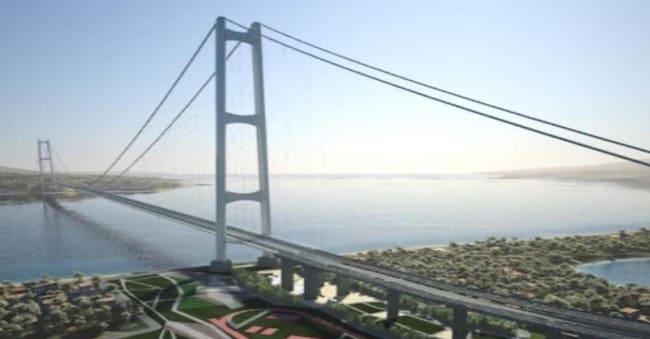
Un rendering del Ponte sullo Stretto.

6' min read

6' min read

The mayor of Villa San Giovanni and the mayor of Messina proceed more or less in unison. "We want to protect the city and its inhabitants, because today we are called upon to express ourselves on design documents, on deeds and not on hypotheses of transport development and economic growth," says Giusy Caminiti. "We note that Stretto di Messina has proposed mostly descriptive solutions that are not represented in technical and feasibility terms, and doubts have been confirmed for the various issues dealt with," says Federico Basile from the Sicilian side.

Mayors' cautions, SdM's fast pace

The mayors of the two cities are more than cautious, indeed, they are often in clear disagreement with Stretto di Messina (concessionaire of the single-span link project between Calabria and Sicily) which would instead like to proceed swiftly in order to collect the go-ahead from CIPESS by the end of the year. In order to resolve all the critical issues encountered, the Stretto di Messina company has supplemented the documentation submitted to the Ministry of the Environment with 800 project documents, "but with a scant degree of thoroughness," according to the mayor, Caminiti, "without addressing all aspects of the work's feasibility and design details, postponing investigations, tests and the design of essential works to the executive project, and without even considering the fact that, for Villa San Giovanni, the construction site will mean a net interruption of territorial continuity, breaking the city in two.

Loading...

Grant Agreement, 25 mln for executive co-design

Meanwhile, the company led by Pietro Ciucci has just signed a Grant Agreement with Cinea (the European Commission's Climate, Infrastructure and Environment Executive Agency) for the European co-financing of the executive design costs of the bridge over the Strait of Messina. A non-reimbursable contribution of about EUR 25 million will cover 50% of the costs, for the part attributable to the railway infrastructure. "The signing of the subsidy agreement," commented Stretto di Messina CEO Pietro Ciucci, "together with the recent inclusion of the bridge in the Scandinavian-Mediterranean corridor by the European Council, confirms the strategic role of the project and lays the groundwork for finding additional resources to cover construction costs, with concrete prospects of reducing the burden on the state budget. For Minister Matteo Salvini it is "the confirmation of the seriousness of the project and its supranational interest, despite the 'No to progress' ultras who are doing Italy harm".

The burning issues

.

On the territories, however, other issues are burning, affecting the landscape, the urban fabric, and the life and future of communities: the first citizens of Messina and Villa San Giovanni highlight SdM's failure to carry out investigations and analyses on both the Sicilian and Calabrian sides. "In Calabria, this can be deduced, for example, from the filing of monographs and assumptions that are not based on further scientific data," writes Giusy Caminiti in the document sent to the Ministry of Transport. "Moreover, the picture, in some respects, is even worse than what this body had previously been able to study and highlight. And they express the same objections regarding the possibility of developing adjustments to the project during the executive phase.

Hot spots on the Calabrian side

.

A hot spot on the Calabrian side is the Cannitello fault under the bridge abutments. The company, in the design documents filed with Mase, "admits its existence but minimises its effects," glossing over, for example, "the constraint of absolute non-protection placed by the legislator," emphasises Caminiti, for whom the documents produced "are not considered exhaustive and pose further perplexities on the feasibility of the work. An obvious discrepancy was found by the environmental engineer Paolo Nuvolone, consultant to the Calabrian municipality, who found attached to the company's documentation a table that gives 'a representation of the territory concerned without faults, which cannot be found in any other study or official cartographic elaboration'.

Dynamics, 'soft' barrier rejected by Region

Another critical issue, coastal erosion: the Dynamica project, also delivered by SdM to the ministry, envisages a 'soft barrier', a modular structure in reinforced concrete, laid on the seabed to protect the Villa San Giovanni coastline, from Cannitello to Punta Pezzo. But it was already rejected by the Region last March. "How is it possible," wondered the mayor, "to think of proposing the construction of a pier for the mooring of barges for the transport of material from the port of Gioia Tauro, given that the platform would then cut the barrier in two? The interference between the two works has not even been verified. What, then, is the compatibility of the bridge with the city's development plans? What is the construction project?".

Unfinished business

.

The conclusion is that, seen from Villa San Giovanni, as from Messina, the updated bridge project 'does not rise to the level of final design from any point of view, technical, economic, environmental, landscape, and lacks detailed studies and a construction site project that would allow comprehensive and complete assessments to be made. The findings produced by the SdM have no impact on the evaluations that this body,' Caminiti pointed out specifically, 'is deputed to carry out given the lack of detailed studies and specific designs. Unresolved issues remain: pollution, urban regeneration and environmental protection - starting with the protection of the Laminarie ochroleuca forests -, the 'cutting' of the water and sewage network, public lighting and alternative roads.

Preliminary works worth 135m euro

For the opening of the construction site, the Calabrian municipality is asking MIT for €135 million in preliminary works concerning the water, sewage, public lighting and alternative road network. "We will also soon produce the cost of environmental monitoring. We have also reiterated the request to suspend the preliminary conference until the outcome of the Environmental Impact Assessment procedure, integrated with that of the Environmental Impact Assessment and the verification of the Plan for the use of excavation earth and rocks, as well as until the deadline for the presentation of the so-called design by progressive construction phases. At Mase, however," Caminiti continued, "we expressed the non-exhaustiveness, omission and partiality of the integrations provided by Stretto di Messina.

Inquiries to the Mase and the Cipess

In a municipal resolution, therefore, Villa San Giovanni asks the Ministry of the Environment to urge Stretto di Messina to provide, "on pain of a negative opinion, the submission of all the documentary documents that can qualify this project as a definitive project as required by law, including the resolutions of interference for the town of Villa San Giovanni; otherwise, the Mase will suspend the assessment in itinere pending detailed studies". And, in order to protect the citizens affected by expropriation, it invites the CIPESS "to suspend the declaration of public utility of the work in the event that the prescriptions to the executive design to be carried out by "progressive construction phases" affect the identification of the area to be expropriated; in the alternative, the municipality's document states, 'the CIPESS will refrain from declaring the work to be of public interest, referring to the projects that will be submitted from time to time in the various "construction phases", pursuant to Law 120/2024, in order to protect the expropriated persons, who would otherwise be deprived ab initio of one of their rights, without any guarantee that the works will actually be carried out'.

The doubts of Federico Basile

.

The mayor of Messina's assessments are also unequivocal: "Doubts persist with regard to the construction of the various bridge and ground works, with respect to the liveability of the city and, in particular, with respect to traffic, emissions and noise," Basile says. "But also with respect to the impact on protected natural areas and areas of particular landscape and environmental value, with respect to technical shortcomings in terms of connections and the planning tools that will be disrupted by the bridge work. In addition, specific attention has been paid to the water resources required,' the mayor continues, 'for the realisation of the works connected to the bridge, as the simple forecast that it will not be necessary to connect to the city's water network without proposing feasible design solutions in terms of the timetable and the necessary flow rates is not satisfactory.

"Messina thought of as an empty city of 200,000 inhabitants"

.

In the light of SdM's additions, Basile's position becomes radical with respect to the urban planning issues that affect the community and the ongoing development of the area: "The project seems to be set in a sphere that does not look at the presence of a city that has to live and coexist with construction sites from north to south every day, but seems to be designed in a sphere that is empty of the daily life of 220,000 inhabitants in addition to commuters, university students and workers, and a tourist and production reality that is developing.

Copyright reserved ©
Loading...

Brand connect

Loading...

Newsletter

Notizie e approfondimenti sugli avvenimenti politici, economici e finanziari.

Iscriviti