Aviation crisis

Strait of Hormuz: alternative jet fuel supplies are not enough

For analysts, flows from the US and North Africa averted risks in the short term. UK opens up to Russia and Germany to Israel
3' min read

Translated by AI
Versione italiana

3' min read

Translated by AI
Versione italiana

by Mara Monti

Airlines celebrate on the stock exchange the more concrete signs of a possible agreement between the United States and Iran. Markets are betting on an easing of tensions in the Middle East and, above all, on the reopening of the Strait of Hormuz.

Loading...

No one, however, is under any illusions. Even if Hormuz, through which some 30% of aviation fuel destined for Europe transited before the crisis, were to reopen tomorrow, it would still take months to return to normal.

Alternative supplies of jet fuel only partly compensated

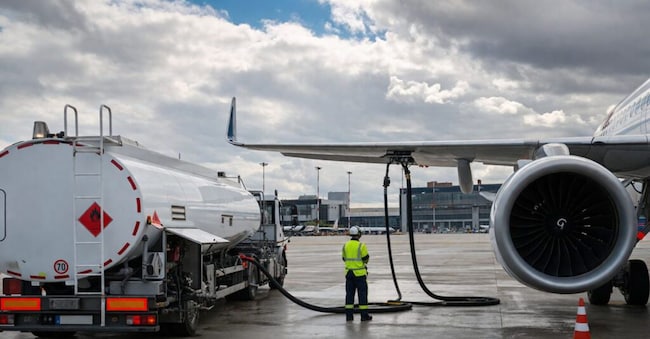
For the time being, the risk of fuel rationing in Europe, which has already emerged in some Asian countries, seems to have been averted. "Supply has remained stable thanks to jet fuel from the US and Nigeria, via the Dangote refinery," explain analysts at Kpler, a company specialising in oil sector analysis. Despite the improved scenario, risks remain high. Alternative supplies have only compensated for the needs of April and May and may not be enough in the long run. In that case, many countries would be forced to draw further on strategic stocks, which are already close to their lowest in five years.

Refineries are working at full capacity

Rising prices prompted many refiners to redirect cargoes initially destined for other markets to Europe, more quickly than expected offsetting the loss of supplies from the Gulf.

European refineries are working at full capacity. In the Netherlands, for example, part of the diesel production has been converted to jet fuel, which is now more profitable. However, jet fuel requires more complex processes, management and logistics than other distillates and is not produced in all European plants, as the cases of the Exxon refinery in Antwerp and the German MiRO show. Rapidly increasing production would mean high logistics costs for relatively small volumes.

The most exposed European countries

The most exposed countries remain France and the United Kingdom. London, in particular, is in a more fragile position because it is Europe's largest net importer of aviation fuel and has smaller stocks after the closure of some strategic refineries.

The UK opens its doors to Russia

The UK itself authorised the import of jet fuel obtained by processing Russian crude oil in third countries. The licence includes diesel and jet fuel refined in India and China from Ural oil, then exported to the British market. The move has provoked strong criticism from British and Ukrainian MPs, who accuse the Starmer government of easing economic pressure on Moscow. The Trade Minister, Chris Bryant, however, clarified that the measure was temporary and was taken 'in light of the situation in the Middle East'.

... and Germany to Israel

Germany also moved to strengthen supplies. In fact, Berlin accepted Israel's willingness to transfer jet fuel after the German government's request for assistance following the Hormuz crisis. Neither the quantities nor the timing of the agreement have been disclosed.

The reaction of the airlines

In April, airlines had sounded the alarm about possible fuel shortages during the summer. In recent weeks, however, the tone has become more optimistic, although many carriers have already raised fares and reduced some routes. Delta Air Lines, for example. expects fuel costs to rise by $2 billion by June 2026. CEO Ed Bastian said that rising oil prices are the main pressure on the industry, leading to capacity reductions of 3.5% and maintaining high fares to protect margins.

Lufthansa Group estimated an increase in fuel bills of EUR 1.7 billion in 2026. To counter the costs, the group has cancelled some 20,000 flights scheduled until October 2026 to save 40,000 tonnes of paraffin.

United CEO Scott Kirby warned that if prices remained at current levels, the company would face $11 billion in extra annual expenses for fuel alone. United has already cut about 5% of its planned flights for the second and third quarters of 2026.

Air France-KLM, on the other hand, expects the fuel bill for 2026 to increase by EUR 2.4 billion. Consequently, it reduced its annual capacity growth forecast from the previous 3-5% to 2-4%.

Finally Ryanair, which although it has hedged 80% of its fuel requirements until April 2027 at a fixed price of around USD 67 per barrel, the company warned that the remaining 20% not hedged is suffering from market increases. CFO Neil Sorahan described the situation as a potential 'Armageddon' scenario for weaker companies that do not have adequate hedging.

The danger has been postponed

Is the danger, then, really over? Not entirely. According to Morgan Stanley, 'the market underestimates a scenario of high fuel prices for a prolonged period, with consequences for inflation, demand in the summer of 2026 and the fares of low-cost airlines, which may be forced to reduce prices to sustain traffic'.

Disruption, therefore, has not been avoided: it is only postponed.

Copyright reserved ©
Loading...

Brand connect

Loading...

Newsletter

Notizie e approfondimenti sugli avvenimenti politici, economici e finanziari.

Iscriviti