Strategies for sleeping well: the phenomenon of Ping Minimalism
Disconnect from technology with paints and fabrics that shield radiation and electromagnetic fields in the bedroom. Goal: banish notifications before bedtime.
by Margherita Proietti
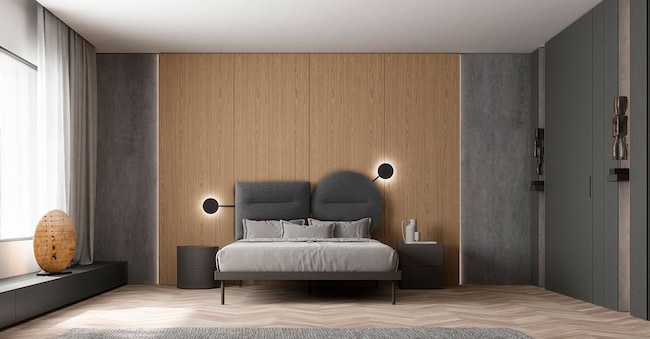
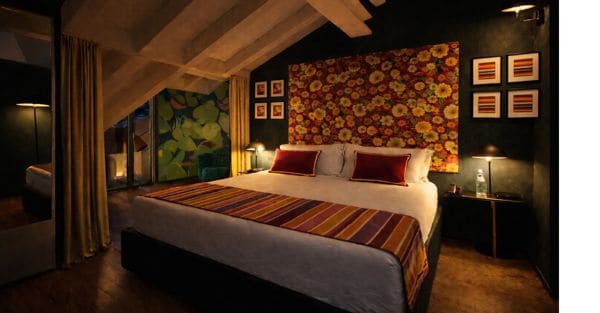
Entering the Off Room at Hostal Grau in Barcelona, the first thing you notice is not what is there, but what is missing. No routers in sight, no bright stand-bys or flashing lights. The wifi can be switched off, replacing it with a cable. Beneath the white paint on the walls is a layer of shielding paint that reduces the radiation generated by networks, smartphones and antennas. The room represents one of the latest changes in interior design: spaces designed to disconnect from technology, with effects on behaviour, but also on the body. As a conscious act of self-care. Many people want to reduce radiation in the home, and they do so for different reasons.
There are those who suffer from electrosensitivity - headaches, difficulty concentrating -, even though for the WHO there is no evidence that those symptoms are caused by exposure to the fields. And there are those who sleep badly: blue light inhibits melatonin, notifications break our rest even when we do not open them. Italians spend an average of almost three hours a day looking at their mobile phones, concentrated between the morning as soon as they wake up and the evening before bed, the same hours that used to be marked by silence. In the United States, it is more than five hours, 14 per cent more than in the previous year. At some point someone stopped wondering how to use the phone better and started wondering how to build rooms, buildings, hotels, where it finally doesn't pick up.
"This need has a precise name: Ping Minimalism," says Sara Maggioni of WGSN, a leading global trend analysis company, which included it in the report Future Consumer 2027: Emotions. "After pandemics and polycrisis, emotions have become the main driver of consumer behaviour, fuelling a desire for a less overburdened life. A mistrust of technology is also growing, prompting a redefinition of the boundaries of connectedness'. For 2027, WGSN identifies the witherwill, a term coined by writer John Koenig in the Dictionary of Obscure Sorrows, as a key emotion for 2027, to denote the desire to free oneself from responsibility. "The problem is not technology itself, but compulsive use: constant notifications, scrolling, addiction designed by the platforms themselves. Change mostly comes from building new daily habits, such as setting limits and establishing offline moments'.
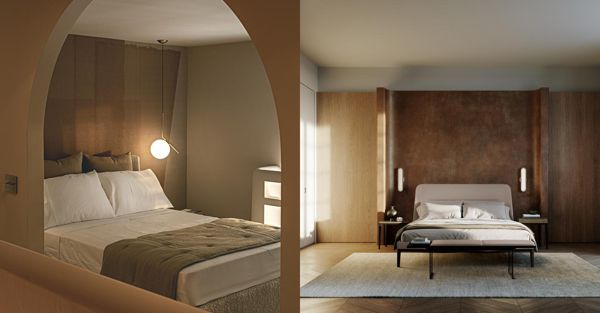
But outside the trendy studios and inside real life, someone has already started to act on the walls of rooms. The market for shielding materials works on a physical principle, the Faraday cage, a conductive surface that reflects or absorbs electromagnetic fields like a mirror. Shielding fabrics (silver, copper or stainless steel fibres) are used for curtains, wall linings, canopies. The Swiss company Swiss Shield produces them by weaving organic cotton with a monofilament of silver and copper. The most popular product, Naturell, weighs 69 grams and costs from 30 euros per square metre. Shielding paints, on the other hand, act directly on walls. The manufacturer of choice is YShield, a German company active since 2003 and distributed in over 150 countries. It produces a water-based black paint that can be applied as a primer on almost any surface and then finished with any decorative paint.
One litre covers 4 to 8 square metres, the price ranges between 40 and 50 euros. The fact that customers include Apple, Google, Airbus and Mercedes-Benz says a lot about the origin of these products, which originated for test chambers in the electronics industry and are now increasingly common on the residential market. The most radical approach is a pilot project in Brussels, told to Flemish public TV VRT by its creator, engineer Miguel Coma. Flats where radiation does not enter, without wifi, gsm or bluetooth, only wired connections. The building, which is still under construction, will use shielding materials for walls, roof and windows, including technical glass that blocks incoming and outgoing radiation. "Ping Minimalism is not only about what we remove, but also how we remodel space to support analogue living," Maggioni adds.