
Tightening up on speed cameras: new rules for placement and use
The decree on speed control, in force as of tomorrow, lays down the new rules for the location and use of speed cameras

3' min read
Key points
3' min read
The clampdown on speed cameras announced by Minister Salvini is coming. The decree of the Ministry of Infrastructure will be published tomorrow 28 May in the Official Journal and should come into force immediately.
New products coming
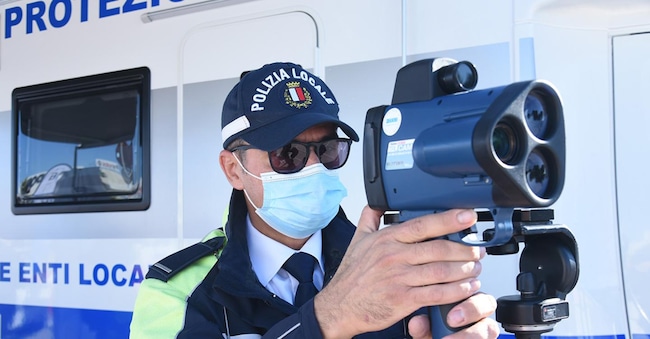
.The package of regulations had been lying in ministerial drawers for 13 years and will impose a powerful crackdown on speed cameras by restricting the scope of speed control devices. Starting with the location of the devices. The decree regulates the cases in which immediate contestation cannot take place, for which there is a particular need to ensure that citizens do not feel 'unfairly harassed' by the use of these devices. But going into more detail, the decree also states that the stretches of road where speed cameras may be used must be identified by a provision of the Prefect; there must be a distance of at least one kilometre outside built-up areas between the sign imposing the speed limit and the device; and in any case, even in built-up areas, there are minimum signalling requirements.
The 50 km per hour constraint
."The objective," explained a note from the MIT, "is to ensure that their use complies with traffic safety, accident prevention and road user protection requirements. Therefore, first and foremost, the devices can be positioned by order of the prefects in areas with a high level of accidents, documented impossibility or difficulty of proceeding to immediate contestation on the basis of structural conditions; but also where the speed limit identified is not more than 20 km/h lower than the generalised maximum, 'except for specific and justified derogations'. For example, the Italian Ministry of Economic Development announced in a note, 'on main extra-urban roads, where a speed limit of 110 km/h is envisaged, the device can only be used if the speed limit is set at at least 90 km/h, but not for lower limits'. The squeeze also comes in the city where it will not be possible to sanction for speed limits below 50 km/h, as immediate notification is required in such cases. For extra-urban roads, there must be a distance of at least one kilometre between the sign imposing the speed limit and the device.
A brake on sanctions
."Lastly,' the MIT continues, 'to stem the excessive proliferation of sanctions, which are often the subject of litigation, minimum distances are envisaged for the stretches of road on which the devices are placed, as well as minimum distances between the speed cameras themselves. But on the sanctions front, it is the Highway Code under discussion in the Senate that provides for a single sanction for more than one violation committed in one hour on the same stretch. Finally, the decree clears 'mobile' speed cameras without immediate contestation only in cases where it is not possible to place fixed or mobile posts. And in any case they must be recognisable.
The unresolved knot of homologation
.The new text gives mayors 12 months to adapt speed cameras to the new rules. On the other hand, the decree does not address the knot of device homologation raised by a recent ruling of the Court of Cassation. Salvini is intent on rectifying the vulnus by the summer with the new Highway Code. Until then, all fines issued through speed cameras will potentially be subject to appeal.

