
Student protests: 1 in 3 are actively taking part, whilst as many as 6 in 10 agree with the reasons behind the demonstrations
Shortcomings in school facilities, too much funding being channelled into weapons, and the difficulty of achieving independence: these are the reasons behind the student protests most widely cited by those directly affected

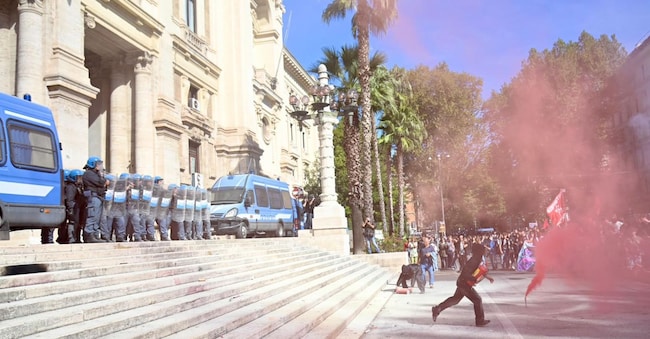
So much for the ‘couch potato generation’: as many as a third of sixth-formers (33 per cent) are actively taking part in the student protests taking place at the moment. A survey carried out by Skuola.net on a sample of 1,500 high school pupils has mapped out the extent of active participation in the youth movements that have emerged during this ‘hot autumn’ in schools (and beyond).
The data
Looking at the details of participation, around 1 in 10 said they were taking part in, or had taken part in, a full-scale occupation at their school, whilst roughly a quarter (24 per cent) had taken part in self-management initiatives, strikes, demonstrations or sit-ins.
Shared dissent
But the impact of this phenomenon is even wider: if we add to these figures those who did not personally take part in the protests but live in communities that have been mobilised (26 per cent), it turns out that as many as 6 in 10 – 59 per cent, to be precise – have come into close contact with some form of dissent, and almost as many (56 per cent) agree to some extent, if not entirely, with the reasons behind the demonstrations.
Italia versus France: the appeal of the ‘hard line’ and the choice of a peaceful approach
If we broaden our perspective, it is inevitable that the buzz of Italian schools will become intertwined with images of the explosive scenes in French town squares, creating an interesting clash of views amongst young people. Young people are strongly drawn to the protests across the Alps: 63 per cent of those surveyed agree (21 per cent ‘completely’, 42 per cent ‘somewhat’) with the methods of protest adopted by their peers in France. Paradoxically, however, approval for the forms of protest adopted in Italia is slightly lower, garnering 56 per cent support (17 per cent ‘completely’, 39 per cent ‘somewhat’). However, when it comes to openly siding with one of the two models, the softer approach and the rejection of urban violence still prevail here. When faced with a choice, 62 per cent of students prefer the Italians’ more ‘dialogue-oriented’ approach, convinced that it is better to demonstrate peacefully. The rampages in city centres over the past few days should therefore be seen more in the context of urban guerrilla warfare, which has little to do with the world of education. However, there remains a substantial minority (38 per cent) ready to endorse the hardline approach from across the Alps, convinced that ‘this is the only way to achieve any results’.
Occupations as ‘civil disobedience’: the consequences are not a cause for concern
Despite this, students are still not prepared to give up traditional forms of protest, which they regard as an indispensable means of making their voices heard. Once again, more than 6 in 10 young people (62 per cent) say they agree with school occupations: 23 per cent usually take an active part in them, whilst 39 per cent support them in principle without being directly involved.

Brand connect


Newsletter Scuola+
La newsletter premium dedicata al mondo della scuola con approfondimenti normativi, analisi e guide operative
Abbonati