War

Sudan, blame-shifting with Ethiopia. US blitz on Eritrea sanctions

The military blames Addis Ababa and Abu Dhabi for a role in the latest air raids on Khartoum, with the risk of (further) widening the conflict

from our correspondent Alberto Magnani

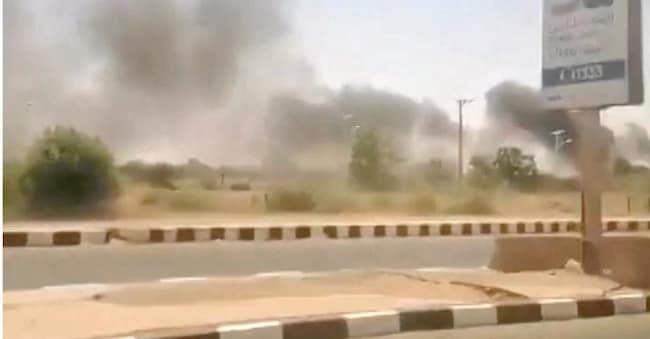
L’attacco via drone sull’aeroporto di Khartoum Reuters

3' min read

Translated by AI
Versione italiana

3' min read

Translated by AI
Versione italiana

NAIROBI - The Sudanese military government has formally accused Ethiopia and the United Arab Emirates of involvement in drone attacks on the country, including those targeting the airport in the capital Khartoum. The lunge is triggering an increasingly heated dialectical escalation between Khartoum, the Horn of Africa and the Gulf, now entangled even more by Donald Trump's diplomatic blitz with the lifting of sanctions on Eritrea.

In a press conference, Foreign Minister Mohieddin Salem and army spokesman Asim Awad Abd al-Wahab spoke of 'conclusive evidence' of the launching of four drones from the Ethiopian base in Bahir Dar, blaming Adu Dhabi for the supply of the aircraft.

Loading...

The government has recalled its ambassador from Addis Ababa for consultations and threatens to be ready for 'all scenarios', including a direct war confrontation with the two countries under indictment. 'We do not intend to launch an attack against any country, but whoever attacks us will receive a response,' Minister al-Din Salem said in his meeting with journalists. Ethiopia has rejected the charges and accused the Sudanese government of foraging Tigrinya rebels operating in the north of the country and being fought by Addis Ababa in the two-year conflict between 2020 and 2022.

Sudan, 6 caschi blu uccisi in un attacco con droni contro base Onu

The Sudanese standoff and the risk of enlargement

The war in Sudan broke out on 15 April 2023 and has just entered its fourth year of hostilities, escalating to the size of the 'worst humanitarian crisis' recorded by the United Nations.

The UN High Commissioner for Refugees speaks of almost 12 million Sudanese forced to leave their homes and included among the internally and externally displaced persons, while the death toll fluctuates between 'minimums' of a few tens of thousands and US sources raising the bar in the hundreds of thousands.

The conflict stemmed from disagreements between the two generals al-Burhan and Mohammed Dagalo known as 'Hemetti', the little Mohammed, respectively leading the regular army and the paramilitaries of the Rapid Support Forces. The clashes started in Khartoum and spread to the rest of the third largest African country, creating a de facto split in Sudan between the south-west under the control of the paramilitaries and a centre-east administered by the regular army. Today, fighting is mainly concentrated in the Kordofan and Blue Nile regions, with a robust growth in the use of drones. The latest air raid hit Khartoum airport on 4 May, shattering the - relative - quiet that had enveloped the capital in recent months.

The accusations made by the military authorities are not unprecedented. The government has already accused the Emirates of supporting the Rsf paramilitaries, an accusation that led to a lawsuit for 'complicity' in the genocide of the black population of Darfur at the International Court of Justice in The Hague (Netherlands).

A Reuters investigation and a study by Yale University in the US documented the involvement of Ethiopia's leader Abiy Ahmed, revealing the training of Rsf troops within the country's borders and logistical supplies to militias.

The ministry's lunge may accelerate the escalation, increasing a risk already foreseen by some analysts: the expansion of the conflict on a regional scale, calling in actors who have acted mainly by proxy. One of the most feared horizons was that of an expansion to the west, beyond the borders of a Chad already permeable to migratory flows arriving from Sudan. Today's diplomatic sparks could direct it further east, towards the Horn of Africa and the Gulf.

The tensions triggered by the Sudanese jihad represent an 'important step' and can 'exacerbate regional polarisation', explains Federico Donelli of the University of Trieste. On the one hand, says Donelli, the "perception" of an axis between the Emirates and Ethiopia is reinforced, with "Israel in the background". On the other, the harmony between Sudan and Egypt can be consolidated, in a security key and against the backdrop of further players such as Djibouti, Saudi Arabia and Eritrea itself, fresh from the sanctions relief from the US. The perspective, says Donelli, is however that of fluid alliances, capable of 'making a political solution more difficult and increasing the possibility of escalation in the Horn of Africa and the Red Sea'.

At its roots remains the quarrel between Sudan and Ethiopia, now heading for an alarming escalation. "Both sides believe that the other is supporting their armed adversaries. The war in Sudan is becoming increasingly difficult to contain within national borders'.

Copyright reserved ©
  • Alberto Magnani

    Alberto MagnaniCorrispondente

    Luogo: Nairobi

    Lingue parlate: inglese, tedesco

    Argomenti: Lavoro, Unione europea, Africa

    Premi: Premio "Alimentiamo il nostro futuro, nutriamo il mondo. Verso Expo 2015" di Agrofarma Federchimica e Fondazione Veronesi; Premio giornalistico State Street, categoria "Innovation"

Loading...

Brand connect

Loading...

Newsletter

Notizie e approfondimenti sugli avvenimenti politici, economici e finanziari.

Iscriviti