
Summer air with Felice Carena at the Gallerie d'Italia
Until 29 September, the Gallerie d'Italia in Milan is exhibiting the chameleon-like painter from Turin
3' min read
3' min read
Crossing the threshold of the entrance immediately, it is definitely a difficult task to categorise the painting style of Felice Carena (1879-1966), an artist from Turin (Florentine and Venetian by adoption) of the historical 20th century, a well-known name that is sometimes unjustly underestimated. There are six exhibition sections on show at the Gallerie d'Italia in Milan to recount the rise and development of his art, from his beginnings to the Venetian Biennials. A journey through the first half of the 20th century with ever new techniques, in a continuous search for dialogue between classical and Renaissance tradition, symbolism and expressionism. Right from the bleakest early works with Caravaggesque accents such as in Dancing Drunks of 1909, in the fading of the dark forms in Portrait of the Baroness Ferrero (1910) or The Blue Ribbon (1911) one can see the spasmodic search for light, to investigate a humanity that grows more and more as time goes by. These were the artist's Roman years, in which he created masterpieces with a Pre-Raphaelite style such as Ophelia (1912), which winks at Millais' work without overpowering it. Later he devoted himself to compositions of material still lifes and common things, searching with utopian eagerness for a plastic light in the world of forms. His style becomes more colourful, glazed and mellow: the reference to the French expressionism of Matisse and the geometric rigour of Cézanne is evident with the flamboyant colour worked through powerful brushstrokes and textural jaggedness of colour areas.
Popular Theatre
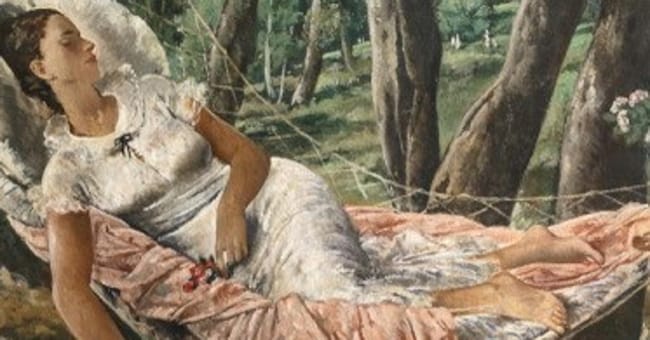
Passionate about popular theatre, in the paintings of 1933 and 1954 on this theme, Carena shines a light on the spectators and not on the actors, emphasising their merits, mimicry and faults: the actors become the people themselves, the vanquished suddenly transmute into stars. Over the years, the artist's painting became much more existentialist and tormented, as can be seen in the self-portraits, calmed, however, by the composed and limpid luminosity of the still lifes and compositional values that give a sense of respite and inner peace. Religiosity and spirituality play a fundamental role for Carena, in the century of the 'eclipse of the sacred': his famous Depositions dated 1938, 1955 and 1963 have different and tragic pictorial conducts, from realist titanism to a wavering outburst with tormented bodies. There are various biblical and mythological subjects with vibrant and synthetic graphic strokes, soft and sketchy figures taken from quick drawings as in Adam and Eve, Judith and Holofernes, or The Horsemen of the Apocalypse from 1949. Finally, the last room: it seems incredible how from the symbolism of the first self-portrait with its pulpy colours - dated 1904 - Carena twenty years later produced works of the calibre of Serenità (1925) or La Pergola, where volumes and attention to detail dominate. Like a multiform chameleon, however, it is in his most famous work that his varied stylistic path can be seen most emphatically. Summer (The Hammock) depicts a young woman lying in the sun, in total existential otium. Her face stretched out in a seraphic smile, one hand softly on the ground and the other clasping a bouquet of flowers like the damsel in Leopard's Il Sabato del Villaggio give her a carefree air, charged with the vibrant light that the summer season gives and that Carena has pursued all her life: a decidedly happy choice.
Felice Carena, Gallerie d'Italia (Milan), until 29 September 2024

