
Summer explorations through the forests, villages and art of the Gargano
From the charm of the wild Umbra Forest to the small coastal towns such as Vico del Gargano, Vieste, Mattinata and Pugnochiuso

Key points
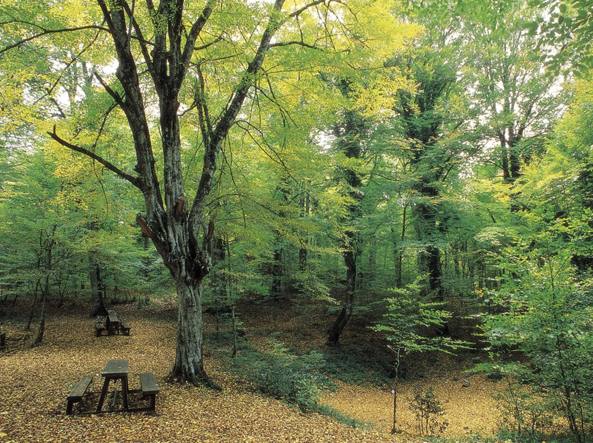
The broad-leaved trees form a seemingly unsolvable botanical puzzle. Even the Agrifoglio Tour jeep, driven by Peppino Fasanella – a true shaman – struggles to make its way along the track that climbs up to the Tacca del Lupo, the most daring promontory in the Foresta Umbra. You have to climb up here in the off-roader to take in, in a single glance, this green lung stretching across 11,000 hectares within the Gargano National Park: even the long, azure expanse of the Adriatic Sea, which here – between the Tremiti Islands and the Croatian islands of Pelagosa – seems truly serene, reveals itself to the eye. Aleppo pines cover 80 per cent of the Gargano’s rocky spur. La Tacca del Lupo was also a favourite spot of Lucio Dalla, who would pile his friends into his open-top car and drive up to gaze at the stars, count the butterflies, and scramble over the many fallen tree trunks with their spiral shapes amongst the red casemates, exciting excursions that can be recreated whilst staying at Masseria Sgarrazza, accompanied by rustic snacks at the La Zita farm. The singer from Bologna was also particularly fond of the wild orchids, which come in dozens of species.
Along the Adriatic coast
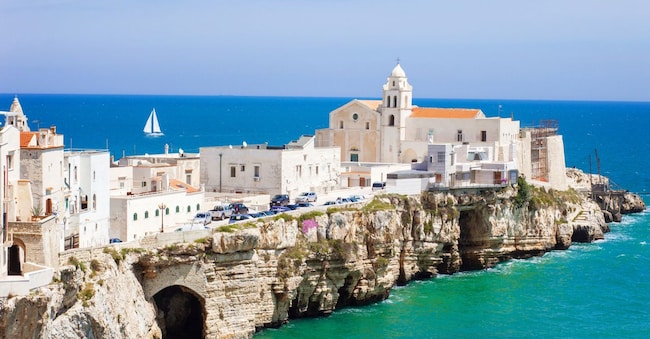
On the mainland, Dalla was particularly fond of Peschici, nicknamed the ‘Santorini of the Gargano’ because of the white walls and blue window frames of the houses in its colourful historic centre, which can be reached via Porta del Ponte or, if arriving by sea, via Via Porta di Basso: the domes, the pitched roofs, a tour of the dungeons of the castle dating back to the year 1000, the skulls on the door panels of the Church of Purgatory and that of Sant’Elia – chosen as patron saint because he saved the inhabitants from a locust invasion in the 14th century – are a dizzying feast for the eyes. Following the coastal road, you reach Vico del Gargano, the village near the Monte Pucci necropolis, passing through an ancient olive grove on the banks of the Torrente Romandato, a rugged karst canyon with a bare riverbed. After enjoying an ice cream at the historic Bar Pizzicato, you’re ready to discover the 11th-century Castrum Vici, nestled amongst the medieval houses, next to the Chiesa Matrice where many worshippers come to pray to Saint Valentine, who is venerated here above all as the patron saint of citrus fruits, although the presence of a very narrow ‘alley of the kiss’ and the Palazzo della Bella (a 20th-century replica of Florence’s Palazzo Vecchio) tempts even the most romantic travellers into displays of affection.
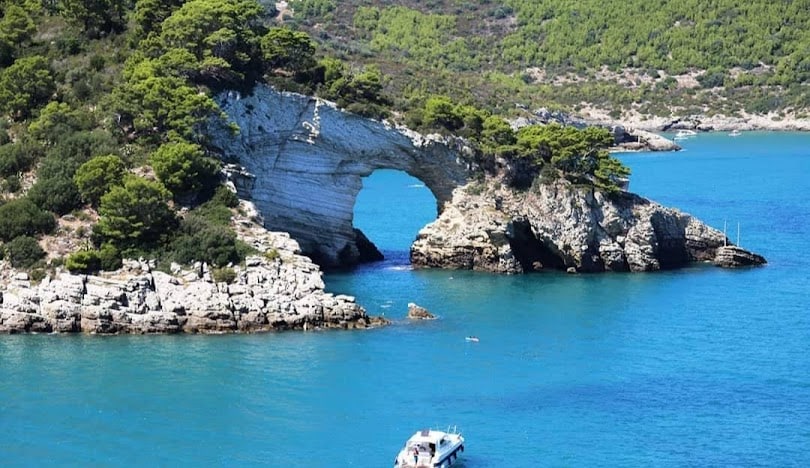
There is no doubt that Vieste’s beauty is dazzling: the white ‘tooth’ of the Pizzomunno monolith rising from the blue sea beneath the snow-white cliff, the light dancing across the houses from the lantern of Sant’Eufemia, the minimalist sculptures at the Malacological Museum, the Corinthian capitals of the Cathedral above the sprawling trabucco, the altars of the remote church of San Francesco, and the Ristorante al Dragone set inside a cave – these sights will never be forgotten. Equally unforgettable is the sight of Gattarella Island at dawn from the rooms – hidden away in the dense pine forest – of the Family Resort of the same name, which offers a summer holiday with a fairy-tale feel for children and adults alike: from its beach, you set sail on a maritime adventure between the architiello of San Felice (where an exhibition by Renato Guttuso is on display in the tower) and the Sfondata caves, Dei Due Occhi (from whose skylight the sky seems to plunge down), the Contrabbandieri Cave and Cala della Sanguinara. The beauty of Pugnochiuso Bay – which inspired Enrico Mattei to build a holiday village there for Eni employees – the idyllic cove of Vignanotica and that of Zagare in Mattinata complete the picture. Before setting off, a visit to the Grotto of St Michael the Archangel in Monte Sant’Angelo and the Basilica of Siponto is a must, where early Christian, Romanesque and contemporary art converge in Edoardo Tresoldi’s wire-mesh installations.

