
Summer is drawing to a close; today marks the autumn equinox: here’s what changes
In the northern hemisphere, the hours of daylight will continue to decrease gradually until the winter solstice on 21 December, the shortest day of the year

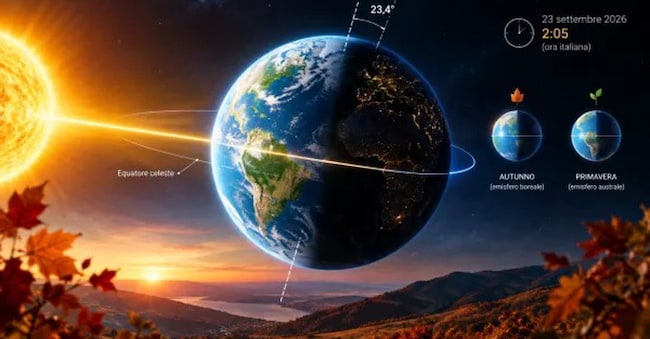
After months of sweltering heat and record temperatures, the summer of 2026 has come to an end: at 2.05 am on the night of 22–23 September, the autumnal equinox occurred, the moment that marked the change of season across the entire northern hemisphere. At that moment, the Sun crossed the celestial equator – that is, the projection of the Earth’s equator onto the celestial sphere – moving from north to south. Whilst this crossing marks the beginning of autumn in the northern hemisphere, in the southern hemisphere it heralds the start of spring.
Equiluce
The term ‘equinox’ derives from the Latin phrase ‘aequa nox’, which means ‘night equal to day’. At this time of year, in fact, the Sun is at its zenith over the Earth’s equator, where its rays strike the surface at right angles: in both hemispheres, the hours of daylight will be roughly equal to those of darkness. Similar conditions occur once more during the year, at the spring equinox.
In reality, the exact balance between light and darkness does not occur on 23 September. Since the Sun is a disc, rather than a point, sunrise and sunset are defined respectively by the appearance and disappearance of the upper edge of the solar disc, resulting in a longer day. Added to this is the effect of atmospheric refraction, which bends the Sun’s rays and makes the Sun visible even when its geometric centre is already below the horizon. Consequently, on the day of the equinox, the hours of daylight are a few minutes longer than those of darkness. The equilux – perfect equality – occurs only a few days later, generally around 25 or 26 September at Italian latitudes.
What will happen
At midday on the day of the equinox, the Sun is directly overhead at the equator, and at that moment, objects standing perfectly vertical cast no shadows.
From the day after the autumnal equinox, the hours of daylight will continue to decrease gradually in the northern hemisphere until the winter solstice on 21 December, the shortest day of the year. In the southern hemisphere, however, the exact opposite occurs. Here, following the June solstice, daylight hours begin to increase, and the September equinox marks the moment when daylight hours exceed those of darkness and spring begins.

