
Summer Night Visions at the Teatro Massimo
In Palermo 'Giselle' in a new version and profiles of the new season

4' min read
4' min read
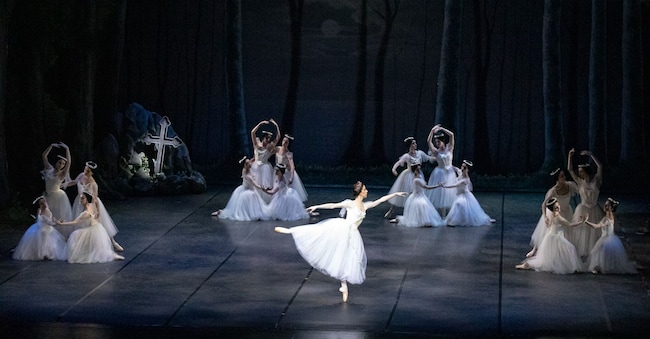
"Giving new life to Giselle without betraying her soul". The lithographs, sketches and iconic nineteenth-century images that have marked the historical course of one of the most famous ballets of the French Romantic season are some of the references to which the new choreographic version of 'Giselle' created by the Director of the Corps de Ballet of the Teatro Massimo of Palermo Jean-Sébastian Colau with the collaboration of Delphine Moussin, winks. The reference to some prints of the time in this fourth and last appointment of the dance season is indeed slavish: among them, the most attentive ballet history enthusiast will certainly have caught the evocation of the well-known engraving by J.A. Lavielle when our protagonist, in the first act, is proclaimed "queen of the grape harvest, crowned with vine leaves and carried in triumph" - as Théophile Gautier, one of the creators of the libretto of this ballet, recalls - or again the choreographic designs conceived for the second act with the plastic formations of four villi that seem to rescue from oblivion the historical tributes paid by Chalon to the four undisputed stars of nineteenth-century dance. Details that rarely find their way into the innumerable versions of Adolphe Adam's title, and which in Palermo today gain appropriate placement. In this respect, it is certainly worth mentioning the decision to keep the veil on the head of the 'spirits of the night' for a long segment of the second act as if to emphasise the peculiarities of the inescapable Austrian tradition of Slavic origin that is the hinge and foundation of the opera. Nor does the new staging, which bears the signature of Francesco Zito - with the collaboration of Antonella Conte - for the hand-painted scenes seem to betray the soul of the title: if the decoration adorning the façade of Giselle's hovel is delightful, the richly painted blue drape of the first proscenium backdrop seems reminiscent of Alexandre Benois's 1948 "maquettes à l'aquarelle" imagined precisely for the story of the unfortunate young woman.
Colau's choreography
Colau's choreography, close to the primigenial source, has the merit of highlighting the potential of the corps de ballet, which, while not benefiting from remarkable numbers and first-rate uniformity, delivers credible melancholic vigour and poetic evocations to the pale, cold villi. Ingenuity, candour, balance and technical prudence shine through in Martina Pasinotti's Giselle, at her side Alessandro Casà skilfully alternates vivacity with convincing contrition in valiant feats. Francesca Davoli gives the Villi queen candour and inflexibility, port de bras to be honed. Mention must be made of the peasants' pas de deux, which here benefits from the temperament of Giulia Neri and Michele Morelli.
Summer and Dance
After the inauguration of the summer season last 22 June with 'Canto per Santa Rosalia', the appointments with dance in Palermo gave space to investigate Platonic philosophy, mythology and the many nuances of the female personality with 'Olimpo - Serata di Danza': an opportunity to discover the choreographic verve of Lucia Ermetto, Marcello Carini and Alessandro Cascioli, tersicorei of the Foundation's corps de ballet engaged in three creations entitled 'διάλογος - The Symposium of Myths', 'He Who Melts' and 'Women'. The second and last choreographic segment of the summer season in the Sicilian capital has also returned to tragic female figures from literature and opera: to Juliet, Traviata, Anna Karenina and Carmen is dedicated, in fact, the show 'Fatality' scheduled from 27 to 31 July with a production by the Tirana Opera House and choreography by Toni Candeloro.
The new season
In the days leading up to the summer break, the programme for the upcoming 2025-2026 season entitled 'Souls in the Balance, Beyond the Boundaries' is also unveiled. A dense weave of characters and titles that reconfirms the four appointments with dance and ballet for the new year, starting with Director Jean-Sébastian Colau's hoped-for dream of finally proposing 'Swan Lake'. Tchaikovsky's ballet will, in fact, be seen from January in a new version designed by Colau himself, close to the legacy of Marius Petipa and Lev Ivanov, in a new production set in the era of the "Leopard" and starring two international guests in some performances: Maia Makhateli, Principal of the Dutch National Ballet, and Andrea Sarri, prima ballet dancer of the Opéra de Paris. From March, space will be given to "Don Quichotte" signed by José Martinez - Director of the Corps de Ballet of the Opéra de Paris - in a new production co-produced with the Opéra National de Bordeaux. This will be followed by "Caravaggio" by Mauro Bigonzetti and "La bella addormentata" in a production by the Salzburger Landestheater with choreography by Reginaldo Oliveira in a version that will recount the great classic of the choreographic repertoire in a new way.
Therefore, the investment that the Palermo Massimo reserves for dance deserves appreciation and support: can one day or another we not look to the gradual expansion of the Palermo troupe to attempt to resurrect the art of Tersicore at the Italian lyric-symphonic foundations that today lack tutus and pointe shoes?

